
Austin staff unveil neighborhood-level Economic Mobility Index to guide investments
Get AI-powered insights, summaries, and transcripts
Subscribe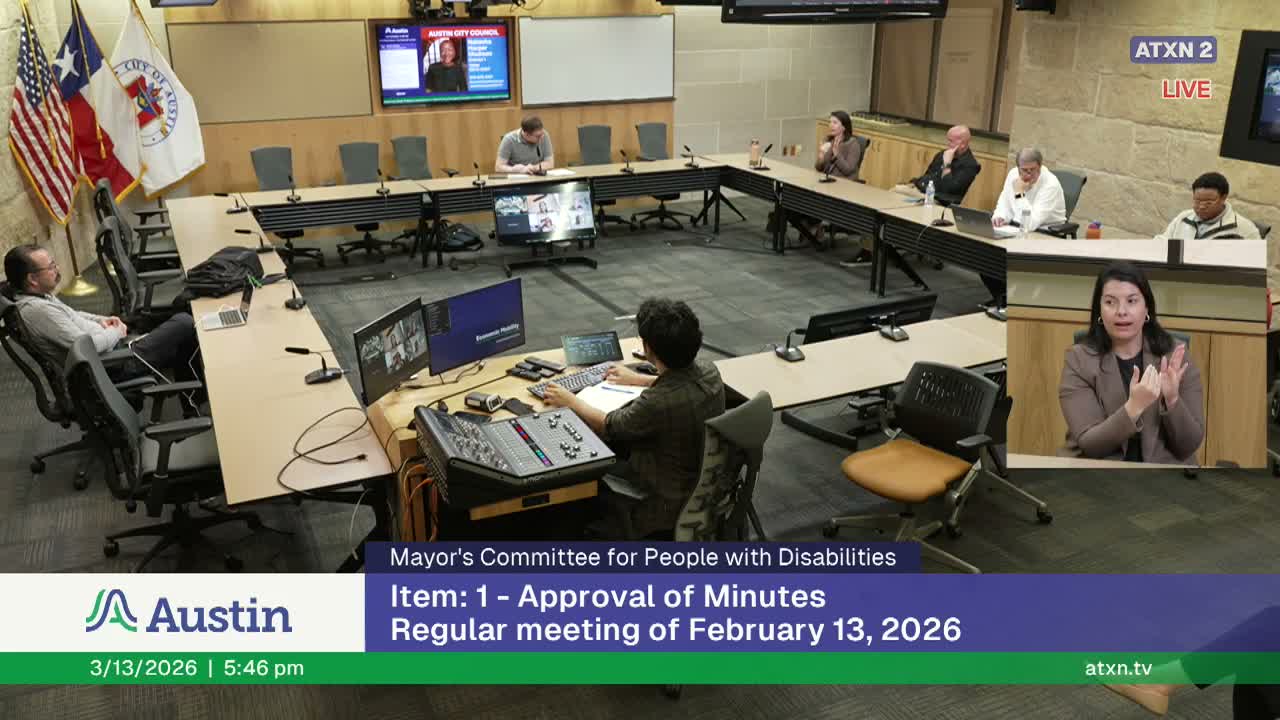
Summary
City staff presented a searchable Economic Mobility Index that rates census tracts across 18 levers to help target services, track progress and guide partners; staff said the map and raw data will be posted and the tool will launch in April with training and a two-year update cycle.
City of Austin staff presented a new Economic Mobility Index to the Mayor's Committee for People with Disabilities on March 13, describing a neighborhood-level, place-based tool intended to visualize disparities and guide program investments. Gary Aaron, business process consultant senior in Austin Equity and Inclusion, said the index combines 18 equally weighted levers across multiple themes and is available as an ArcGIS/Esri layer.
"What the city of Austin now has is an economic mobility framework comprised of 2 halves," Aaron said, explaining the index pairs a shared definition with a practical measurement layer that lets users click on a census tract to see percentile ranks and individual indicator scores. He said the tool is intended to complement existing resources rather than replace them.
The presenters said the index draws on ACS and other census-tract data, national composite frameworks (including the Social Vulnerability Index and Opportunity Atlas), and consultations with departments, community groups and a vendor, Every Texan. The tool includes indicators staff said will be relevant to the disability commission, including the percent of individuals with a disability, percent of population age 65 and up with ambulatory difficulty, and the share of people living in group quarters.
Commissioners asked about comparator cities and update cadence. Aaron said the project examined approximately 10 comparable cities and took a deeper dive into Tempe, Tucson, Tulsa and Tacoma; staff selected comparators by state, size and demographic similarity. He also said about 80% of indicators could be updated annually, though some measures rely on five-year or decennial data, and staff prefer a two-year formal update cycle to align with the city's fiscal rhythm.
Staff said the map, technical documentation and raw data will be posted to the city's website and open data portal, and they plan training and exploratory sessions tied to the Fair Housing and Economic Mobility Conference on April 29 at the Norris Conference Center. Aaron said departments, schools, nonprofits and funders can use the tool to align programs with neighborhood needs and to identify where to place supports such as skill-building or wraparound services.
Next steps: staff intend an April launch, publication of technical documents and raw data, and outreach and trainings for internal and external partners. Committee members encouraged staff to work with local education partners and disability-serving organizations as outreach is planned.