Get Full Government Meeting Transcripts, Videos, & Alerts Forever!
Get email alerts on the Noise Ordinance topic
No spam. Unsubscribe anytime.
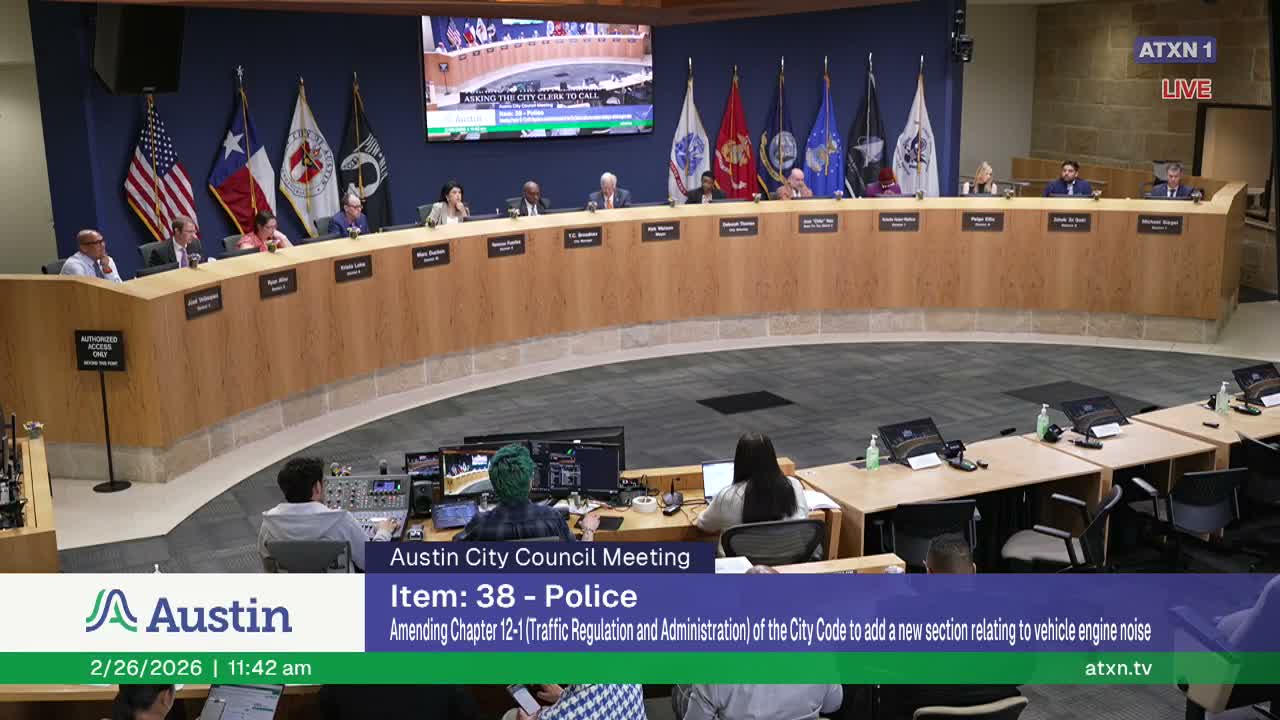
Council approves noise ordinance targeting deliberate roadway engine noise, adds warning requirement
Summary
After hours of public testimony, Austin City Council adopted a revised noise ordinance aimed at deliberate, repeated vehicle engine noise (racing, revving). Council added a required warning and directed staff to study non‑vehicular motor noise before broader enforcement.
Austin City Council on Feb. 26 adopted a revised noise ordinance that creates a new enforcement tool for deliberate roadway engine noise such as repeated revving and street racing, after extended public comment and committee debate.
Residents from multiple neighborhoods described repeated high‑pitch revving and racing on routes such as FM 2222 and MoPac. “This is not occasional traffic noise,” said Lauren Earthman, who urged the council to pass the ordinance to restore livability and safety. Neighbors and neighborhood associations presented video evidence and asked council to adopt enforceable language.
Councilmembers proposed and adopted several changes before final passage. Councilmember Jose Velasquez moved — and the council adopted — an amendment requiring officers to issue an initial warning before a citation is issued; councilmember Ryan Siegel sought language aligning mental‑state elements with state penal standards, but his amendment failed in a recorded vote. Councilmember Kathie Duchin and others argued the measure needs “teeth” to be enforceable; the council retained a set of criteria including a decibel presumption and allowed for documentation such as decibel meters.
Civil‑rights advocates and equity groups warned the council that criminalizing noise risks disproportionate impacts on low‑income and immigrant residents and urged alignment with state standards and issuance of warnings. The council’s Velasquez amendment was explicitly aimed at addressing those concerns by requiring a warning before a ticket.
The ordinance as adopted targets purposeful, repeated conduct that creates offensive engine noise and includes the warning requirement and direction to city staff to return with additional study, including potential non‑vehicular motor noise sources. The council adopted the item as amended.