
City unveils IT consolidation plan and app-rationalization work that could trim tech costs
Get AI-powered insights, summaries, and transcripts
Subscribe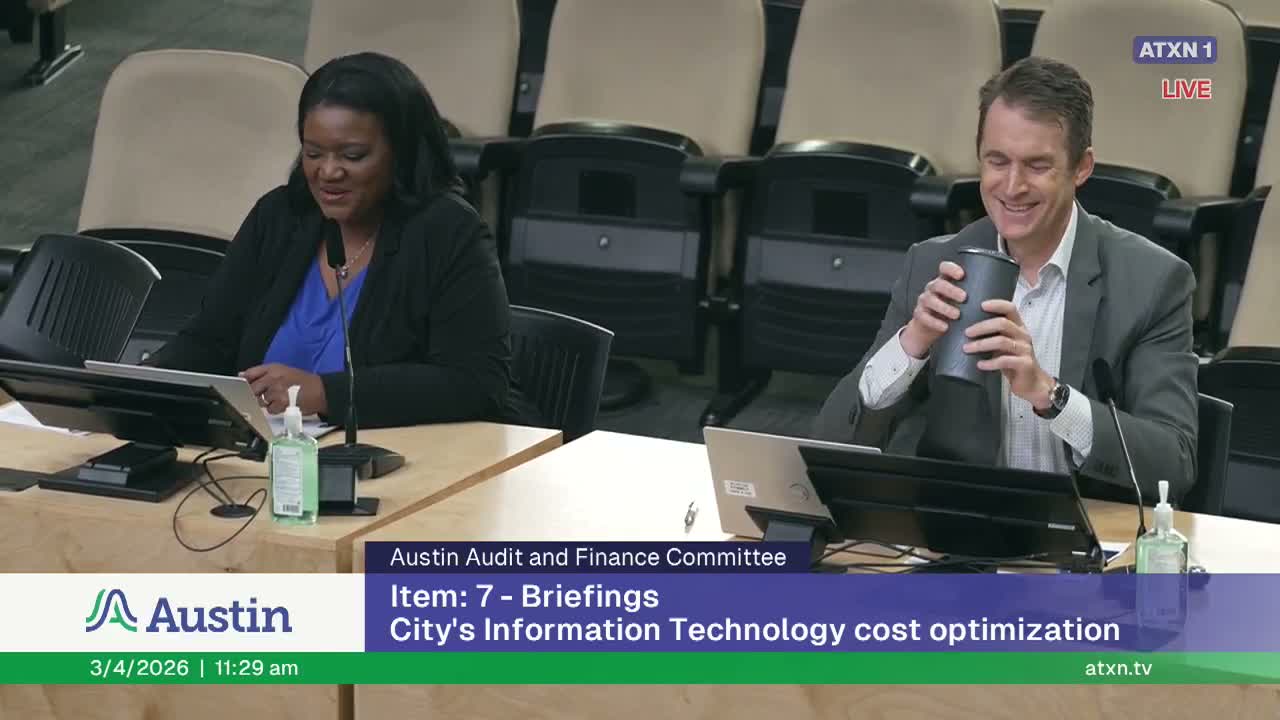
Summary
City staff described a plan to centralize IT staff into Austin Technology Services and to rationalize a portfolio of 1,184 unique applications (2,009 instances), identifying 24 consolidation opportunities; staff said detailed cost‑savings figures will be provided after phase-5 analysis.
City financial staff and Austin Technology Services briefed the Audit and Finance Committee on March 4 on efforts to centralize technology staff and rationalize the city’s application portfolio to reduce duplication and save costs.
Chief Information Officer Carrick Aleki said an initial Gartner assessment found Austin spends more on IT compared with peer cities (a high-level estimate cited ~81% more and roughly $210,000,000 annually), that only about 30% of IT staff are centralized compared with 81% in peers, and that the city has significant duplication and inconsistent standards. The application rationalization baseline counted 1,184 unique applications and 2,009 instances and identified 24 consolidation opportunities that could reduce more than 300 application instances; staff said a detailed cost-savings analysis was due later in the month.
Council members asked about near-term savings, workforce impacts and how concerns from AFSCME (the employees’ union) will be addressed. CIO Aleki said staff has been collecting and answering questions on a dedicated site, will follow consultation processes with the union, and plans phased implementation over 2–3 years. Staff cautioned the identified consolidation opportunities require additional vetting and that implementation—training, migration, and change management—carries operational implications.
Why it matters: Technology is a fast-growing portion of the city budget. Consolidation and stronger governance could reduce redundant software and staff duplication and free funds for prioritized investments; however the transformation affects staff roles and requires multi-year implementation.
What’s next: Staff will return with a phase-5 cost-savings analysis this month and alignment recommendations for an organizational model (expected to be shared with staff in April and rolled out in May for initial onboarding work); formal implementation is planned over two to three years.