
Mobility Committee reviews ACT Plan; staff recommends selective two‑way conversions while keeping some one‑way 'heavy lifters'
Get AI-powered insights, summaries, and transcripts
Subscribe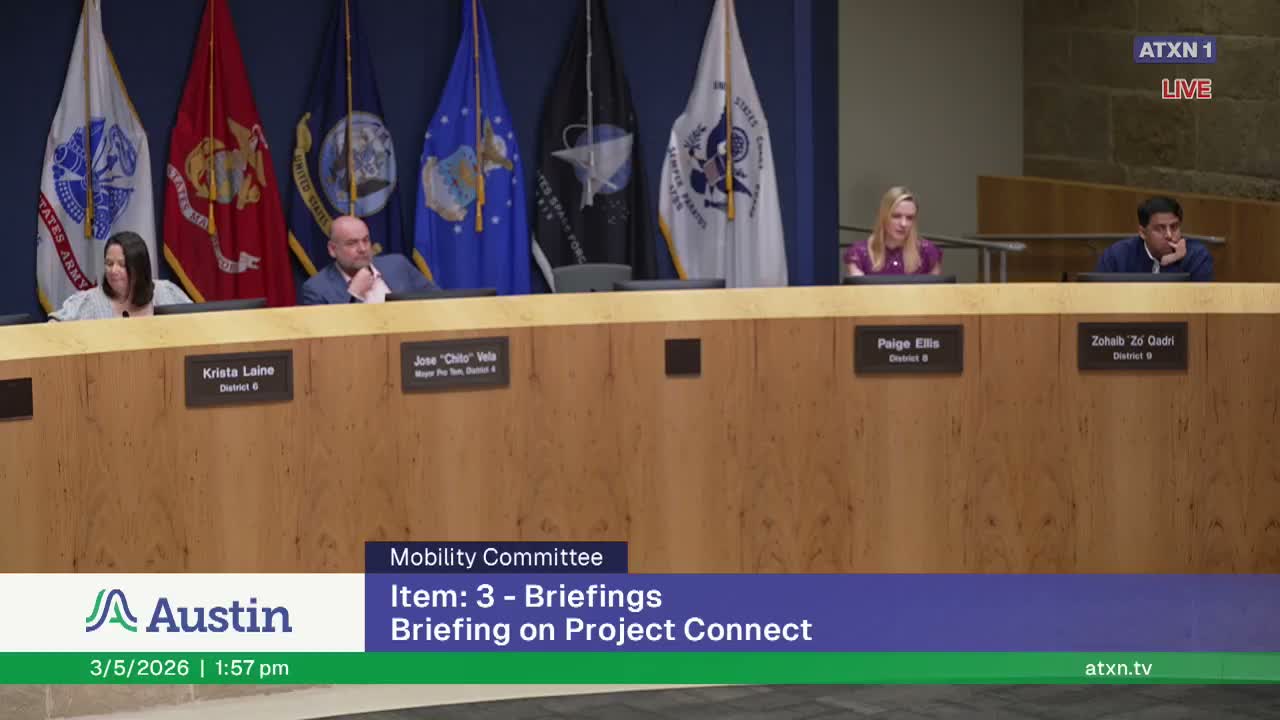
Summary
Transportation staff presented the Austin Core Transportation (ACT) Plan, recommending targeted two‑way conversions downtown while retaining several one‑way 'heavy lifter' corridors (notably 5th and 6th) to preserve transit and cross‑town connections; Vice Chair Kadri circulated a motion sheet calling for more studies, curb management, and implementation steps.
Transportation and Public Works staff presented the Austin Core Transportation (ACT) Plan to the Mobility Committee on March 5, describing a downtown small‑area mobility plan that would reallocate vehicle space to transit lanes, protected bike facilities and wider sidewalks while recommending targeted two‑way conversions for many streets and retaining certain one‑way corridors that function as network "heavy lifters."
Michelle Marks, transportation officer with strategic projects, told the committee the plan is a "segment by segment" analysis intended to align downtown mobility with Project Connect and nearby I‑35 changes. She said the ACT Plan proposes converting several one‑way streets to two‑way operations (7th, 9th, 10th, Brazos and others) while keeping 5th and 6th one‑way in order to prioritize continuous transit lanes and cross‑town connectivity.
Marks said two‑way streets are not automatically safer than one‑way streets and emphasized that safety depends on design factors including speed management, left‑turn controls and protected pedestrian crossings. "There really is no one size fits all approach," she said, adding that the plan includes signal additions and other speed‑management tools to address pedestrian gaps.
Public commenters overwhelmingly urged more two‑way conversions. Carol Freezer said one‑way streets downtown are "too fast, wide, dangerous, loud, and confusing," arguing two‑way conversion makes downtown safer and more family‑friendly. Several speakers, including design and business advocates, cited Second Street conversions and economic studies showing increased tax revenues and new housing near two‑way corridors.
Vice Chair Kadri circulated a draft motion sheet at the meeting outlining four items: require comprehensive capital cost and funding estimates for ACT projects; mandate updated studies and engagement for any future redesigns of remaining one‑way streets; begin downtown curb management work; and accelerate implementation of multimodal projects and two‑way conversions identified in the plan. Kadri stressed the sheet is a draft for committee discussion and that no final vote would occur until council consideration of the plan on March 26.
Council members asked technical questions about whether the two‑way conversions were modeled in traffic analysis; staff said they had not modeled every one‑way vs two‑way scenario in the traffic model but had performed "sanity checks" and coordinated with Project Connect and I‑35 planning. Staff warned that 5th and 6th function as east‑west connectors and that retaining them as one‑way corridors preserves critical transit and regional connectivity during concurrent construction.
Staff noted implementation will be staged and tied to funding cycles and construction coordination with partner agencies; they said certain signal additions and speed‑management measures are included in the revised plan to reduce signal gaps and improve pedestrian spacing.
The committee discussed sequencing and evaluation timing — including concern about making large street pattern changes while major downtown construction (Project Connect, TxDOT work) is still underway — but did not vote on the ACT Plan at this meeting. The administration will return with the ordinance to amend Imagine Austin/ASMP and proposed adoption of the ACT Plan at the March 26 council meeting.