
City staff propose rewrites to bond financial policies to focus on credit goals and bond delivery
Get AI-powered insights, summaries, and transcripts
Subscribe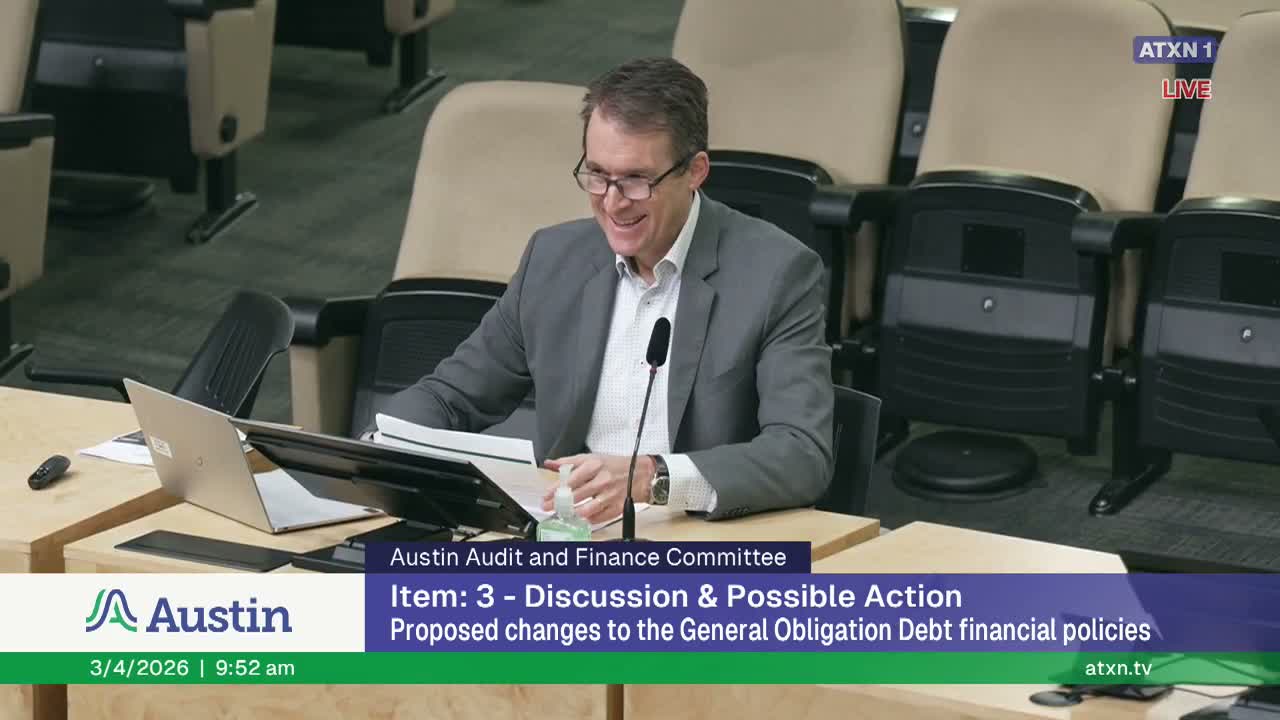
Summary
City financial staff proposed replacing fixed debt ratios with a goal to maintain a AAA credit rating, clarifying bond-election timing to require prior programs reach substantial completion (about 90% expended), and adding guidance to size propositions for a predictable six‑year delivery cycle; council members pressed for more implementation details and data.
Ed Vannino, the city's chief financial officer, presented proposed changes to the city’s general obligation debt financial policies at the March 4 Audit and Finance Committee meeting, describing the revisions as a way to align written policies with the bond decision tree council adopted earlier.
Key proposals Vannino described: remove outdated numeric ratios (for example a 2% debt-to-assessed-valuation benchmark and a 20% debt service-to-expenditure test) and instead set a policy objective that the city will structure bond issuances to maintain a AAA credit rating; clarify timing by saying a new bond election should not be called until prior bond programs have reached "substantial completion" (staff suggested this generally occurs when approximately 90% of bond program expenditures have been incurred); and require that individual bond propositions be sized and implemented to fit a predictable six‑year delivery cycle to avoid undersized propositions that run out of funds too quickly.
Council members raised implementation questions across multiple bond types. Council member Fuentes expressed concern about applying a strict 90% expended threshold to affordable-housing propositions and noted variance in how funds are obligated or disbursed (some housing bond dollars are application-based). Council members urged staff to provide the committee with current metrics on the city’s unissued bond portfolio (staff cited projections that some prior bonds would be 90% obligated by 2027 and 90% expended in 2028). Others asked for periodic reporting of the rating agencies’ criteria and for policies that preserve flexibility to take advantage of market opportunities.
Why it matters: The proposed changes would shift the city’s written debt policies from prescriptive numerical caps to a policy framework focused on credit objectives and predictable program delivery. That could change how future bond elections are timed and sized and how councils and staff prioritize capital programs.
What’s next: Staff said recommended policy language would be incorporated into FY27 budget documents and ultimately enacted when the council approves the budget; the committee asked staff for additional data and clarifying language on implementation and would review follow-up materials in future sessions.