Get AI Briefings, Transcripts & Alerts on Local & National Government Meetings — Forever.
Senator Kurt advances amendment to require guardians’ inclusion in mental-health intake assessments
Loading...
Summary
The Judiciary Committee advanced Senate Bill 14 73 after adopting an amendment that would require facilities to include a court-appointed guardian in a ward’s intake assessment when possible; authors and members debated enforcement limits and emergency-treatment exceptions.
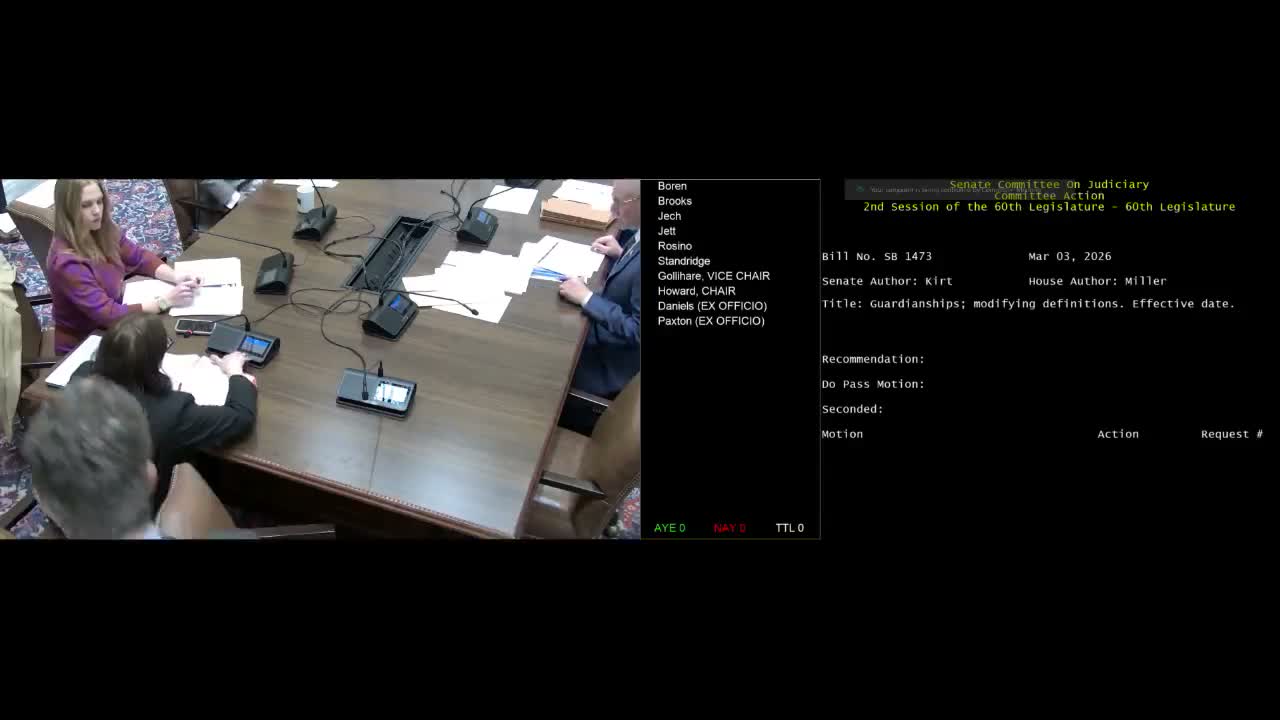
Senator Kurt, the minority leader, urged the Senate Judiciary Committee to advance Senate Bill 14 73, a follow-up to the Courtney Smith Act aimed at ensuring people who are gravely disabled and homeless can obtain guardianship and access care.
The measure — amended to require that a guardian who has been granted general guardianship be present for a ward’s intake assessment at an inpatient mental-health facility when possible — was offered by Senator Curtin. Curtin told the committee the amendment seeks to close a gap where guardians who have completed legal steps are not recognized or involved in intake "for weeks" and so cannot provide historic information useful to clinicians.
Committee members probed whether the amendment would tie a provider’s hands or delay emergency care. Senator Rosino asked whether emergency treatment such as medication could be delayed if a guardian was not present; Curtin responded, “That’s not the intention at all. The intention is solely for the assessment piece… We don't want to delay treatment.” Curtin and Kurt both said they are open to reworking language to avoid unintended consequences when guardians are unavailable (for example, out of the country) or when immediate treatment is required.
The committee adopted the Curtin amendment and advanced the bill. The chair and sponsors emphasized the proposal is intended to be additive — to include guardians when feasible — rather than to create an enforcement mechanism that would bar urgent care.
The next step is floor consideration, and the sponsor said she will work with stakeholders, including the Department of Mental Health, to refine language before it reaches the full Senate.