Get Full Government Meeting Transcripts, Videos, & Alerts Forever!
Get email alerts on the School Construction topic
No spam. Unsubscribe anytime.
Architects present Wakeford Middle School Stage 2 submission; committee raises scope and cost questions
Summary
Perkins Eastman and the district presented updated site plans and the Stage 2 submission schedule for the proposed Wakeford Middle School project and broader CIP; committee members pressed for clarity on which projects are priority 1 for the $60 million bond and flagged a roughly $4 million difference between the submission and the bond amount.
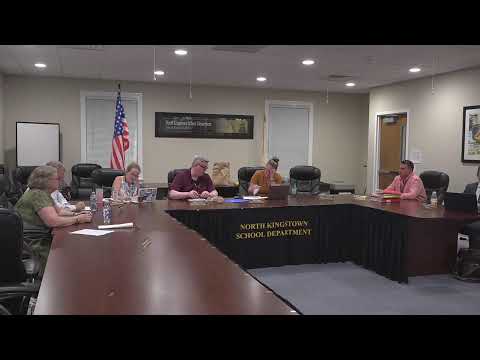
Design teams and the district on Aug. 1 presented a Stage 2 submission update for the proposed Wakeford (Wickford) Middle School and the capital improvement plan (CIP) the district plans to include in a November bond question.
Inga, the owner’s project manager, said the final Stage 2 application (due Sept. 15) will include two volumes — the new middle school building and the district‑wide CIP — and that a live link is being maintained so committee members can follow progress and updated documents. Perkins Eastman’s project manager, Tina Greco, described site organization, circulation that separates parent drop‑off from bus access, emergency‑vehicle connections, and security measures developed with first responders.
Architects showed a two‑story academic wing, relocated media center, a cafeteria sized for performance seating, and a target of net‑zero energy through photovoltaics and a geothermal field. They said landscape and building massing were designed to respect the neighborhood and historic elements.
Committee discussion focused on cost, scope and prioritization. Administration presented an updated CIP spreadsheet with new estimates that together were about $4 million higher than the bond amount the committee previously approved; some projects that had been discussed earlier appear in the current packet as removed or shifted. Administration said some additions were made in response to RIDE (the state agency) recommendations for educational enhancements and to ensure eligibility for state reimbursement, while other projects were removed to keep the core priority 1 list intact.
Several board members asked the district to confirm which projects must be included in Stage 2 to secure state reimbursement and which can be held as contingencies if funding falls short. Administration said the architects need approval for the projects marked in black on the spreadsheet (priority 1) to proceed with schematic design and that the committee can decide which of the optional $4 million in projects to drop if necessary.
Members raised practical concerns — parking counts for events, accessibility, outdoor learning areas and buffering from adjacent roads — and asked about geotechnical findings related to drainage and soils. The civil engineer said portions of non‑native soil will be removed and that planned grading and drainage will improve current ponding issues.
The administration and the building team agreed to produce a cross‑check showing (1) the original priority‑1 items the committee approved, (2) the projects now proposed for Stage 2 (black items), and (3) the optional items that would be cut if funding is limited, so the committee can confirm priorities at an upcoming meeting.
If the state review and local approvals proceed on the anticipated schedule, the bond question would appear on the November ballot and design would continue through the fall. The district said it will return with clearer comparisons of the previously approved list and the proposed Stage 2 submission and asked the committee to indicate any projects it objects to before architects complete schematic design work.