Get Full Government Meeting Transcripts, Videos, & Alerts Forever!
Get email alerts on the Pensions topic
No spam. Unsubscribe anytime.
City staff tell Austin audit committee pension reforms cut amortization and restored bond rating; OPEB liability remains $1.3 billion
Summary
Deputy CFO Diana Thomas and CFO Ed Bagnino updated the Audit & Finance Committee on legislative and administrative pension reforms, reporting amortization improvements (police amortization ~27.4 years), restored AAA bond rating by Fitch after reforms, increased city contributions from $185M (2022) to $283M (2026), and an actuarial OPEB liability of $1.3B.
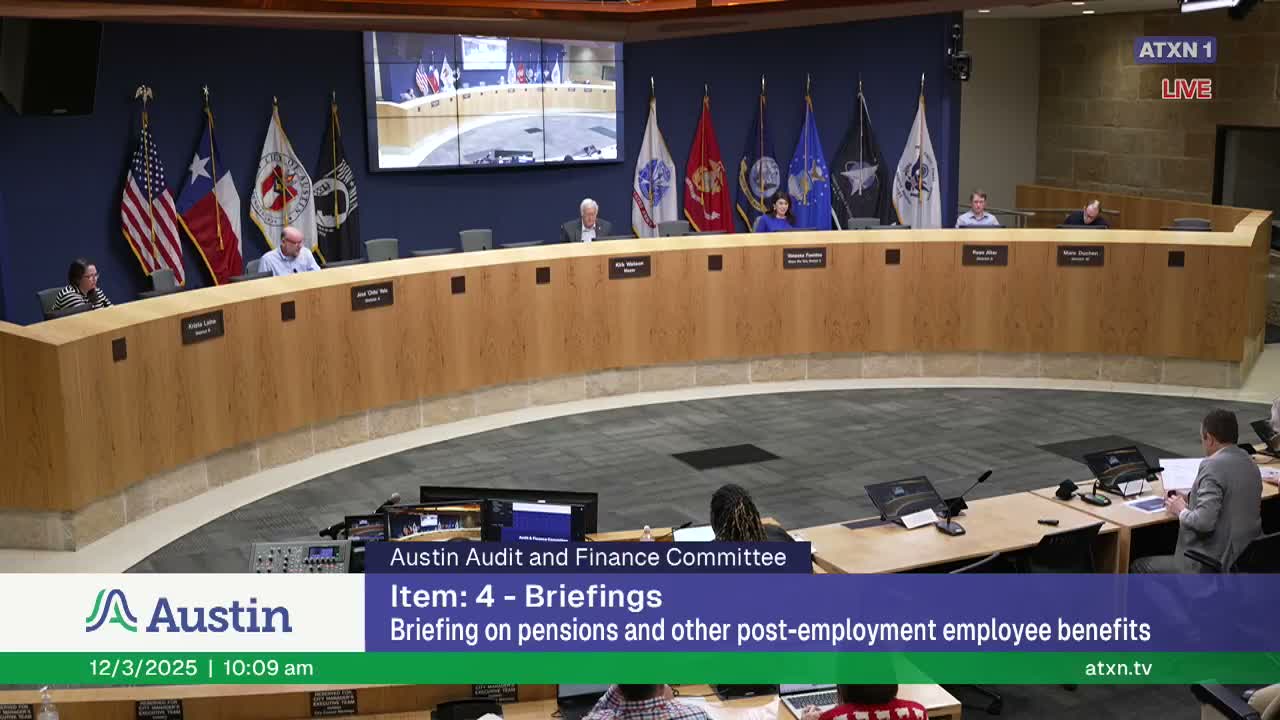
City financial staff provided the Audit & Finance Committee with an annual update on the three city contributory defined-benefit retirement systems and related other post-employment benefits (OPEB) on Dec. 3.
Deputy Chief Financial Officer Diana Thomas described reforms implemented over recent years that changed contribution models to actuarially determined contributions, established lower benefit tiers for new hires, and altered board governance. She said those reforms reduced the systems’ amortization periods and moved them within the Texas Pension Review Board (PRB) guidelines.
Ed Bagnino said the reforms were material to credit standing: after reforms, Fitch Ratings restored the city’s AAA bond rating earlier this year. Staff reported specific outcomes for the systems: the police system’s amortization period fell to about 27.4 years (below the PRB threshold of 30 years), and funded ratios range from roughly 58% (police) to about 77% (fire).
Staff provided membership and contribution figures: CoERS has roughly 24,000 members, APRS roughly 3,000 and the Fire system roughly 2,000. City contributions toward pensions rose from $185 million in 2022 to $283 million in 2026, a roughly $100 million increase driven in part by legacy liability payments that appear across multiple city funds (general fund and enterprise funds such as Austin Energy and Aviation).
On OPEB, staff reported an actuarial liability of approximately $1.3 billion and explained the city historically pays retiree medical benefits on a pay-as-you-go basis (no prefunded trust). They noted the liability fell from an earlier higher figure (cited as about $3.2 billion) after changes including requiring Medicare-eligible retirees to participate in Medicare Advantage plans in some cases.
Council members asked where pension and OPEB contributions appear in the budget documents; staff said police and fire contributions show in their respective department budgets while CoERS contributions are distributed across city funds and that more details can be found in personnel budget line items. Staff also agreed to monitor potential federal changes (reported in news coverage) that could require Social Security participation for some entities and to follow up if required.
Why it matters: Pension and OPEB liabilities are multi-billion-dollar obligations that affect the city’s long-term budget and credit capacity. The committee update showed reforms have shortened amortization timelines and increased ongoing contributions to address legacy liabilities.
What to watch: Staff follow-up on where contributions are shown in budget documents, ongoing monitoring of federal legislation that could affect contribution and benefit structures, and any proposals to address OPEB funding beyond pay-as-you-go approaches.