Get Full Government Meeting Transcripts, Videos, & Alerts Forever!
Get email alerts on the Efficiency Audit topic
No spam. Unsubscribe anytime.
Council debates scope and safeguards of proposed citywide efficiency audit; vote likely delayed
Summary
Council members and the city auditor debated a proposed ordinance to authorize a comprehensive, citywide efficiency assessment. Staff said costs are unknown and a competitive RFP could take 4–6 months; labor representatives sought worker protections and early consultation. Mayor proposed postponing the ordinance to allow additional refinement and stakeholder input.
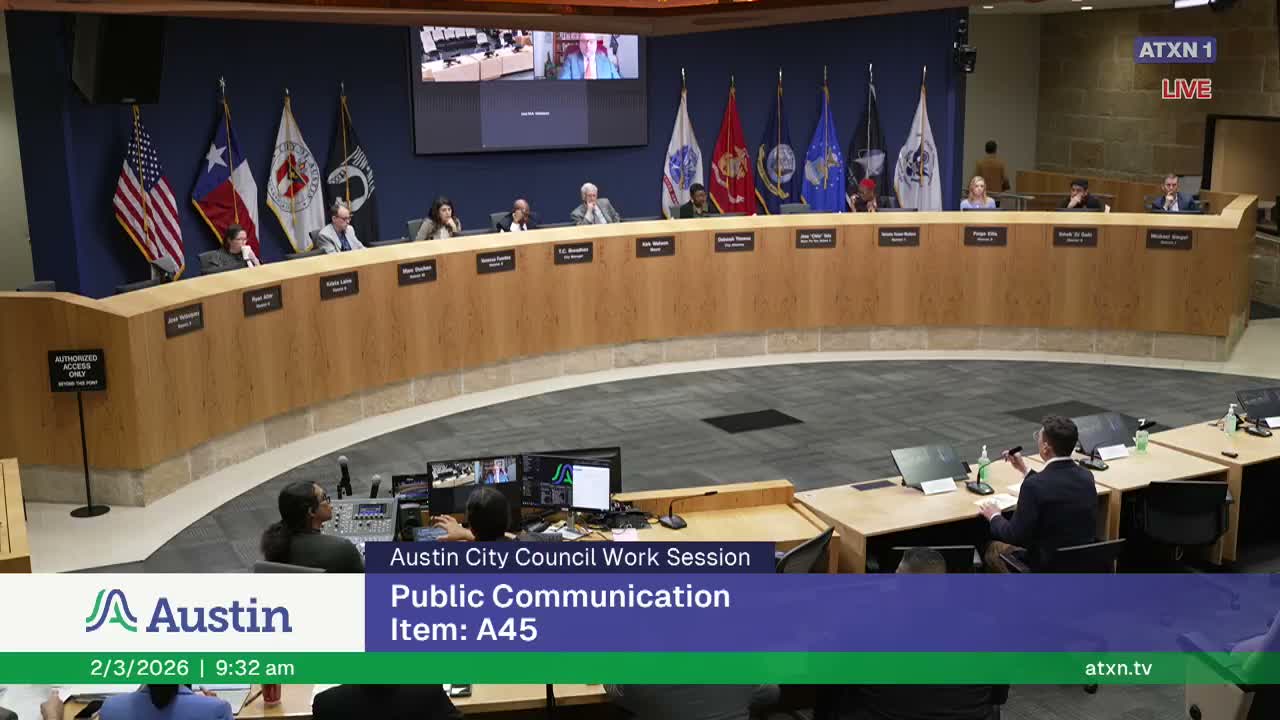
The Austin City Council spent the second half of its Feb. 3 work session on a proposed ordinance (item A45) to authorize an ongoing, citywide efficiency assessment run by an external consultant.
Bridal Summers and Carol Guthrie, speaking for AFSCME Local 1624, urged council to add worker protections and slow the timetable, saying the ordinance lacked clarity on whether city jobs could be contracted out and what guarantees the city would provide to its workforce. "Without greater clarity, we... cannot support this and we think it either needs to be postponed or some changes made to the ordinance itself," the union representative said. Councillors echoed the need for clarity about scope, cost and employee input.
City Auditor Jason Hadavi told the council the assessment is unprecedented and that credible market comparables were not available. "We attempted to pull some market research that wasn't successful... We don't have any credible numbers because this is an unprecedented type of assessment," Hadavi said, adding that a competitive procurement would likely take four to six months and that the auditor would evaluate proposals not solely on price but on methodology and value. Hadavi said he envisioned a single consultant to maintain consistency across multi-year work and recommended controls: budget approvals during the regular budgeting process and council-level contract approval as check points for cost control.
Council questions ranged from whether the assessment would be a department‑by‑department review or function‑based, to how worker input would be incorporated and how community values would be enforced in the RFP. Hadavi said employee surveys and fraud‑hotline tips are standard parts of audit processes and that the consultant should incorporate frontline worker input when developing findings. Several council members asked whether the existing Gartner contract for IT work related to the proposal; a city staff speaker said Gartner had performed organizational benchmarking and application rationalization for technology services but was not the only consultant involved.
Mayor Kirk Watson indicated he would likely recommend against a Thursday vote to allow additional time for consultation and refinement and suggested posting the ordinance for a later meeting (Feb. 26) to let the auditor, manager and council integrate the questions raised. "I want confidence in the process as well as confidence in the outcome," he said. Council did not vote on the ordinance at the work session and directed further work and stakeholder consultation before any final approval.