Get Full Government Meeting Transcripts, Videos, & Alerts Forever!
Get email alerts on the Surveillance Cameras topic
No spam. Unsubscribe anytime.
Austin council hears hours of public opposition and staff defense of proposed Live View park cameras
Summary
Council members and staff debated a proposed contract with Live View Technologies for mobile surveillance trailers in parks after dozens of public speakers warned of privacy risks, racial bias and data-sharing with federal authorities; staff said AI features would be disabled and security controls applied, but several councilmembers urged more time and a clear surveillance-use policy before a vote.
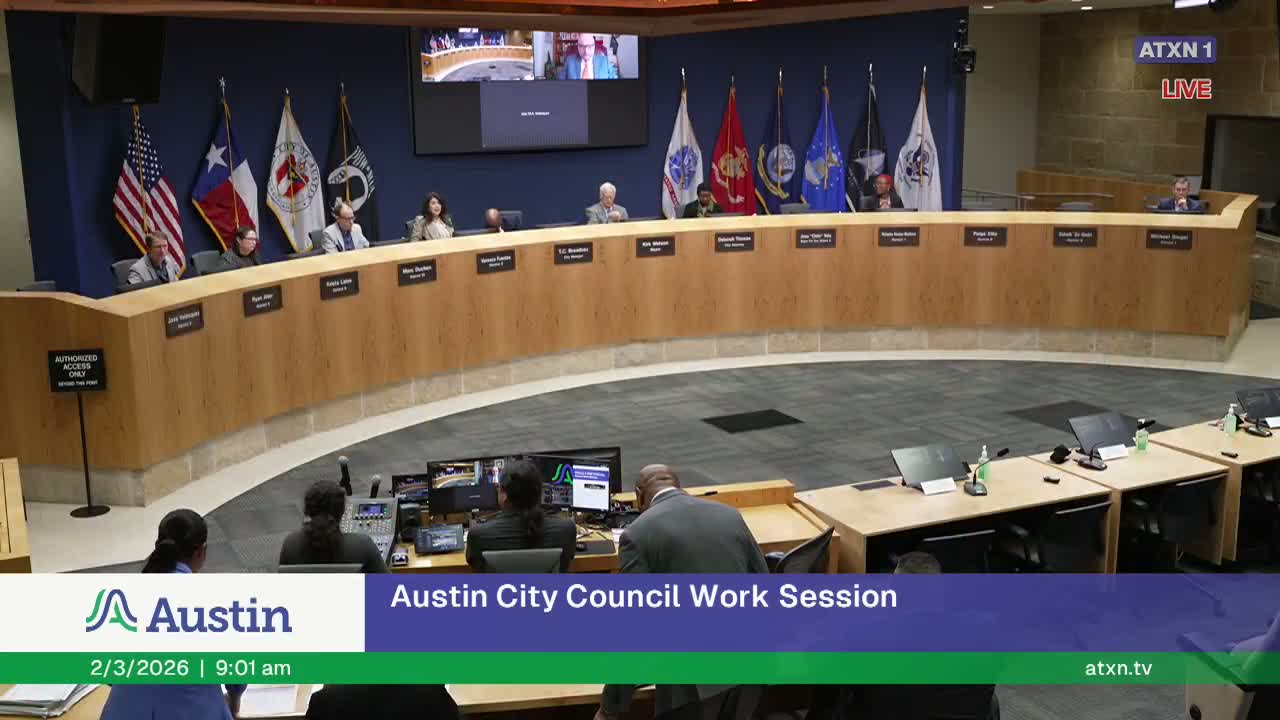
Council members spent the Feb. 3 work session dissecting a proposed three‑year rental contract to deploy mobile, AI‑capable camera trailers in city parks, after a lengthy public comment period in which residents, parents and community groups urged council to reject the deal.
Dozens of residents told the council the contract raises civil‑liberties and equity concerns. "The concerns over agenda item 3… are boiled down to 2 things," said Austin Wright of Hands Off Central Texas, describing worries that taxpayers would be required to "opt into a tool that could very well be used for mass surveillance" and that video would be handed to a private company with insufficient oversight. "The only safe data is data that is not collected," several speakers said in variations on the same theme. Marina Roberts of Workers Defense Action Fund warned that the vendor’s data could be joined with commercial data brokers and used to identify and target immigrant communities; Daniela Silva cited a recent staff memo and said, "under the interpretation of SB 4… APD would seem to be under legal obligation to turn the data over." Several commenters urged closed‑circuit (local storage) systems or investments in park staffing, rather than cloud‑hosted AI systems.
Staff said the proposed contract differs from unconstrained, third‑party surveillance and that technical and contractual limits would be used to reduce risk. "There are things that this technology can do that we have asked in the contract required in the contract for it to be disabled," Amanda Ross, division manager for natural resources in the Parks and Recreation Department, told council. Dr. Brian Gardner, interim chief information security officer, said features that would enable facial recognition or cross‑system correlation would not be enabled under the city’s security and privacy configuration, and that the city is conducting a privacy impact analysis. Assistant Chief J. J. Schmidt of the Austin Police Department described how police would ingest footage into the Real Time Crime Center and Axon evidence systems so that records would follow existing evidence and retention rules.
Council members pressed staff on several fronts: whether the January 26 memo’s claim that "the city maintains sole and exclusive ownership of all system data" matched the vendor’s actual contract, whether an addendum prohibiting vendor use of city footage for AI training had been agreed to by the vendor, and whether a two‑week public posting of privacy/analysis could be required before a vote. Mike Siegel, the council member who pulled the item, said staff had told him those contractual safeguards were still a draft and that "the vendor hasn't seen these provisions as far as I know," arguing the public needed more time to evaluate the material.
Staff said the pilot deployments (cameras previously placed at parks such as Mayfield Park and Mount Bonnell) were similar to the proposed devices and that the mobile trailers were intended for parks lacking wired power or infrastructure; Parks staff said the contract contemplates roughly six to 10 trailers deployed as rentals during seasonal spikes and hotspots rather than year‑round deployment. On safeguards, staff said they would require encryption, multifactor authentication and immutable audit logs to track who queried footage and why; Dr. Gardner said audit controls would be enforced to show "who accessed the system and what they were actually pulled within the system."
No final vote was taken. Multiple councilmembers said the contract and memo as published created confusion because addendum language was still in draft; Siegel proposed using the item as a first test case for the surveillance‑use policy (the "trust act") being considered on Thursday and asked staff to return with contract language and a public posting at least two weeks before a final vote. The item remains scheduled for further action on the council calendar pending those clarifications and any contract negotiations.