Get Full Government Meeting Transcripts, Videos, & Alerts Forever!
Get email alerts on the Bond Funds Status topic
No spam. Unsubscribe anytime.
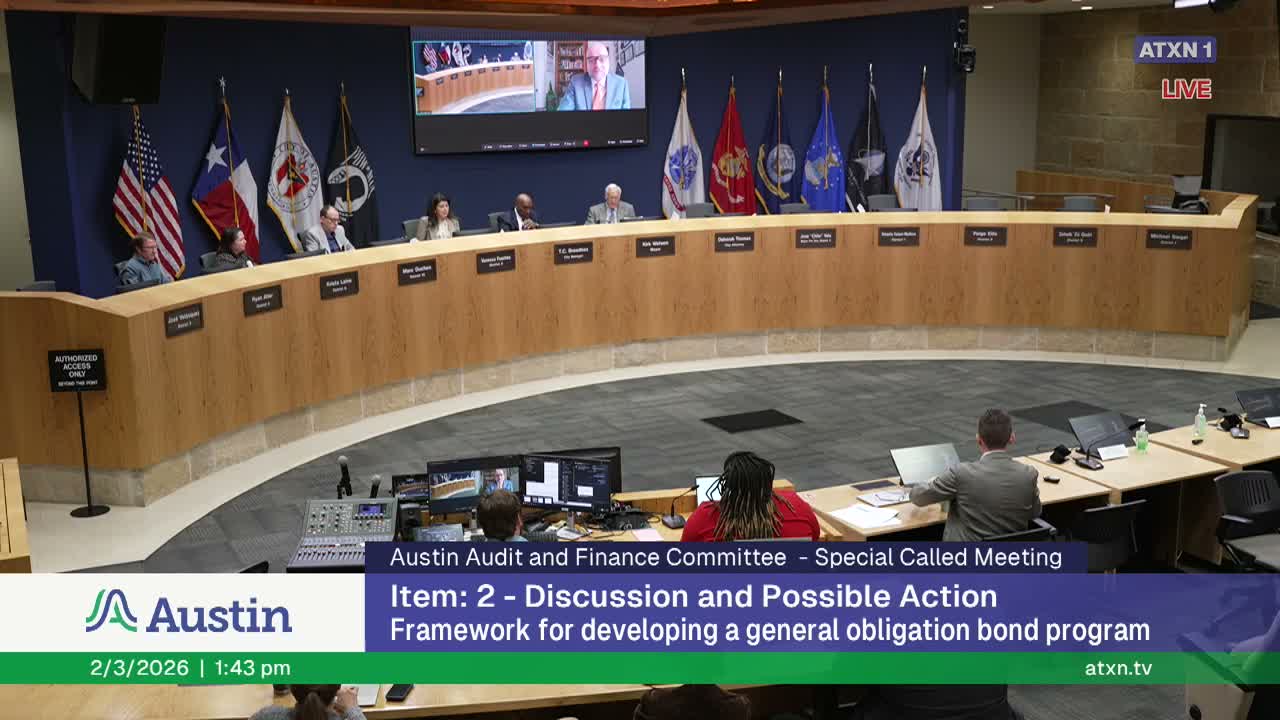
Staff briefs committee on $2.45B in past bond programs; housing shows $166M uncommitted
Summary
City staff told the Audit and Finance Committee that $2.45 billion was appropriated across 2012–2022 bond programs, about $1.5 billion has been spent, and roughly $166 million in housing bond funds currently remain uncommitted; staff outlined reallocation limits and deauthorization options.
City financial and capital delivery staff told the Audit and Finance Committee on Feb. 3 that the city's 2012–2022 general obligation bond programs total roughly $2.45 billion in appropriations across more than 1,200 projects and that about $1.5 billion of that has been spent.
Eric Bailey, deputy director of Capital Delivery Services, described the distinction between funds spent (payments to contractors), dollars under contract (obligations) and remaining balances (funds with identified spend plans). He said remaining balances are concentrated in a small set of projects and that historically delays arose when bond projects were not fully developed before voter approval. "When we move forward with several bond elections in quick succession, it put a financial strain on the city that we're currently dealing with," Bailey said.
Bailey listed projects and status by bond year: the 2012 bond is about 97% spent with remaining work on East 51st Street and Waller Creek; the 2016 corridor program holds the bulk of the 2016 balance with multiple projects nearing construction and a $16 million contingency to cover bid risk; many 2018 propositions (affordable housing, flood mitigation, open space) are 95% or more obligated; and the 2020 transportation bond still holds unobligated funds for major capital projects such as Congress Avenue and the Longhorn Dam Wishbone Bridge.
On housing, Nicole Jocelyn (housing and community development officer) told the committee staff currently identifies about $166 million as uncommitted in housing bond accounts, while roughly $180 million has been committed to projects. She said staff expects solicitations and competitive application rounds that would allocate portions of the uncommitted balance (including up to $50 million for planned vacant‑land gap financing and roughly $50 million across competitive rental/ownership cycles).
Mandy DeMaio, deputy director for housing, said the department had originally planned a five‑year spend plan for housing bond resources but is projecting a six‑year spend plan to allow for deliverability and to align with the decision‑tree discussion.
Kim Olivares, director of financial services, described the city's broader debt picture: certificates of obligation and other non‑voter debt fill out general obligation capacity, with roughly $790 million of CEOs authorized but unissued. She explained reallocation constraints (bond funds may only be used for purposes named in the original proposition unless council takes action) and deauthorization options, including voter deauthorization and a paired ballot approach; Olivares also noted an AG‑guided ‘‘staleness’’ practice where funds unused for about 10 years present deauthorization risks.
Committee members pressed staff on deliverability for long‑delayed projects (for example, South Lamar Corridor) and asked when transparency tools and dashboards will be available; staff said a strategic implementation plan and enhanced public dashboards are in development, with reporting improvements expected in the coming months.
Next steps: staff will continue reprogramming and solicitations for housing funds and deliver policy and implementation materials to council and the bond advisory task force for spring deliberations.