Get Full Government Meeting Transcripts, Videos, & Alerts Forever!
Get email alerts on the Water Emergency Management topic
No spam. Unsubscribe anytime.
Austin Water officials say winter readiness, new tools limited outages during recent storm
Summary
Austin Water briefed the Climate, Water, Environment & Parks Committee on its "all-hazards" emergency management program, saying training, incident-command procedures and investments such as VOC software, water tankers and added generators helped preserve service during a recent winter event.
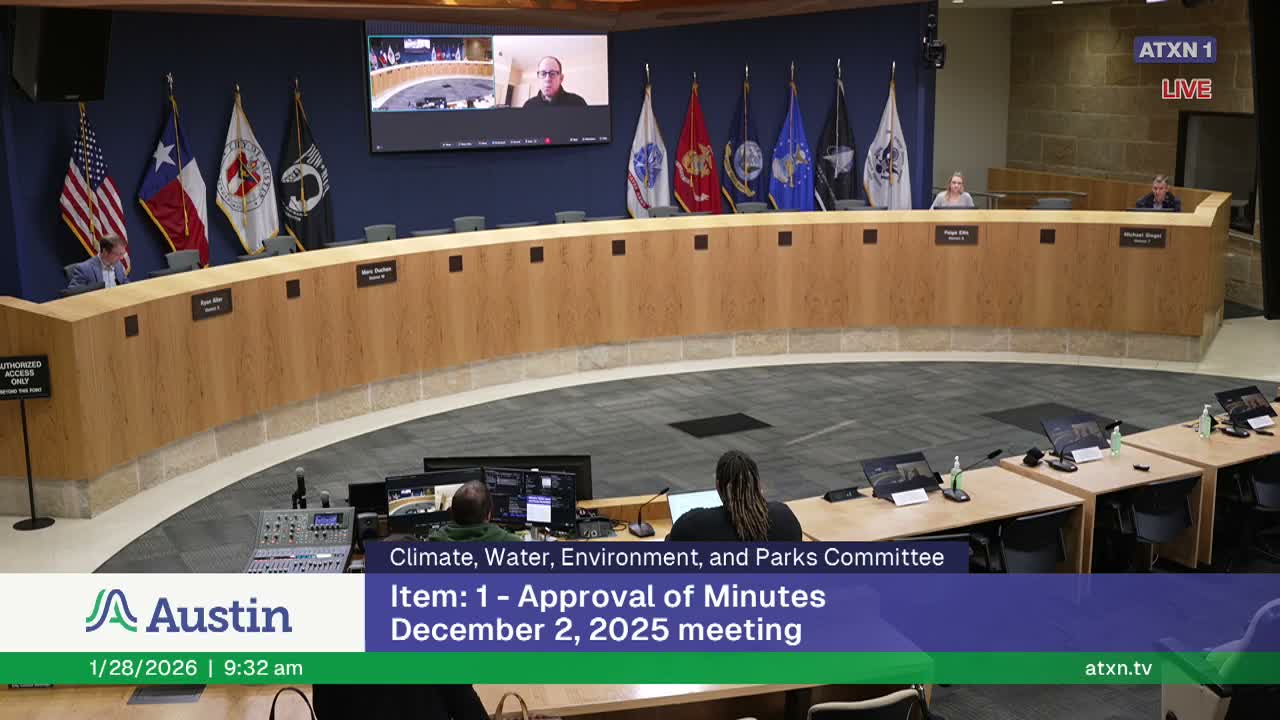
Austin Water officials told the City Council's Climate, Water, Environment & Parks Committee on Jan. 28 that the utility's all-hazards emergency management program and recent operational investments helped the system remain generally functional through a recent winter storm.
"We had a significant test of that readiness," said Shay Rawls Rolston, director of Austin Water, who opened the briefing. Rick Beeman, the utility's emergency management division manager, described an incident-management approach that uses the Incident Command System and VOC software for continuous emergency management, and said nearly 200 employees have training for incident management-team roles.
Why it matters: Officials said preparations made after the 2021 freeze improved visibility and response. Rolston noted the department has completed deployment of automated meters (AMI), which give better data about private-side breaks, and that water tankers purchased after the 2021 storm are maintained full and ready for distribution.
Beeman listed operational resources—the utility keeps potable water tankers, hydrant taps, bottled water pallets and emergency contracts with vendors—and described a department operations center that can activate at short notice. He said Austin Water runs 12-hour rotating incident-management shifts and maintains specialized equipment and spare parts at critical sites.
Amy Petrie, Austin Water's interim chief of staff and manager of public information, said communications depend on pre-prepared templates for regulatory notices (boil-water or do-not-drink advisories), FAQs translated into 15 languages and geofenced alerts via the myATX Water portal. Petrie said a deputy incident commander position focused on communications ensures messaging and operational command are separated during activations.
Operations manager Stephanie Hsu outlined winter-preparation steps: inspecting insulation and heat tracing, adding heaters on solids-processing equipment that had frozen during prior storms, commissioning a new substation at the Orecch treatment plant to strengthen power resiliency, and staging fixed and portable generators for critical pump and lift stations.
Council members asked about resident-facing tools and how to report problems. Officials said customers with emails tied to their accounts receive emergency notifications and can use the public leak and outage map; they also asked residents to report visible leaks by calling the customer service number, 972-1000. Rolston said Austin Water covers a 538-square-mile service area and more than 4,000 miles of pipe, noting citizen calls help crews locate hard-to-find breaks.
The committee did not take formal action on policy; staff said they will follow up on technical questions raised by members (for example, best practices for fire suppression systems in multifamily buildings). The utility indicated it will provide additional details requested during the meeting.