Get Full Government Meeting Transcripts, Videos, & Alerts Forever!
Get email alerts on the Bond Decision Framework topic
No spam. Unsubscribe anytime.
Audit and Finance Committee forwards revised bond decision tree to full council
Summary
The committee voted Feb. 3 to recommend version 2 of a decision framework for proposing voter-approved general obligation bonds to the full Austin City Council on Feb. 26, adding language that ties the timing question to whether a proposal is consistent with the city’s policy on years remaining or 'substantial completion.'
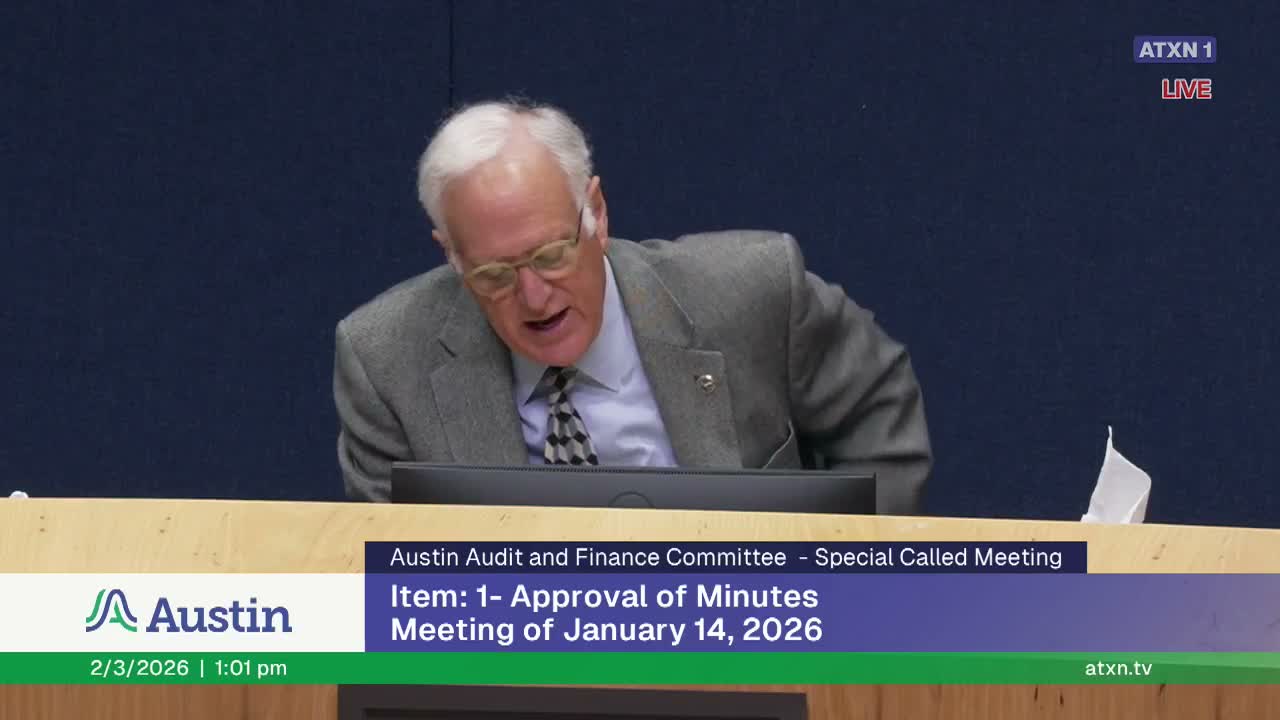
On Feb. 3, 2026, the Austin Audit and Finance Committee voted to forward a revised “decision tree” for proposing voter‑approved general obligation bonds to the full City Council for consideration on Feb. 26.
The committee’s recommendation replaces a strict “are there two years or fewer of estimated voter‑approved bonds remaining to be issued?” test with a question that asks whether a proposed bond is “consistent with policy related to the number of years or substantial completion of estimated voter‑approved bonds remaining to be issued,” language the chair said would preserve flexibility while council considers a separate policy change. "Is this consistent with policy related to the number of years or substantial completion of estimated voter‑approved bonds remaining to be issued?" the chair read aloud while presenting the edit.
Councilman Walter said the existing two‑year rule needs clarification because departments come to council at different stages of project delivery and a rigid rule could leave some departments behind. "I continue to have a concern around a particular department that may be way behind and they might have four years worth of spend plan left and them holding up everybody else," Walter said, urging a separate policy discussion about exceptions.
Staff advised the committee that the city has generally interpreted the timing question in practice as a ‘‘substantial completion’’ test rather than a precise percentage, and recommended wording that would allow for that interpretation. Mr. Vannino, who spoke for staff, described how substantial completion and project deliverability are used in staff analyses and said the draft framework could incorporate that concept to avoid setting a fixed percent threshold.
Mayor Pro Tem moved to forward version 2 of the decision tree — including the revised wording on the timing question — to the full council; the motion was seconded by Council member Alter and approved by the committee without objection.
The committee and staff agreed the decision tree will guide the city’s bond advisory task force and inform council deliberations this spring; the task force is expected to deliver recommendations in May, with any final decisions to call an election to follow the council’s timeline for ballot-setting.
The committee’s recommendation is procedural only: it forwards the draft framework to the full council for consideration and does not itself adopt changes to the city’s financial policy. The committee asked staff to prepare any additional policy language or analysis needed for council discussion before Feb. 26.
Next steps: version 2 will be considered by the full City Council on Feb. 26. If council approves a policy change, the decision tree language can be adjusted to match the revised policy.