Get Full Government Meeting Transcripts, Videos, & Alerts Forever!
Get email alerts on the Intergovernmental Collaboration topic
No spam. Unsubscribe anytime.
Joint Austin subcommittee directs staff to map shared services; targets homelessness, workforce and parks
Summary
The Austin city–county–school district joint subcommittee asked staff to produce an asset map of existing programs and return recommendations focusing on workforce development, parks/open-space management and homelessness, with agreed follow-up and a tentative return in early May.
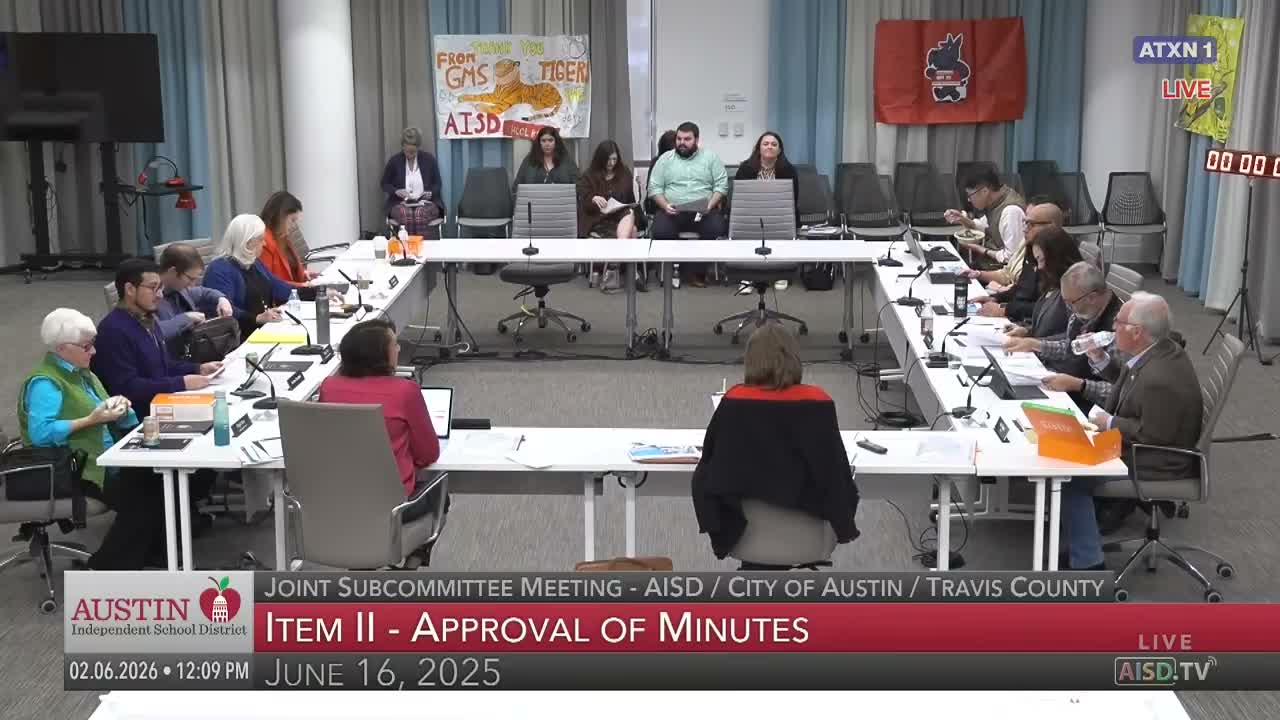
Vice President Catherine Whitley, vice president of the Austin Independent School District Board, called a joint subcommittee meeting to order at 12:09 p.m. and asked the group to consider whether the city, county and school district should pursue cost‑sharing and collaborative service delivery.
The subcommittee agreed that staff should compile an "asset map" of existing programs, facilities and interlocal agreements and come back with two or three prioritized, staff‑vetted projects the jurisdictions could pursue together — candidates include workforce development, parks and open‑space management, and homelessness prevention and shelter capacity.
Why it matters: members cited mounting budget constraints and overlapping services across jurisdictions as reasons to coordinate. A Lawmaker urged keeping the work simple and staff‑driven so the public can see clear, transparent savings and results. "The public has to trust that we're actually doing something that's more efficient, more efficacious, saves money," the Lawmaker said.
What was decided and next steps: the subcommittee asked staff from the three entities to assemble baseline data — including existing interlocal agreements, facilities lists, shelter and student‑mobility information, and revenue/capacity summaries — and to recommend a prioritized, phased workplan. Assistant City Manager Stephanie Hayden said city staff typically assign a subject‑matter expert to compile the material and suggested staff (including Edna and Pilar) coordinate across agencies to agree on a common format. "They will assign someone that works in this area... and they will compile the information and put the information together," Hayden said.
Scope and candidate priorities: speakers repeatedly recommended starting with an asset map and then narrowing to two or three specific initiatives. A Trustee proposed workforce development as a priority and cited projected job openings (technology and infrastructure were noted in the meeting materials) as a reason to align K–12, community college and private‑sector training. For parks and open space, a Committee member proposed cataloging facilities and equipment to find shared capacity and avoid duplicate purchases. On homelessness, members suggested focusing on early intervention, family shelter capacity and supports for youth aging out of foster care; one Lawmaker proposed a target example of 50 new family shelter beds as a community goal to study.
Budget and existing investments: a Committee member highlighted recent county investments funded by federal COVID relief, saying, "We got $247,000,000" and describing a $117,000,000 commitment toward permanent supportive housing expected to create about 1,900 units. Members said those kinds of existing investments and interlocal agreements should be captured in the asset map.
Timing and reporting: staff were asked to return with an initial framework and findings at the next subcommittee meeting; members discussed meeting quarterly and identified the week of May 4 as a tentative target for the next convening. The meeting adjourned at 1:26 p.m.
Meeting actions: the body approved minutes for 06/16/2025 earlier in the meeting and adjourned after the presentation and discussion. The subcommittee did not take a formal policy vote to adopt projects; it directed staff to compile and return with options.