Get Full Government Meeting Transcripts, Videos, & Alerts Forever!
Get email alerts on the Teledriving topic
No spam. Unsubscribe anytime.
Austin staff brief committee on teledriving pilots; MOU, permits and safety reporting proposed
Summary
City Transportation staff said they are negotiating an MOU with a private teledriving operator and will monitor pilot operations this spring; staff proposed a future ordinance enabling director-issued operating permits, first‑responder coordination, safety reporting and operational limits (fleet size, service area, stop behavior on comms loss).
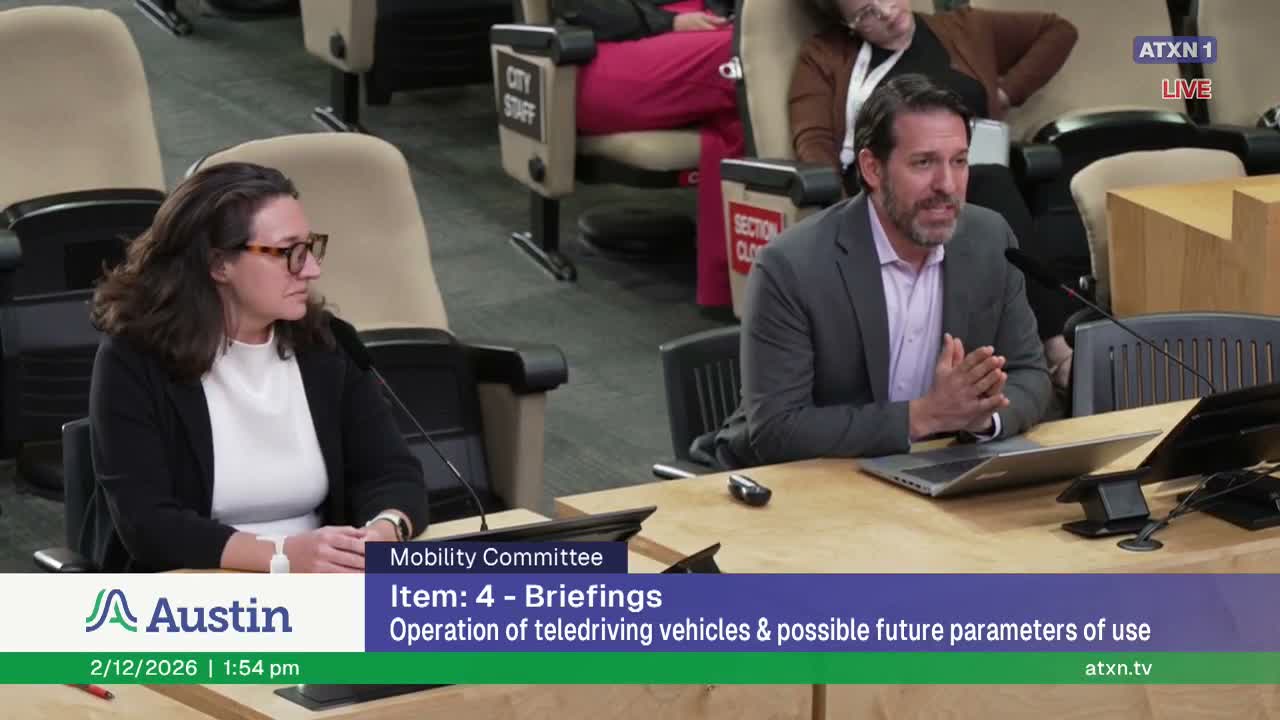
City staff told the Mobility Committee on Feb. 12 they are preparing to formalize oversight for teledriving — remote, human‑operated vehicle control over cellular networks — by negotiating an MOU with a private operator and planning potential director rules and permitting.
Lewis Lef, assistant director at Austin Transportation and Public Works (ATPW), and Rachel Castagnolis (ATPW) explained teledriving is continuous, real‑time vehicle control by a remote human operator using video and audio feeds; because a human is driving remotely, staff said teledriving is not covered by the autonomous‑vehicle subchapter of the Texas transportation code and the city has authority to make rules for it.
Staff said they are working with a private company that expects to begin operations in the coming months and are negotiating an MOU to document operational standards, safety reporting, first‑responder coordination and what data will be shared with the city. The MOU is intended to provide early operational visibility and could be followed by an ordinance allowing the director to create permit and licensing rules modeled in part on state AV permitting approaches (e.g., first‑responder plans and permit reporting).
Committee members asked for the company’s identity; staff declined to name the firm publicly while negotiations remain preliminary, citing proprietary concerns. Staff noted experience in Las Vegas where teleoperations have been used for car‑share repositioning at low speeds (staff said that jurisdiction limits teleoperated vehicles to about 26 mph) and acknowledged reports of a small number of crashes in those operations.
Council members raised multiple oversight questions: where teleoperators are housed (staff said office facilities with backup power and redundant connectivity are used), whether teleoperators could work remotely from home (staff said operations coordinate through centralized facilities), how vehicles would behave on connectivity loss (staff said designs call for a controlled slow stop in lane), camera/sensor configurations (video and audio plus vehicle assist sensors; not all teleoperated vehicles rely on lidar/radar), and what consumer protections and contact mechanisms will exist for injured pedestrians or collision reports (staff said MOU and subsequent rules would include reporting and company contact information).
Several council members highlighted potential benefits for access and employment: a human operator can interpret hand signals or officer directions more quickly than some AV systems, and teleoperation could create driving employment opportunities for people with mobility disabilities. Staff said the AV safety working group (police, fire, EMS, airport, CapMetro and others) has engaged with teleoperation firms and will continue to coordinate on first‑responder plans.
Staff recommended finalizing the MOU this spring, monitoring early operations, and potentially bringing an ordinance to council in the summer or fall to permit director rules and a licensing/permit system. No ordinance was proposed at the meeting; staff sought committee guidance and additional time for analysis and coordination.