Get Full Government Meeting Transcripts, Videos, & Alerts Forever!
Get email alerts on the Public Safety topic
No spam. Unsubscribe anytime.
Austin City Council approves four-year firefighters contract, secures four‑person staffing
Summary
On Dec. 18, 2025 the Austin City Council approved a four‑year collective bargaining agreement with the Austin Firefighters Association that locks in the city's four‑person staffing ordinance, raises pay, creates a new 'Austin schedule' and includes companion budget amendments and added FTEs.
The Austin City Council on Dec. 18, 2025 approved a four‑year collective bargaining agreement with the Austin Firefighters Association that locks in the city's mandatory four‑person staffing ordinance, increases pay and phases in a new work schedule designed to improve firefighter wellness.
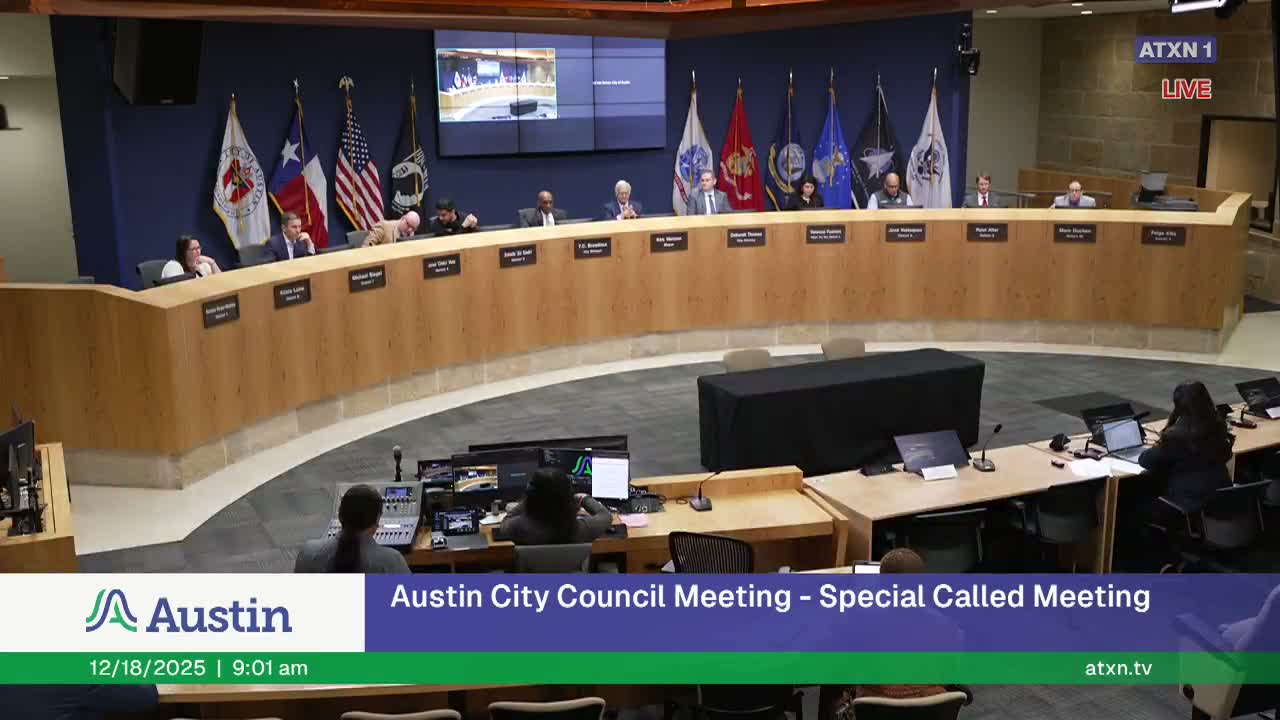
The agreement, presented at a special called meeting at City Hall, takes effect immediately and runs through September 2029. Council adopted the contract (item 1), an accompanying budget amendment to fund it (item 2), and an authorization to add staffing (item 3) without objection.
Deputy Labor Relations Officer Roxy Stevens summarized the deal’s central elements. "This agreement is a 4‑year agreement, becoming effective today and ending in September 2029," Stevens said, and described provisions the city and union negotiated to expand hiring flexibility, streamline promotions and allow limited use of non‑sworn employees in specific functions such as recruiting and public information.
Key financial and staffing terms include a projected four‑year cost of about $63,000,000 and a year‑one cost of $5,913,706. The contract phases in a reduced average workweek that goes from 52 hours to 49.8 hours in the third year; that change raises hourly pay roughly 6.43% while holding the same annual salary profile, Stevens said. The agreement calls for adding 54 authorized firefighter positions over the contract period as part of a cost‑sharing plan: 22 additional FTEs in year 1 and 32 in year 2 to support the reduced workweek.
The deal also adjusts pay steps to boost entry‑level pay and recruitment: the entry step increases by 6.21%, step 1 by 5.555% and step 2 by roughly 5.6%, with other ranks receiving different first‑year increases and multi‑year raises (years 2–4 at 3%, 3.5% and 4%, respectively), Stevens said.
Council members asked how the city would manage overtime and potential budget pressure. Carrie Lang, director of Budget and Organizational Excellence, said the contract’s costs were included in the city’s forecast and the finance team will monitor overtime monthly and make administrative adjustments as needed. "It was included in all of our projections and the team ... have come up with a contract that is in line with what we planned for and budgeted for," Lang said.
Some union leaders and speakers raised concerns about budget choices made earlier in the year. AFA President Bob Nix, who addressed the council during public comment, said the union had launched a petition out of concern that budget actions would undermine staffing: "You guys adopted a budget that takes $8,300,000 out of the fire department budget," Nix said, arguing the contract must protect stations and staffing. AFA president‑elect David Gerard and Nix emphasized that the negotiated contract includes guardrails and a joint labor‑management process before any station or apparatus is taken out of service.
Council and staff described procedures for so‑called brownouts or blackouts — temporary or longer‑term removals of apparatus or stations from service. Stevens said the contract allows those measures only under narrow circumstances (a certified severe financial crisis by the CFO or an unforeseen, department‑level budget emergency) and requires a joint labor‑management committee to develop recommendations followed by public advisory notice to council and the union.
City finance chief Ed Vannino told the council that declaring a "severe financial crisis" requires judgment and cannot be reduced to a single numeric trigger, citing past examples such as the 2008–09 revenue collapse.
Councilmembers praised the compromise for strengthening recruitment and retention through pay increases and a new schedule that council and fire leaders say will distinguish Austin in hiring. Assistant Chief Tom Bokey said the department plans to run three cadet classes before the schedule's planned 2027 implementation and expects improved recruiting results.
The council voted to approve the agreement after a motion by Councilmember Velasquez, seconded by Councilmember Harper Madison; members passed item 1 "adopted" without objection. Council then passed the budget amendment (item 2) and the increase in authorized strength (item 3) on all three readings without objection. The mayor adjourned the special meeting at 10:09 a.m.
The contract will now move to implementation steps including hiring classes, monthly budget monitoring and the formation of joint committees to address any potential brownout or blackout decisions. The city and the AFA held a brief signing ceremony after the vote.