Get Full Government Meeting Transcripts, Videos, & Alerts Forever!
Get email alerts on the Bond Capacity topic
No spam. Unsubscribe anytime.
City finance staff cautions against overly large 2026 bond; advises cap near $750 million
Summary
Financial staff told the Audit & Finance Committee that Austin has about $2.4 billion in outstanding GO debt and substantial authorized‑but‑unissued balances, and that adding a new bond program should be limited to roughly $750 million to preserve capacity and delivery. Staff outlined taxpayer impacts under several scenarios and recommended options including delaying to 2028 or a smaller targeted program.
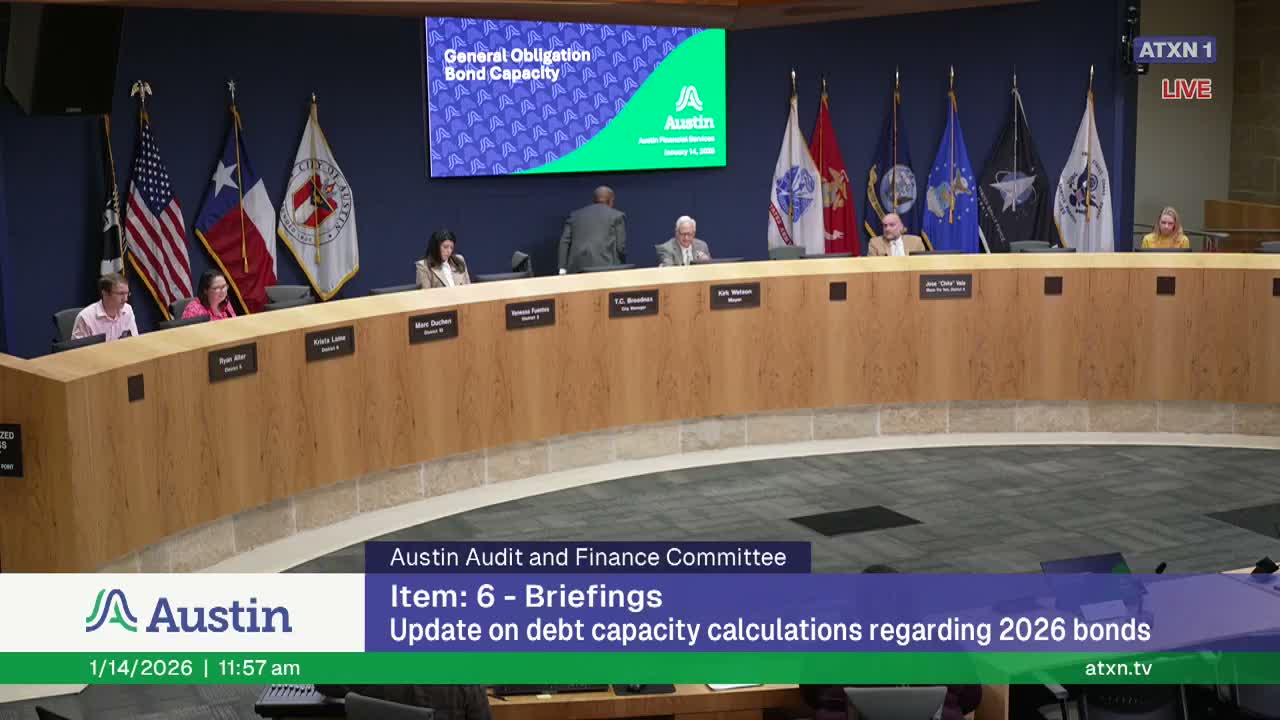
Kim Olivares, director of Financial Services, presented an update on the city’s debt capacity and three bond‑size scenarios at the Audit & Finance Committee on Jan. 14.
Olivares reported approximately $2.4 billion in outstanding general obligation debt and more than $1 billion in authorized but unissued (ABU) debt across prior programs; the largest remaining ABU balance is in mobility and transportation (about $400 million) and affordable housing retains roughly $188 million. Using conservative assumptions (3% assessed‑valuation growth and a 5% borrowing rate for modeling), staff modeled scenarios adding $500M, $750M and $1B to current ABU levels and estimated typical‑taxpayer debt‑service impacts through 2030.
Under current ABU only, staff projected a typical taxpayer debt‑service portion of roughly $614 by FY2030; adding $500M would increase that to about $686, adding $750M to about $722, and $1B to about $758. Based on delivery capacity, credit considerations and peer comparisons, staff recommended not exceeding $750M if the council chooses to pursue a 2026 bond program.
Councilmembers raised concerns about delivery capacity for mobility projects (some large transportation projects are complex and slow to spend), the timing of authorized but unissued balances (developers and project schedules have shifted the earlier 2026 target later), and the flexibility to structure a smaller program targeted at specific impacts such as economic development or high‑priority smaller projects (sidewalks, trails, Safe Routes to School).
Olivares advised options including capping a 2026 package at $750M, delaying a comprehensive program to 2028 to allow ABU drawdown, or composing a more limited program aimed at specific departments that have expended prior funds. Councilmembers asked for follow‑up data, including a breakdown of remaining ABU project lists, historical borrowing rates and the sensitivity of projections to different interest‑rate and assessment‑value assumptions.