Get Full Government Meeting Transcripts, Videos, & Alerts Forever!
Get email alerts on the Efficiency Assessment topic
No spam. Unsubscribe anytime.
Mayor proposes auditor‑led citywide efficiency assessment; council debates scope, timeline and cost
Summary
A proposed ordinance would create an auditor‑led, benchmarked efficiency assessment program for Austin, with phased, multi‑year reviews and public reporting. Councilmembers pressed staff on consultant costs, audit independence, the difference between efficiency and effectiveness, and whether the charter amendment option would be preferable.
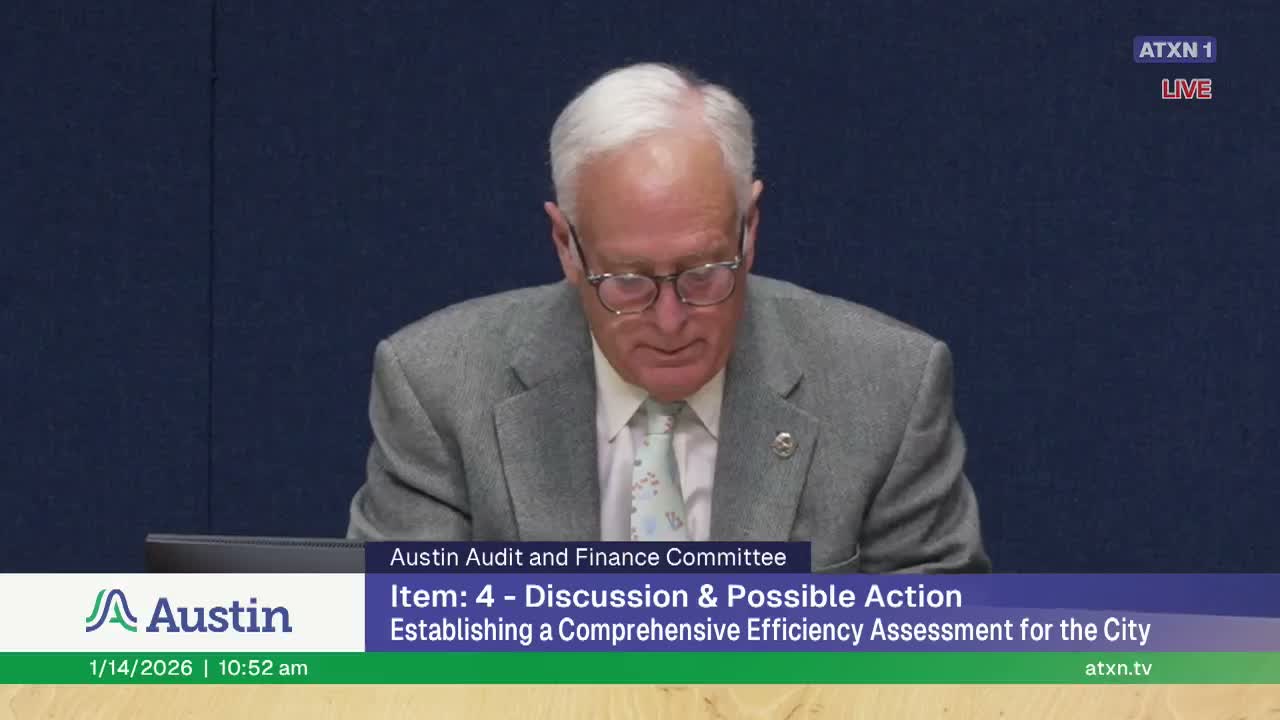
The chair introduced a proposed ordinance on Jan. 14 to create a citywide, auditor‑led efficiency assessment program intended to benchmark operations, identify high‑cost centers, and recommend efficiency and effectiveness improvements.
City Auditor Jason Adavi said the ordinance is written to allow the auditor to break the city into assessment portions and to tailor standards by department and fund. "We would break up the assessment cycle over multiple years because the city is so large and complex," Adavi said, explaining a proposed 5‑year assessment window followed by a 3‑year pause to allow implementation and observation.
Councilmembers emphasized that the program should not only measure efficiency (costs and processes) but also effectiveness—whether work advances council‑adopted strategic goals (housing, Vision Zero traffic safety, etc.). Adavi and the mayor said benchmarking should include KPIs tied to outcomes, not only outputs. "One of the things I'm committed to is ensuring that we use good professional judgment in how we move about this," Adavi told the committee.
Several members asked for cost estimates before the council votes; the auditor said the cost of external consultants is unknown and will depend on scope and bidding. Concerns were raised about a charter amendment route that would require consultants to demonstrate net savings equal to their fees—auditors and the mayor warned that language could create conflicts of interest or an open‑ended contract.
The city manager said the ordinance complements, rather than conflicts with, the administration’s existing optimization work and that staff will continue concurrent efforts. Councilmembers asked for clearer cost estimates, phased options (scaled‑back or spread out), and an explanation of how assessment timing could inform contract renewals and rate cases for major departments such as utilities and public safety.
The committee did not vote on the ordinance but agreed to two work sessions to refine scope, request cost estimates, and consider implementation timing prior to a potential Feb. 5 vote.