Get Full Government Meeting Transcripts, Videos, & Alerts Forever!
Get email alerts on the Office Spending Policy topic
No spam. Unsubscribe anytime.
Audit committee backs mayor-and-council office‑spending policy, leaves room for amendments
Summary
The Audit & Finance Committee recommended adoption of a consolidated mayor‑and‑council office spending policy and set a path for council amendments before a Jan. 22 full council vote, after extensive debate about rollover balances, permitted transfers to departments, software licensing, and transparency requirements.
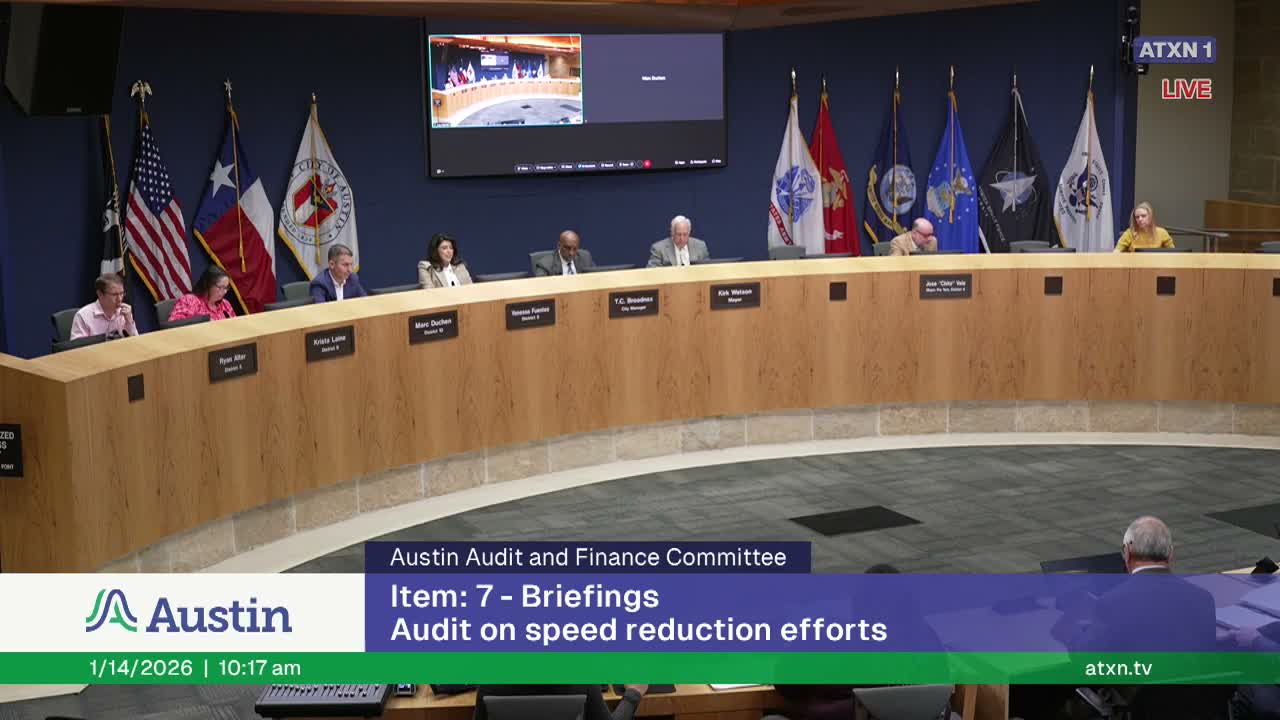
The Audit & Finance Committee on Jan. 14 recommended that the full Austin City Council adopt a consolidated mayor‑and‑council office expense policy that compiles multiple administrative bulletins and clarifies permissible uses of council office funds.
Councilmember Fuentes moved the committee recommendation and Mayor Pro Tem Vela seconded; the motion carried without objection. The committee asked members to post proposed amendments on the message board by the Tuesday preceding the Jan. 22 full‑council meeting.
Discussion focused on two central tensions: maintaining transparency and guarding against over‑appropriation of council office funds, while preserving flexibility for offices to deploy unexpended balances for small district projects. Several councilmembers urged mechanisms—such as midyear transfers, IFCs (interfund transfers), or limited rollover accounts—that would let council offices fund one‑time district needs (park improvements, shade structures, or district‑specific small capital projects) without undermining citywide budgeting discipline.
Councilmembers also discussed software licensing and duplication of resources; some argued for closer coordination with Austin Technology Services to avoid redundant purchases while preserving the ability of offices to obtain specialized tools when citywide systems are insufficient.
The motion the committee advanced recommends adoption of the policy as proposed, with recognition that councilmembers may offer amendments at the Jan. 22 meeting; committee members asked staff to provide clarifying language on implementation timing and grandfathering of existing carryovers where appropriate.