Get Full Government Meeting Transcripts, Videos, & Alerts Forever!
Get email alerts on the Speed Reduction Audit topic
No spam. Unsubscribe anytime.
City audit finds speed‑reduction projects lower speeds but calls for clearer rules and maintenance plan
Summary
A City Auditor review found Austin’s traffic‑calming projects generally cut speeds—especially where speed cushions were used—but flagged gaps in documentation, decision criteria and maintenance planning and issued three recommendations. Transportation staff said the recommendations are feasible and outlined next steps.
Sam Sokolow of the City Auditor’s Office presented a review of Austin’s speed‑reduction efforts that found most projects reduced vehicle speeds and that speed cushions delivered larger speed declines at lower cost than many other treatments.
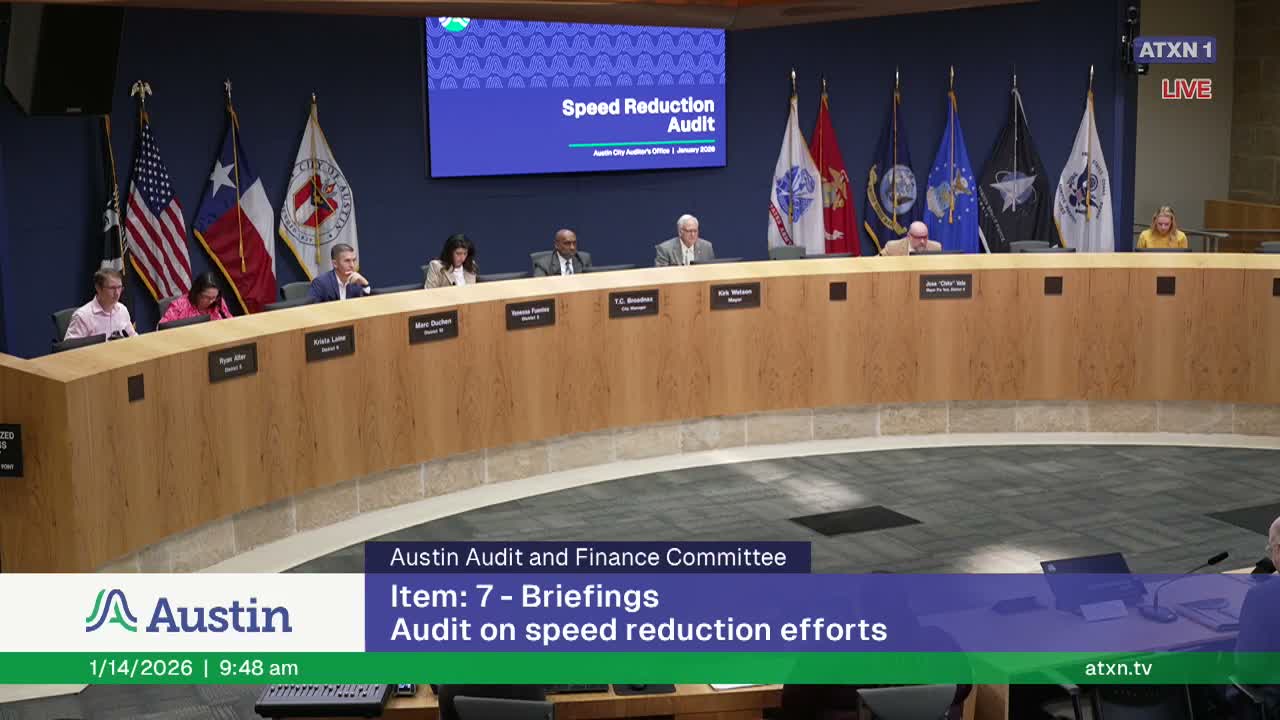
The audit, delivered to the Audit & Finance Committee on Jan. 14, concluded the city uses a risk‑based approach to prioritize locations but does not consistently document key selection and delivery decisions. “We found the city has a proactive approach to speed reduction,” Sokolow said, adding that the report includes three recommendations for project selection, project delivery and asset maintenance.
The report noted a $6,000 approximate per‑location cost for speed cushions and said projects with cushions performed well in measured speed declines. It also documented that the city’s speed management program lacks a formal maintenance plan for cushions and similar assets; maintenance has been largely reactive, staff told auditors.
Richard Mendoza, director for Transportation and Public Works, acknowledged the findings and said some work had already begun before the audit. “These traffic cushions are not inexpensive,” Mendoza said, explaining the need to engineer spacing and location and to do community outreach before installation. He added that the department is exploring alternate funding sources and delivery methods.
During committee questions councilmembers pressed staff on demand versus delivery: TPW reported an average of roughly 1,200 customer service requests per year that can include speed concerns, and that only a portion are candidates for cushions. Eric Balak, managing engineer, said TPW expects to implement the auditor’s recommendations with different timelines for each. “We think those are feasible,” Balak said.
Councilmembers raised maintenance and funding concerns. The auditor recommended that the city document the rationale for selecting projects, use past cost and speed‑outcomes data to guide decisions, set formal financial tolerances and decision points, and adopt an asset maintenance plan for cushions. TPW agreed to preliminary next steps and to provide follow‑up information on specific segments and costs.
The committee did not take action on the audit report itself; auditors said ATBW (Transportation & Public Works) has agreed with recommendations and communicated preliminary next steps and timelines.