Get Full Government Meeting Transcripts, Videos, & Alerts Forever!
Get email alerts on the Municipal Finance topic
No spam. Unsubscribe anytime.
Austin council adopts new office‑spending policy after marathon debate over rollovers and district service funds
Summary
After hours of amendments and votes, the City Council adopted updated rules for council office spending, including a $50,000 rollover framework with a path to seed district service funds; members split sharply over whether unspent office dollars should remain with offices or be moved into a district fund.
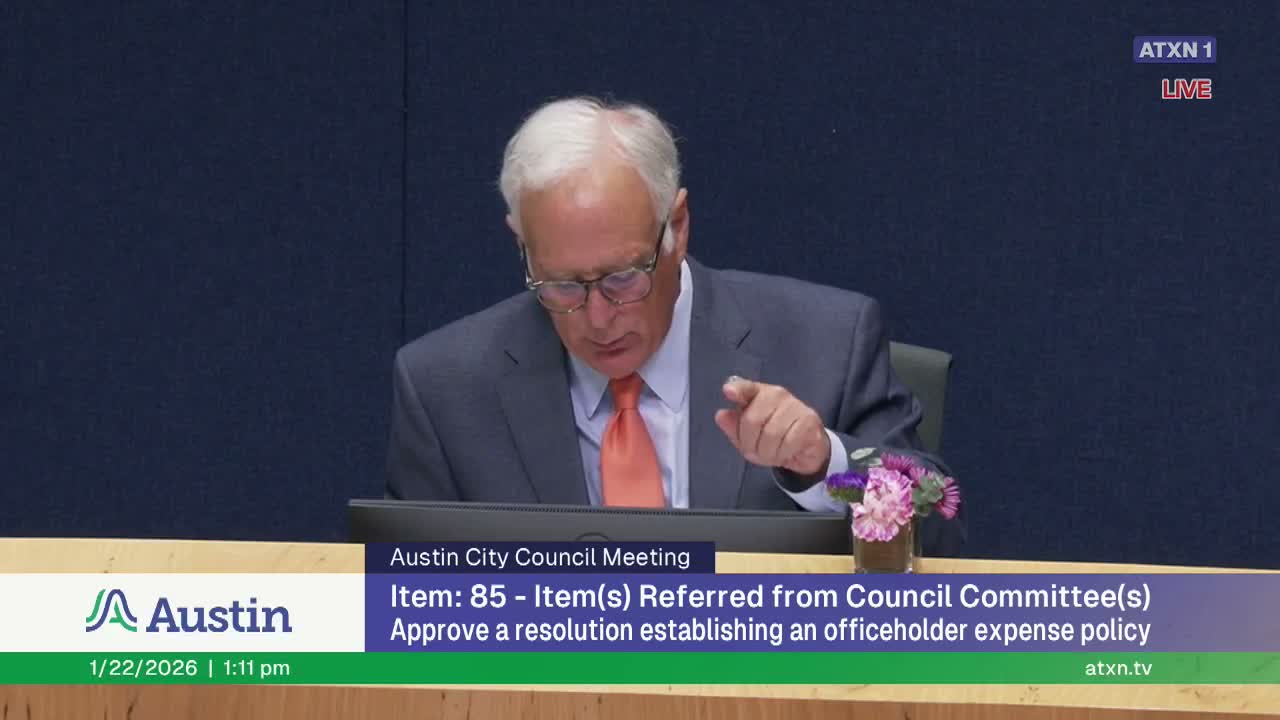
The Austin City Council adopted a revised council office‑spending policy on Jan. 22 that tightens guidance on permissible uses, requires training and sets rules for unspent office funds after an extended Audit & Finance Committee item and multiple amendments.
The policy sets a $50,000 cap on council office carryover with additional procedures for any surplus; councilmembers debated whether surplus funds should revert to a newly described district service fund, remain in offices, or flow back to the general fund. The question dominated discussion throughout the item and produced multiple amendment votes and a failed procedural division motion.
Mayor Kirk Watson, who authored the main motion, described the policy’s goals as clarity, consistency with peer cities and stronger public confidence. “We set the rollover cap at $50,000,” the mayor said during debate, arguing that unrestricted carryover runs counter to common fiscal practice.
Opponents of the cap argued that some council offices rely on carryover to fund district projects — for example translation and community outreach — and that eliminating rollover immediately would hamper service continuity. Councilmember José Velásquez proposed an amendment to maintain rollover flexibility; his amendment passed in committee form after several floor votes.
Councilmember Mike Siegel and others pushed for a separate, budgeted district service fund, pointing to a manager’s memo that described a pilot fund and parameters for using surplus office dollars to seed that program. Several councilmembers said they supported the district service fund idea but wanted the manager to bring robust implementation details and ensure equity across districts.
The meeting included a public comment from Susan Spataro, who testified neutral and urged stronger internal controls and enforcement mechanisms. “It feels like…this is like a slush fund with few internal controls,” Spataro said, urging clearer enforcement language in the adopted rules.
The council moved through a sequence of amendments (Ellis, Lane, Velásquez among others). Several amendment votes were recorded (including a 10‑1 margin on an early motion to amend and a failed 5‑6 motion to divide the question). The final amended spending policy was adopted by the council and the mayor said the new policy represented a significant improvement in transparency and governance.
Implementation steps include manager‑level work to operationalize the district service fund pilot and clarify reporting, training and controls. The council directed the manager’s office and the chief financial officer to provide guidance on how any rollover money would be handled in the upcoming budget cycle.
Because many of the votes were by voice or unanimous consent, the transcript records several detailed amendment results (division failed, some amendments adopted 10‑1, others carried with mixed votes) but does not produce a single roll‑call tally for the final package beyond adoption.
The adopted policy clarifies permissible expenditures (software purchases subject to cybersecurity review, small community expenditures under a de‑minimis threshold included by amendment), requires training for new office staff and describes a process for transferring funds to departments only by council resolution.
Council members said they expect to continue refining district service fund mechanics in the budget process and through manager memos to ensure equity and transparency.