Get Full Government Meeting Transcripts, Videos, & Alerts Forever!
Get email alerts on the Labor Consultation topic
No spam. Unsubscribe anytime.
Austin council adopts AFSCME consultation policy to give city workers a formal voice
Summary
The Austin City Council unanimously adopted a consultation policy on consent that creates a formal channel for AFSCME‑represented civilian city employees to provide input to management, sponsors and union speakers said the change will improve services and transparency.
The Austin City Council adopted a consultation policy that will give the city’s AFSCME Local 16‑24 members a structured, recurring channel to advise managers on workforce and service matters.
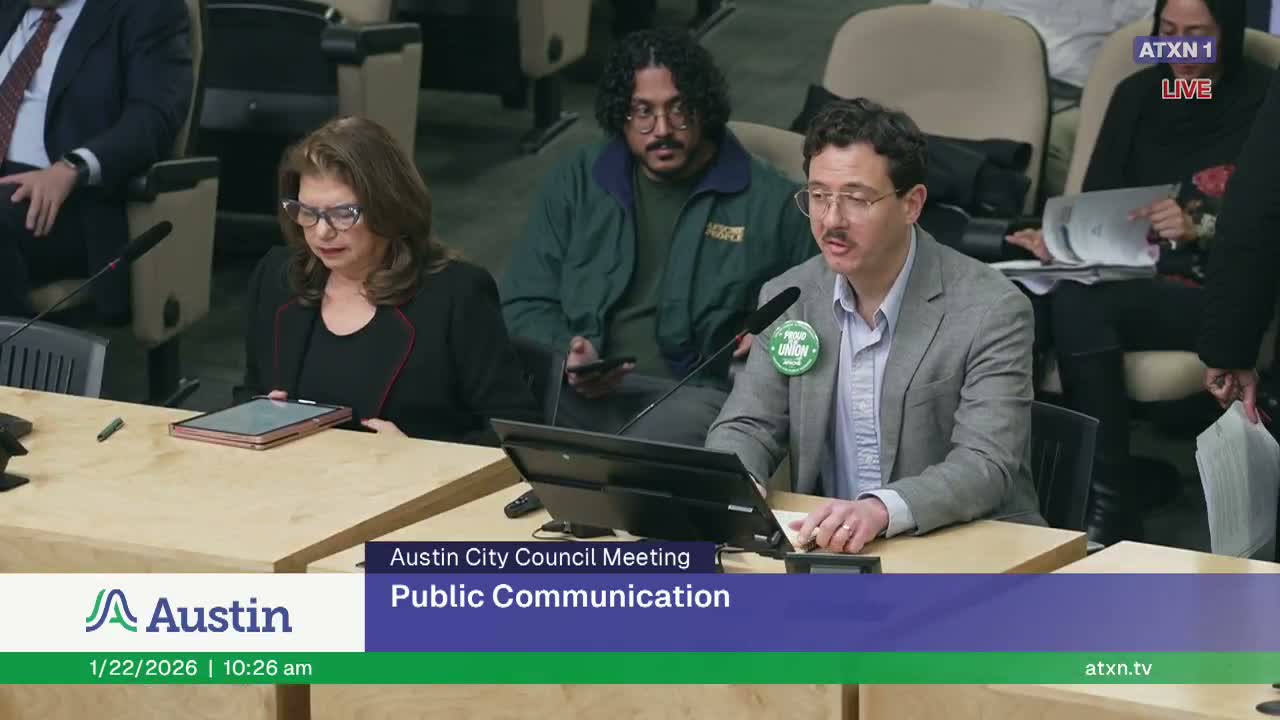
Supporters said the change, rolled into the consent agenda on Jan. 22, reflects practices used by peer cities and will improve operational transparency and outcomes. “We are so pleased that this is on consent because it shows that Austin is a labor town,” Bridal Summers, president of AFSCME Local 16‑24, told the council in public comment.
Union speakers at the noon public‑communication period and during the consent speakers’ list described consultation as a tool to increase two‑way communication between the council, city management and the employees who deliver services. David Cruz, an AFSCME board member and a city worker, said the resolution “moves us closer to those types of agreements we see with municipal workers” in other cities and that workers are often the closest source of expertise about day‑to‑day operations.
Council members thanked union speakers and cosponsored the measure. The mayor read the consent items and, after no member requested a pull, the consent agenda — including the consultation policy — was adopted without roll‑call objection.
The policy will initiate a process between city managers and AFSCME representatives to define the consultation structure, scope and reporting mechanisms. Councilmembers said they expect more detailed implementation guidance from the city manager’s office during the budget cycle and through follow‑up memos.
A representative of the city’s law department and city management participated in drafting the resolution and were thanked publicly at the dais. The resolution does not create collective‑bargaining rights (which are restricted for municipal civilian employees under Texas law); council and union speakers described the policy as a consultative, not contractual, mechanism.
The council also approved other consent items during the same meeting, including a series of routine appointments and project submittals. The consultation policy’s passage places the city formally on a path to begin regular consultation with AFSCME‑represented personnel.
The council did not set a firm implementation timeline during the consent vote; staff and union leaders said they expect follow‑up work and reports as the city manager and HR director finalize program details.