Get Full Government Meeting Transcripts, Videos, & Alerts Forever!
Get email alerts on the Land Use topic
No spam. Unsubscribe anytime.
Towne Lake YMCA PUD pitch draws support for childcare and housing, questions over height, parkland and water treatment
Summary
A YMCA‑led proposal for a mixed‑use Planned Unit Development at Towne Lake drew support for childcare, affordable family housing and environmental features but neighbors and staff raised concerns about proposed height increases, potential parkland impacts and how water quality and affordable‑housing guarantees will be enforced.
A YMCA‑led proposal to redevelop the Towne Lake YMCA site in downtown Austin as a mixed‑use Planned Unit Development drew praise for promised childcare and family‑focused affordable housing, but residents and staff pressed developers on dramatic height increases, parkland use and water‑quality treatment.
Joy Harden of Austin Planning told the City Council the development assessment for case CD2020‑53 covers a 4.8‑acre site at 1100 West Cesar Chavez and parts of North Lamar. The applicant is requesting numerous code modifications, a maximum building height up to 425 feet and a proposed FAR of 7.5:1 in exchange for “superiority” items, Harden said, including a minimum of 90 on‑site affordable rental units, expanded childcare and civic uses.
Why it matters: The project would replace a low‑value parcel with new taxable property and deliver a rebuilt YMCA with early education and expanded programs — benefits that councilmembers and the Y’s leaders said would reach many districts. Neighbors and environmental advocates, however, flagged risks tied to the requested entitlements and to elements that would encroach on parkland and sensitive riparian buffers unless carefully designed and constrained.
Project supporters, developers and partners framed the plan as delivering a mix of public benefits. “This project represents a once in a generation opportunity to transform the health and well‑being of the entire community by reimagining the Towne Lake YMCA,” said Kathy Kuris, president and CEO of the Greater Austin YMCA. Developer consultants emphasized the project’s economic impact and argued increased tax revenue could support park improvements.
Affordable housing and program details were central to the exchange. Walter Moreau, executive director of Foundation Communities, said his organization plans a seven‑story, 90‑unit family housing building adjacent to the YMCA with a focus on two‑ and three‑bedroom units. The applicant’s proposal ties affordable units to bonus square footage; during questioning the applicant said adding market units would likely increase the number of affordable units but specifics would need to be negotiated in the PUD application.
Neighbors asked for firmer enforceability of the affordability commitment. Donna Osborne, speaking on behalf of Awana, said site plan notes appear to allow the PUD’s affordability requirement to lapse if only the YMCA is built: “Any height increase request must contain affordable housing component that runs with the land regardless of the timing of the construction,” she said.
Environmental and parkland concerns drew detailed questions. Witnesses and commenters raised alarms about proposed subsurface treatment systems and impervious cover, and one resident urged the council to verify deed boundaries for Sand Beach reserve before any parkland is altered. Liz Johnston of the Watershed Protection Department said she was not aware of any proposal to discharge wastewater into green space and that Watershed would not support releasing wastewater to the park. Randy Scott and Robin Hammons of Parks and Recreation said the project overlay appears to affect about four acres of parkland for potential roadways or water‑quality elements and that any use of parkland would require a chapter 26 process and mitigation; staff estimated mitigation costs could be substantial.
Developers pushed back on the idea of private use of parkland. “We’re not using the parkland for private purposes,” said a project representative, adding that water‑quality measures are being proposed as community benefits and that the city would decide any use of public land.
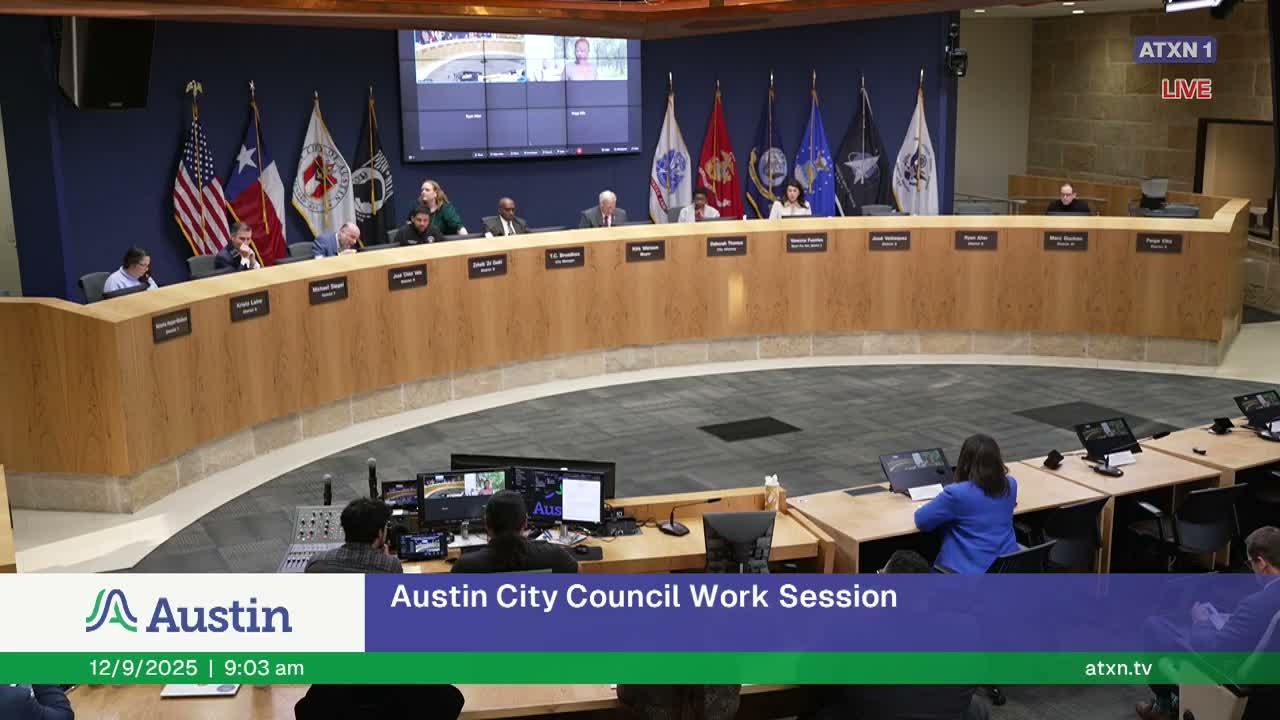
What happens next: Harden told council staff is still weighing the superiority items and the applicant may now submit a formal PUD application, which will proceed through the city’s review process (Environmental Commission, Planning Commission and back to Council). No formal action or vote took place at the work session.
The council’s questions and community input focused the next phase of review on three areas: (1) how affordable units are guaranteed and whether affordability obligations will ‘run with the land,’ (2) precise site layouts and traffic mitigation that staff said were not fully shown in the development assessment materials, and (3) environmental constraints including impervious cover, riparian buffer protections and any parkland mitigation requirements.