Get Full Government Meeting Transcripts, Videos, & Alerts Forever!
Get email alerts on the Peaker Debate topic
No spam. Unsubscribe anytime.
Residents and advocates urge Austin Energy to drop methane peakers, cite inequitable rate impacts
Summary
Several public speakers told the oversight committee that proposed gas peaker plants pose health, climate and equity harms; Austin Energy staff said no peaker recommendation will be made until the All‑Resource RFP is analyzed and defended fixed‑charge and avoided‑cost calculations.
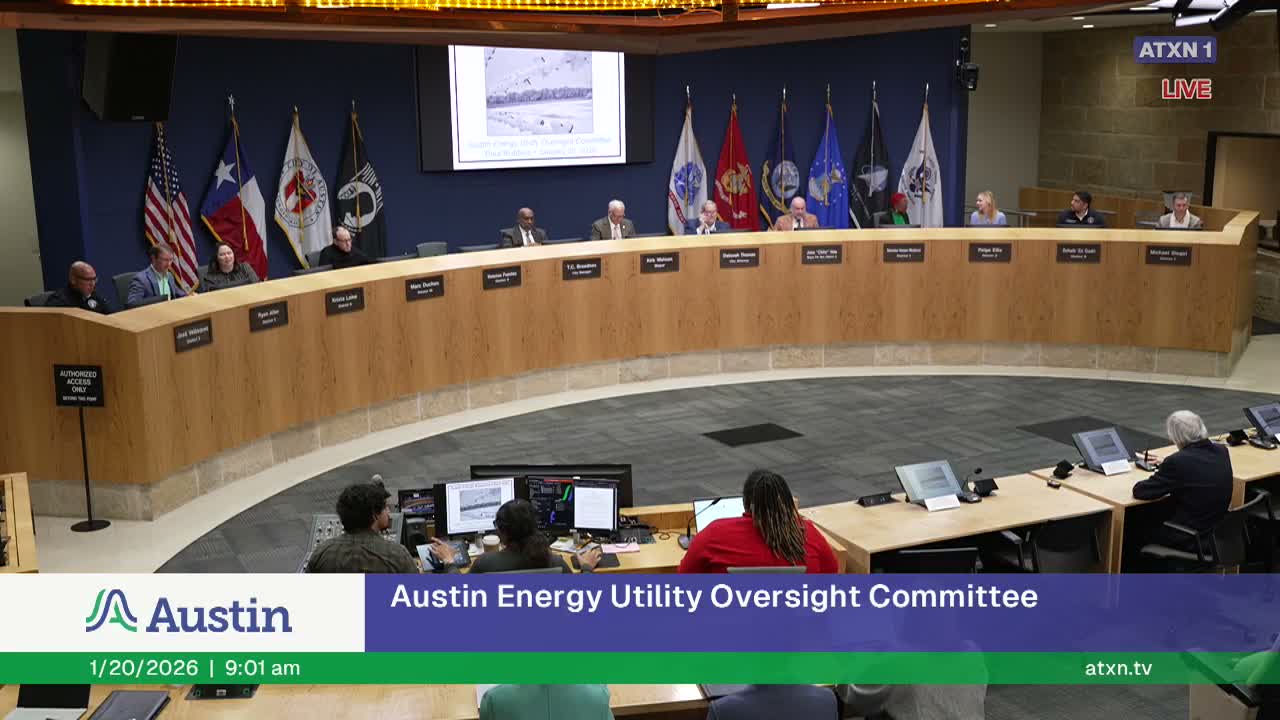
Public speakers at the Jan. 20 Austin Energy oversight committee meeting urged the utility to remove methane‑fired peaker units from its 2035 plan and raised equity concerns about recent rate increases.
Paul Robbins, describing himself as an environmental activist and consumer advocate, told the committee that Austin Energy’s rates had become “more regressive” since 2012 and said overall electric rates rose about 29% since 2022. “You have the power to do this right now,” Robbins told council members, urging them to apply rate increases proportionally across monthly charges and tiers.
Rebecca Bernhardt, a public safety appointee and Texas Physicians for Social Responsibility staffer, framed the issue as a public‑health concern. She said fine particulate matter (PM2.5) from methane‑fired plants and wildfire smoke worsens asthma and can contribute to heart attacks. “Peaker plants aren't just expensive, but they would add to Austin's already significant load of fine particulate matter,” Bernhardt said.
Craig Naser of the Sierra Club and Camille Cook (District 3) also urged the committee to pursue demand response, rooftop solar, time‑of‑use rates and storage rather than buying new gas peakers.
Al Braden, who identified himself as a District 7 voter and EUC commissioner, warned that installing new gas units would conflict with the 2035 decarbonization commitment and cited an estimate — attributed in the public comment — that each peaker could cost about $60 million. “If we buy new gas units now, we are really saying that we are not committed to eliminating the use of fossil fuels by 2035,” he said.
Austin Energy staff responded to several points during the general manager report. Stuart Riley, the utility’s general manager, said he had not reviewed the specific analysis Robbins referenced but emphasized that rate increases were not district‑specific and explained fixed‑charge and kWh components of bills. On peaker timing, both Riley and Lisa Martin said staff do not anticipate any recommendation for new peaker units until the All‑Resource RFP analysis is complete.
The committee did not vote on policy changes during the meeting; public comments were received under the public‑communication agenda item and staff answered follow‑up questions during the general manager’s update.