Get Full Government Meeting Transcripts, Videos, & Alerts Forever!
Get email alerts on the Housing Affordability topic
No spam. Unsubscribe anytime.
Manager's office and BAE present affordability gap analysis; staff proposes 50% MFI density bonus target
Summary
City Manager's Office and consultant BAE Urban Economics presented a detailed affordability gap analysis showing a near-term shortfall of roughly 46,000 rental units under 50% MFI. Staff recommended targeting a new citywide density bonus at 50% MFI and exploring fee-in-lieu and preservation strategies for expiring LIHTC properties.
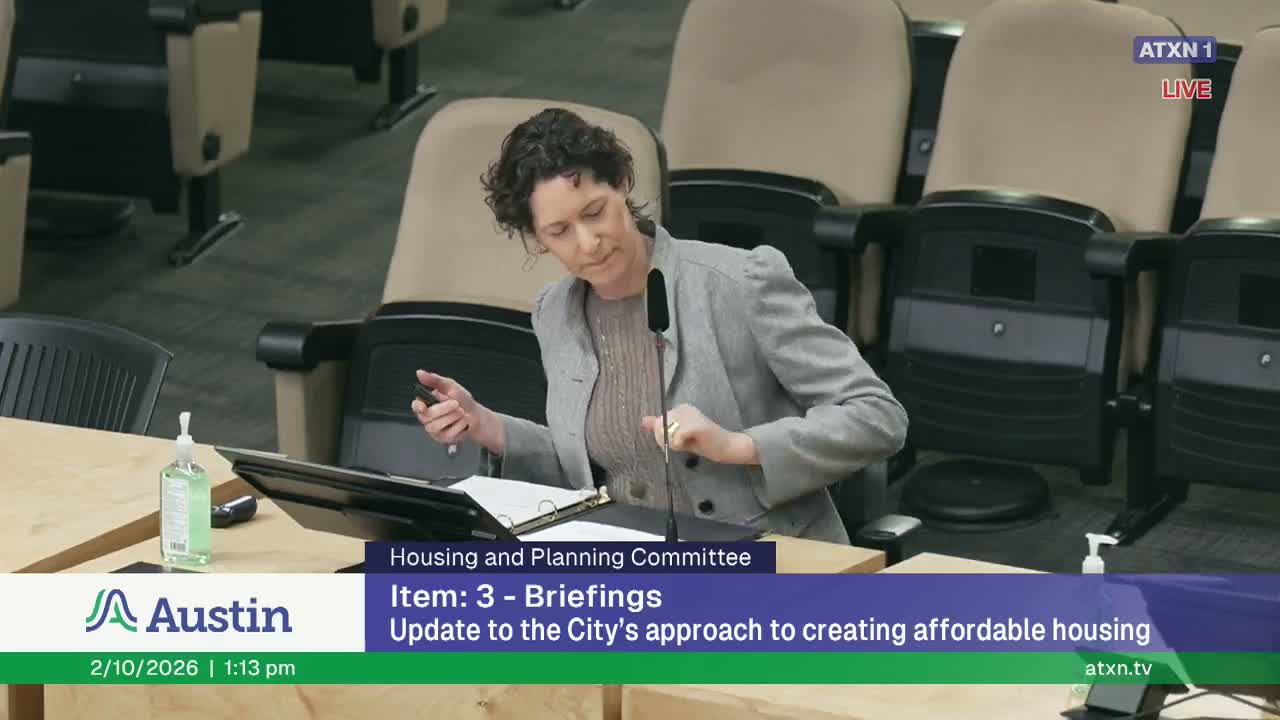
Erica Leek of the City Manager's Office and Paul Penninger of BAE Urban Economics briefed the Housing and Planning Committee on Feb. 10 about Austin's housing affordability challenges and potential policy responses.
Leek framed the briefing by describing the City Manager's housing policy team's mission to update data and identify new incentives after state changes. She said Texas Senate Bill 840 (SB 840) expanded by-right entitlements in commercial and some office-based zones and reduced the leverage of local density bonus programs because some previously bonus-granted entitlements can now be built by right.
Paul Penninger presented a detailed affordability-gap analysis. Among findings he highlighted:
- BAE projects Austin-area population and job growth through 2050 and emphasized the need to coordinate housing with infrastructure and services. - Staff and consultant analysis estimates a gap of approximately 34,000 rental units affordable to households earning less than 30% of median family income (MFI) and about 12,000 units for households earning 30% to 50% MFI, for a combined shortfall near 46,000 rental units at or under 50% MFI. - Historically, staff estimate roughly 20% of the city's affordable units were created through density bonus programs; SB 840's expansion of by-right entitlements reduces bonus leverage and therefore the potential for community benefits acquired through bonuses. - Example occupations (childcare workers, food service workers) illustrated how market rents are unaffordable for many essential workers; BAE showed that households below 60% MFI generally cannot afford average market-rate rents.
Leek and Penninger said staff will explore a suite of tools: a recommendation that the new citywide density bonus program be targeted at 50% MFI (to better reach deeper affordability), adjustments to downtown density-bonus programs, retention and preservation tools for expiring subsidized properties, regulatory and process improvements, financial incentives and new financing mechanisms.
During Q&A, committee members pressed on preservation of properties with expiring low-income housing tax credits (LIHTC). Mandy Demayo, deputy director of the Housing Department, said the housing department has been in conversation with Council offices and tentatively scheduled a preservation briefing on LIHTC expirations for the September Housing & Planning Committee. Members also asked for data on fee-in-lieu estimates, the potential to buy out affordability restrictions on existing units, and the mechanics and legal constraints of retroactive program adjustments.
Why it matters: The staff and consultant findings quantify large shortfalls of deeply affordable housing in Austin and propose a re-tooled density bonus and expanded financing/preservation strategies. Committee members emphasized urgency for deeper affordability (30% to 50% MFI) and for funding mechanisms to support permanent preservation and supportive services.
What's next: Staff said it expects to bring proposals tied to the density bonus redesign and housing incentive packages in the spring and to return with blueprint progress updates in June; the Housing Department flagged a more detailed September preservation discussion focused on LIHTC expirations.