Get Full Government Meeting Transcripts, Videos, & Alerts Forever!
Get email alerts on the 2035 Plan topic
No spam. Unsubscribe anytime.
Austin Energy reports progress toward 2035 carbon-free goal, but flags rising risks and delays on transmission work
Summary
Austin Energy told the oversight committee it is at 65% carbon-free as a percentage of load, set local solar goals of 205 MW (2027) and 405 MW (2035), and said All‑Resource RFP proposals are due late January with council recommendations earliest in May; staff warned plan risks have increased and transmission projects were delayed by lack of local generation.
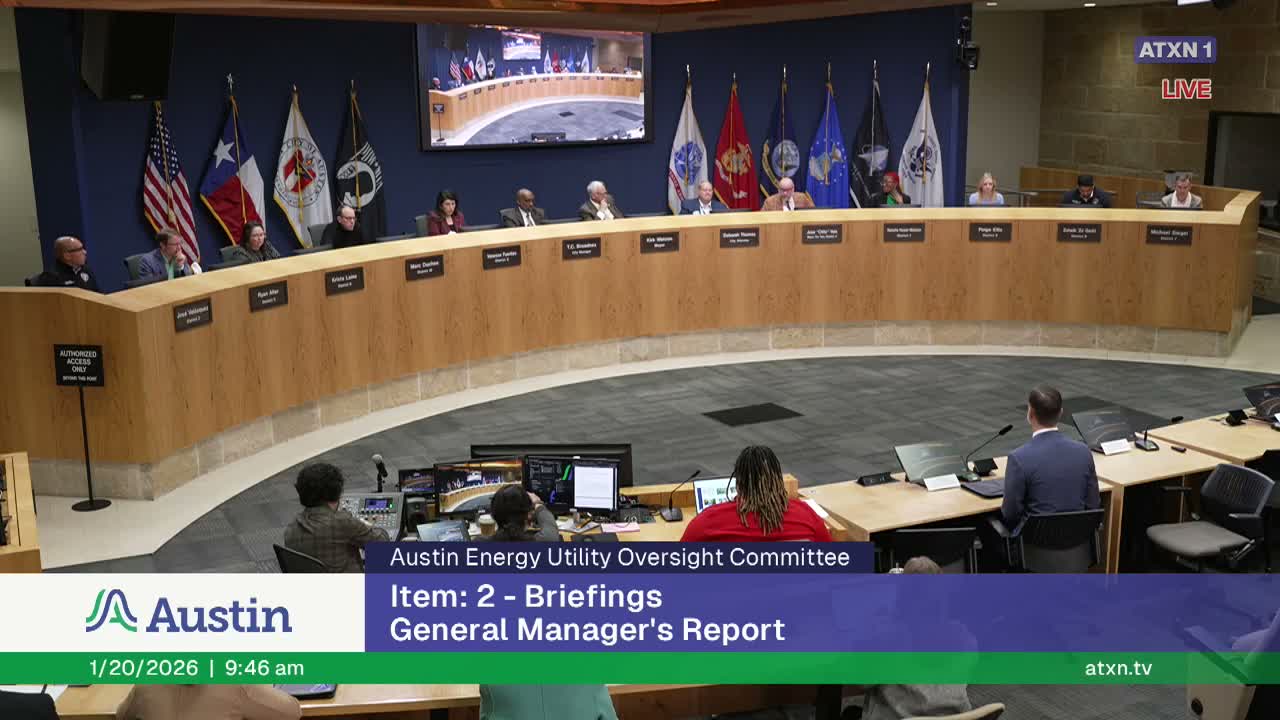
Lisa Martin, Austin Energy’s chief operating officer, told the Utility Oversight Committee on Jan. 20 that the utility is currently meeting about 65% of load with carbon‑free generation and remains committed to the plan goal of 100% carbon‑free generation by 2035.
“We are committed to transparency with regular council updates on aspects of the 2035 plan,” Martin said, and highlighted progress including record local solar installations in fiscal 2025, recent demand‑response gains and a 100‑megawatt, 4‑hour battery storage contract. She said preliminary 2025 data show a sustained drop in stack emissions and that the utility’s carbon‑intensity metric remains below the guardrail set from the 2021–2023 baseline.
Martin gave specific near‑term goals: 205 megawatts of local solar by 2027 and 405 megawatts by 2035, and reported that a geothermal pilot (9.9 MW) and other local projects are moving through feasibility and predevelopment. She noted the utility signed a large battery contract and revived a geothermal pilot that had faced regulatory and financial hurdles.
Martin also warned that plan risks have increased or remained steady. “Federal level policies have drastically changed this year,” she said, citing expiration of renewable tax credits and withdrawn federal grant opportunities. She named two other emerging risks: large new customer loads that complicate forecasting, and added legislative requirements such as enhanced wildfire plan filings.
On procurement timing, Martin said the All‑Resource Request for Proposals is on a compressed schedule: proposals are due in late January, staff expect analysis to take two to three months, and the earliest council date for any recommendations is anticipated in May. She emphasized staff do not expect to bring forward recommendations for new peaker units until they have completed the All‑Resource RFP analysis.
Committee members asked about next steps for successful pilots and implementation. Martin said a successful geothermal pilot could inform larger, economy‑of‑scale projects across Texas that supply carbon‑free, dispatchable power to Austin’s load zone. She also described outreach and evaluation steps for demand‑response growth, and said new evaluation/measurement consultants are helping refine program design.
The presentation closed with a list of 2026 implementation priorities — updated demand‑response programs, transmission submittals to ERCOT, continued battery and solar solicitations, and community engagement scheduled for February through April — and Martin said staff will return with recommendations as projects clear the feasibility and pre‑development phases.