Get Full Government Meeting Transcripts, Videos, & Alerts Forever!
Get email alerts on the Gun Violence Prevention topic
No spam. Unsubscribe anytime.
Crime scientist pitches ‘place network’ strategy, cites local pilot success at Breaker Lane
Summary
Dr. Tamara Harold told the Public Safety Committee that Place Network Investigations target crime networks of sites, convergent settings and corrupting spots; she cited national pilots (Cincinnati) and local work around 900 E. Breaker Lane where operations reduced activity and led to arrests and seizures.
Dr. Tamara Harold, a crime scientist recently affiliated with the National Institute of Justice and now at Texas State University, briefed the Public Safety Committee on Place Network Investigations (PNI) on Dec. 1 and urged a citywide, multiagency approach to disrupt persistent micro‑locations of gun violence.
Harold said crime concentrates in a small number of places and in networks of sites that include the crime site itself, nearby convergent public settings, privately controlled “comfort spaces,” and “corrupting spots” such as businesses that incentivize or enable criminal activity. “When you look at a hot spot on a map, these are just visible symptoms,” she said, arguing that focusing solely on a crime site leaves the network intact and opens the door to displacement or recapture of the site by criminals.
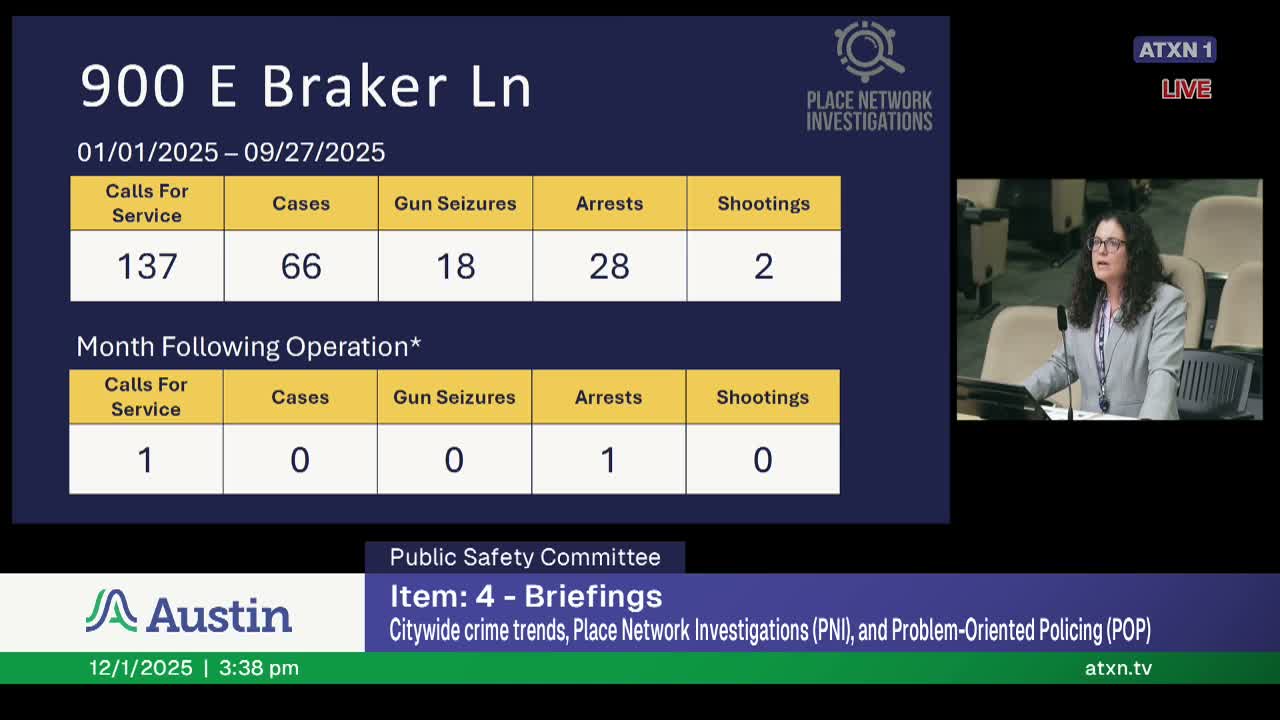
She described evidence from two pilot sites in Cincinnati that produced dramatic reductions in shootings (examples cited: a 93% reduction at one pilot and 77% at another when investigators identified and removed key network locations) and urged replication with fidelity. Harold pointed to local work around 900 East Breaker Lane as an Austin example: between January and September of the year, that micro‑location generated 137 calls for service, 66 investigative cases, 18 gun seizures, 28 arrests and two shootings; investigators subsequently reported marked declines after interventions and additional arrests as suspects tried to re‑establish presence.
Harold emphasized that PNI requires more than police action: an all‑city team should review intelligence, prioritize resources, and implement environmental, regulatory and economic interventions (traffic engineering changes, nuisance abatement, infrastructure upgrades, and community signature projects) so improvements last beyond short‑term enforcement surges.
Committee members requested a deeper, follow‑up presentation and more detail on prioritization criteria and displacement risks; Harold and staff agreed to return with expanded materials to support coordination and pilot design.