Get Full Government Meeting Transcripts, Videos, & Alerts Forever!
Get email alerts on the Municipal Budget topic
No spam. Unsubscribe anytime.
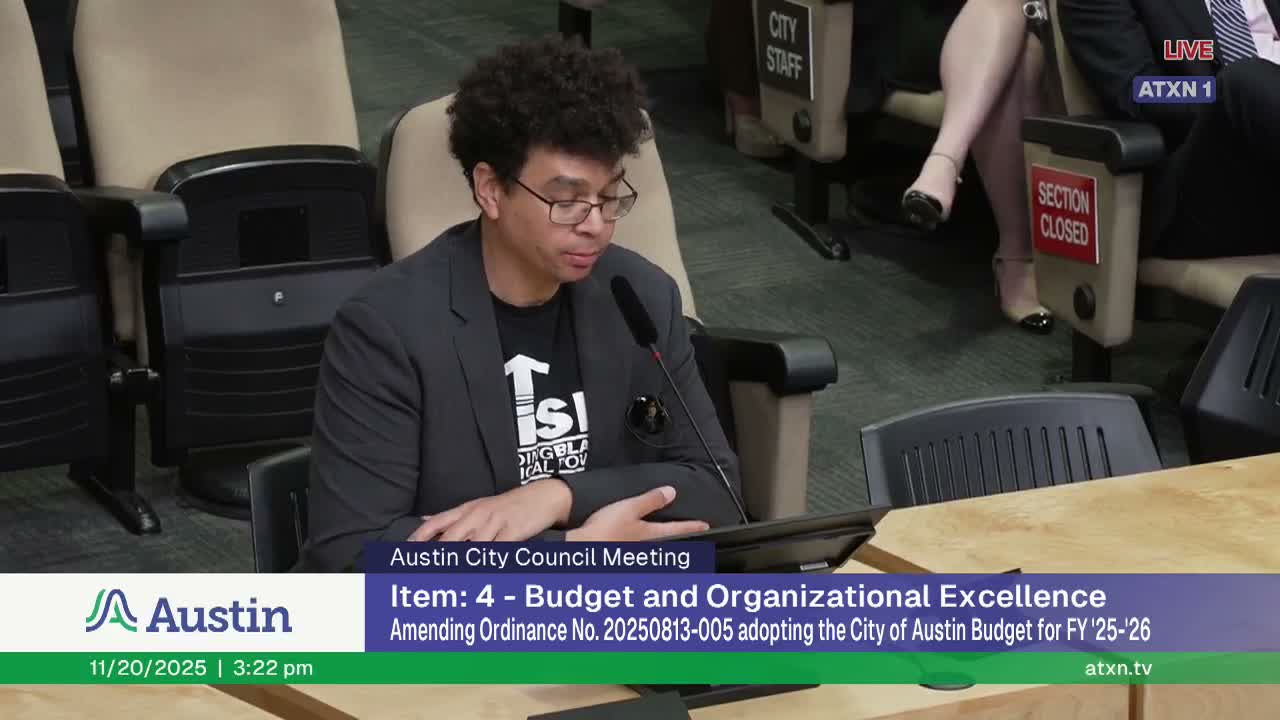
Austin City Council adopts revised FY26 budget and amends tax ordinance after Prop Q defeat
Summary
After hours of public comment and a late substitute amendment, Austin City Council voted 11–0 on Nov. 20, 2025, to adopt a reconciled FY26 budget that preserves shelter and EMS funding, expands MCOT funding, and redirects several one‑time and ongoing items; council also ratified related tax actions.
Austin City Council on Nov. 20 adopted a revised fiscal year 2026 budget and amended the city’s tax ordinance after extensive public comment and late negotiations among councilmembers.
The council voted unanimously, 11–0, to substitute a reconciled amendment (referred to by staff as Exhibit E) for the staff‑recommended changes and then adopted the amended budget. The adopted package included increased allocations for non‑congregate shelter operations, $3.0 million for EMS sworn overtime to prevent ambulance brownouts, and $2.1 million for an expanded Mobile Crisis Outreach Team (MCOT). The council also funded a set of smaller items: $150,000 for school food pantries, $100,000 for home‑delivered meals for older adults, a $1,000,000 increase to wildfire mitigation funded from the Urban Forest Replenishment Fund, and benefits and stipends for some part‑time and temporary city employees.
Budget Director Carrie Lang told the council the staff amendments were designed to preserve key investments in homelessness response and public safety while balancing the general fund. Councilmembers pressed staff on the mechanics of the changes, particularly how to avoid violating state constraints on police appropriations and how one‑time revenues and fund transfers would be used to cover new costs.
Council discussion focused on three tensions: protecting homelessness‑response infrastructure (including rapid rehousing, bridge shelters and landlord engagement), funding emergency medical services so ambulances remain staffed, and expanding 24/7 mental‑health crisis response through MCOT. Councilmembers described the final amendment as a negotiated compromise that trimmed some previously proposed cuts to homelessness programs while dedicating one‑time and reallocated funds to emergency services and other priorities.
The council also ratified the property tax increase reflected in the amended budget and adopted an ordinance adjusting the city’s tax rate to align with voter outcomes after Proposition Q did not pass. City officials stated the final tax ordinance reduces the rate relative to the rate presented in August but must be presented in the statutorily required form; all tax‑related votes were recorded 11–0.
What’s next: City staff will implement the adopted budget and report on program implementation and service impacts. Councilmembers said they will continue oversight of homelessness programs, EMS staffing and MCOT rollout and will monitor one‑time revenue uses to limit future structural gaps.
Votes and formal actions: The council substituted the staff amendment with Exhibit E and approved the amended FY26 budget (Item 4) on an 11–0 roll call. The council ratified the property tax increase reflected in the amended budget (Item 5) and approved an ordinance amending the adopted tax rate (Item 6); those votes were also 11–0.
Authority and legal notes: During debate, speakers cited state law restricting reductions to police appropriations (referenced in the record as HB 1900) and discussed the city’s ability to amend budgets and transfer one‑time funds. Council and staff repeatedly stressed that any change to APD appropriations had to respect those statutory constraints.
Context: The council’s actions responded to the defeat of Proposition Q in an election tied to a previously adopted budget, requiring the city to rebalance spending to match revenue. Council members and community advocates debated competing priorities—public safety, homelessness services, parks, and employee supports—before reaching the compromise the council adopted on Nov. 20, 2025.