Get Full Government Meeting Transcripts, Videos, & Alerts Forever!
Get email alerts on the Budget Forecast topic
No spam. Unsubscribe anytime.
Austin council seeks cuts and efficiencies as multi‑year budget deficits loom
Summary
Councilors pressed staff for clarity on volatile five‑year forecasts and pushed efficiency plans after Prop Q failed, asking staff to identify roughly $30M of savings and preserve priority services including EMS and mobile crisis coverage ahead of votes scheduled Nov. 20.
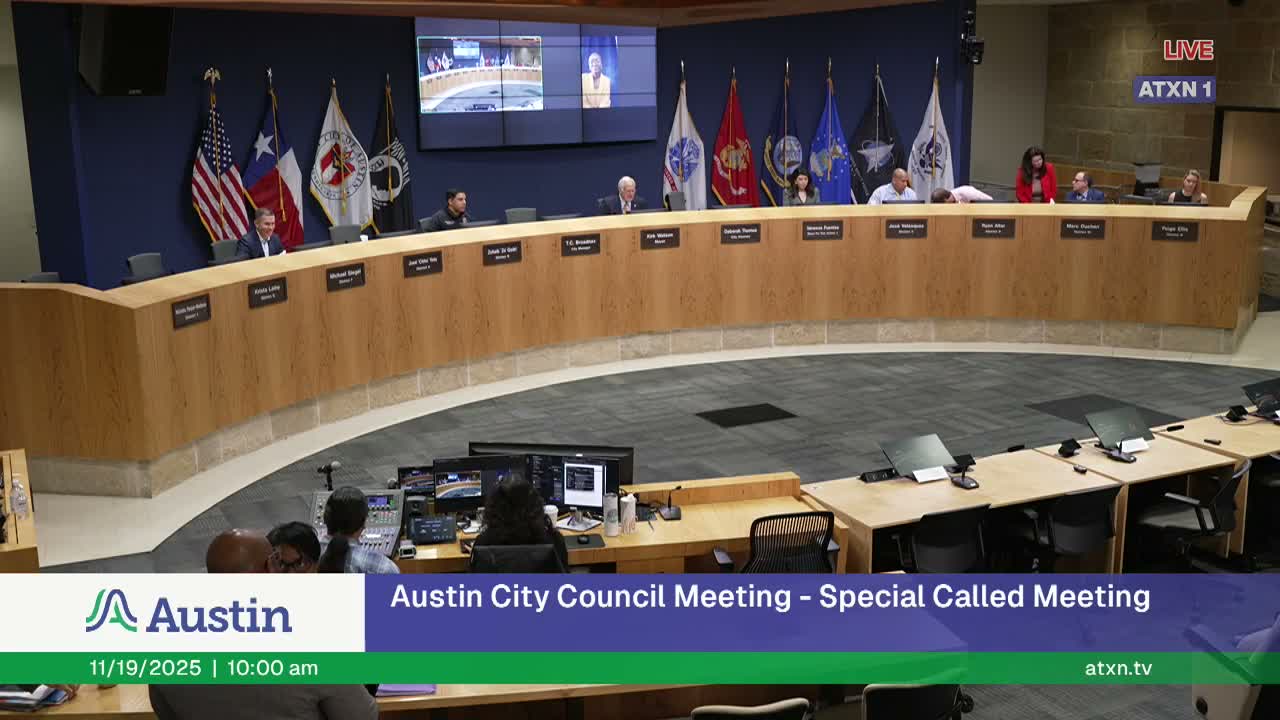
Mayor Kirk Watson called a special meeting Nov. 19 for council to work through revisions to the City Manager's proposed amended fiscal 2025–26 budget after voters rejected Proposition Q. Council members pressed staff for more clarity on a multi‑year forecast that has swung widely in recent briefings and asked the manager to accelerate efficiency work while protecting listed priorities such as EMS, mobile crisis teams and homelessness response.
“Online speaker registration closes at noon today; if you want to be guaranteed an opportunity to speak on the proposed budget amendments before we vote, I encourage you to sign up tomorrow,” Mayor Kirk Watson said as the council framed the schedule for votes and additional meetings.
Carrie Lang, director of Budget and Organizational Excellence, told council the forecast's biggest driver is sales‑tax volatility. "That fund primarily has three revenue sources: the transfer in from the general fund, fee in lieu, and interest or other revenue," Lang said in explaining the housing trust fund and the interplay between revenues and forecasted deficits. Budget staff repeatedly emphasized that small percentage shifts in sales‑tax assumptions compound over several years and drive large changes in the projected out‑year deficits.
Staff and the city manager described four tracks of optimization designed to reduce the city's structural exposure: IT consolidation and contract renegotiation, shared‑services and internal‑services fund optimization (fleet, building services, HR), a review and potential restructuring of social‑service procurement, and department‑level benchmarking and performance reviews. The manager said a solicitation for external consultants is already on the street and that staff will partner with the auditor's office on assessments.
Council members asked for clearer visualizations of forecast uncertainty. Councilmember Ryan Alter asked staff to produce a "cone of uncertainty" showing optimistic, base and pessimistic scenarios so the dais can see how a given percentage swing in sales tax would change the multi‑year deficit estimate.
Several council members signaled they will file amendments to the manager's proposal at the Nov. 20 regular meeting. Staff were asked to look for funding sources and to report back; the mayor emphasized that some revenue streams (convention‑center TRE and Project Connect TRE) are legally restricted and cannot be repurposed.
Public comment over two sessions included dozens of speakers urging the council to preserve funding for homelessness services, eviction prevention, trauma recovery and EMS. Labor representatives and EMS personnel pressed for overtime and additional ambulances; service providers warned that cuts could reduce capacity and increase downstream costs.
Next steps: council is scheduled to take up the manager's proposed amendment as the main motion on Nov. 20, with members offering amendments to that motion. Because council follows the city's reading rules for the budget ordinance, a three‑reading approval in a single day requires seven or more votes; otherwise the council will use additional posted meetings (Nov. 21–25) and the mayor said the body will not vote after 10 p.m. on any day.
Why it matters: staff told council that small changes in sales‑tax growth translate into multi‑million‑dollar swings in the forecast; councilors responded by asking for both conservative baseline assumptions and clearer depictions of uncertainty to inform binding choices about program reductions, reallocations and prioritization.