Get Full Government Meeting Transcripts, Videos, & Alerts Forever!
Get email alerts on the Library Collections topic
No spam. Unsubscribe anytime.
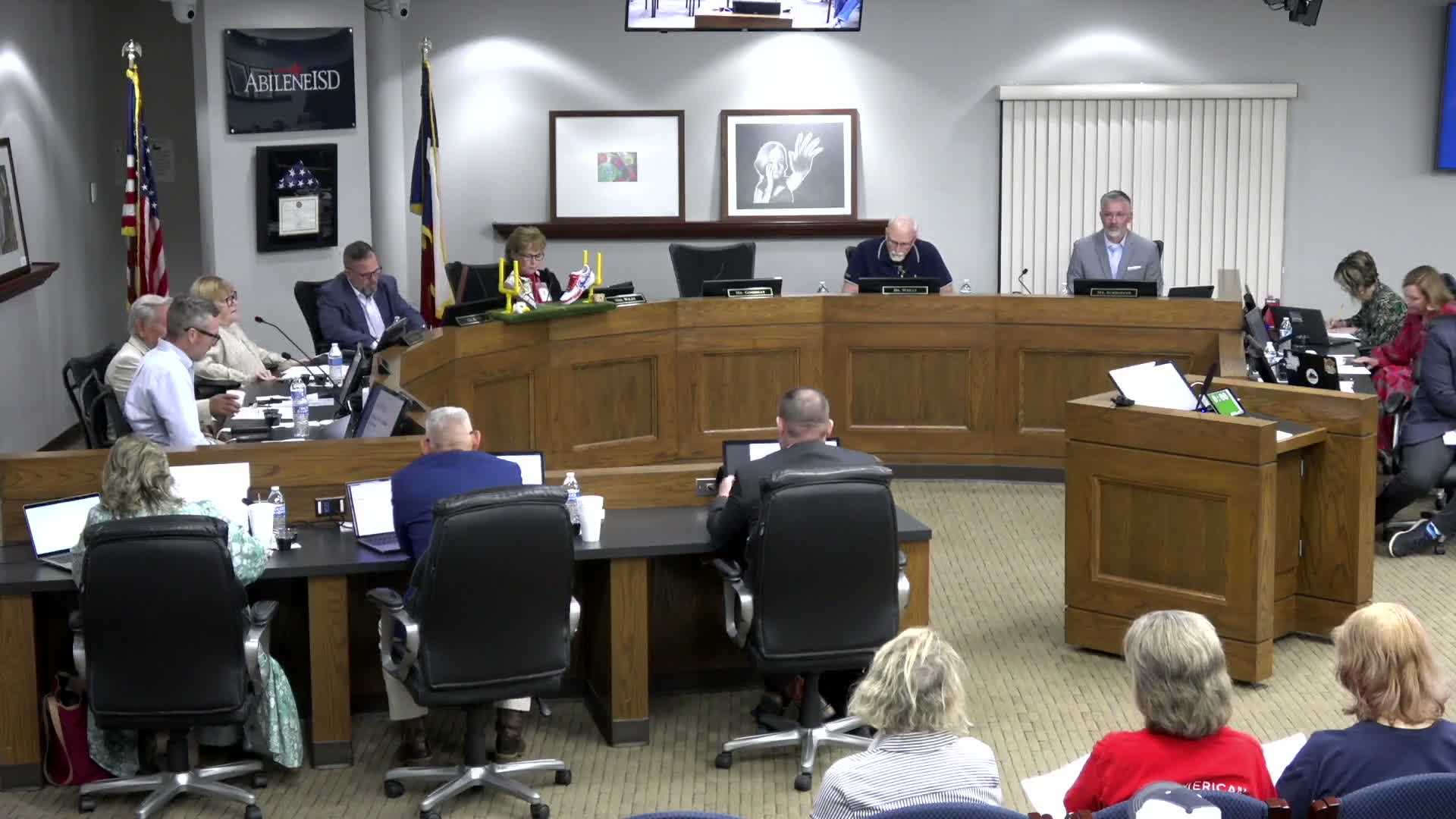
Abilene ISD board approves school library advisory council after days of public complaints over 'explicit' books
Summary
After an hour of public comments citing graphic passages from several titles, the Abilene ISD board voted unanimously to approve membership of a School Library Advisory Council (SLAC) and outlined a formal book-challenge process under new state law (SB13). District staff said challenged books are removed from circulation while SLAC reviews them.
The Abilene Independent School District board on Wednesday approved the membership of a School Library Advisory Council after a lengthy public-comment period dominated by parents and residents who read or described graphic passages they say appear in high school library books.
Dozens of community members, including Tammy Fogel and Denise Reader Baloo, urged trustees to remove titles they described as sexually explicit or depicting drug use. "These books are disgusting," one speaker said as she read aloud passages she attributed to books on local shelves. Several speakers said some titles mentioned are restricted from Texas prisons but remain in local libraries.
District officials described the procedures now in place. Lindsey Williamson, the district's executive director for secondary curriculum and instruction, said the district now uses a formal challenge form (new under SB13) and that items formally challenged are removed from circulation while the advisory committee reviews them. She told the board that some titles had already been pulled pending review. Williamson said the SLAC will be made up mostly of parents appointed by the board and will make recommendations to the board on challenged materials.
Board members repeated that an existing formal process is the district’s first line of response and urged residents to submit formal challenges rather than relying on social media. One trustee said some online lists circulating in the community included inaccuracies and that the formal challenge process provides a way to verify and resolve concerns.
Trustee action: a motion to approve the SLAC membership passed 6–0 with one trustee absent. The board and staff said the district will notify challengers in writing of outcomes and that the district is still seeking guidance on some operational details under the new state law.
What happens next: The district will transmit formal challenges to the SLAC within five days of receiving them and the advisory committee is expected to consider and recommend action within 90 days, per the district's interpretation of SB13 timelines. The board ultimately retains authority to act on SLAC recommendations.
The meeting was part of a wider discussion that also included an update on a District of Innovation process and routine district reports.
Ending: The SLAC membership was approved and the board urged residents to use the formal challenge form posted on the district website so the district can investigate and act.