
Perpich Center tells House committee its $8.6M appropriation supports statewide arts programming, warns per-student math is misleading
Get AI-powered insights, summaries, and transcripts
Subscribe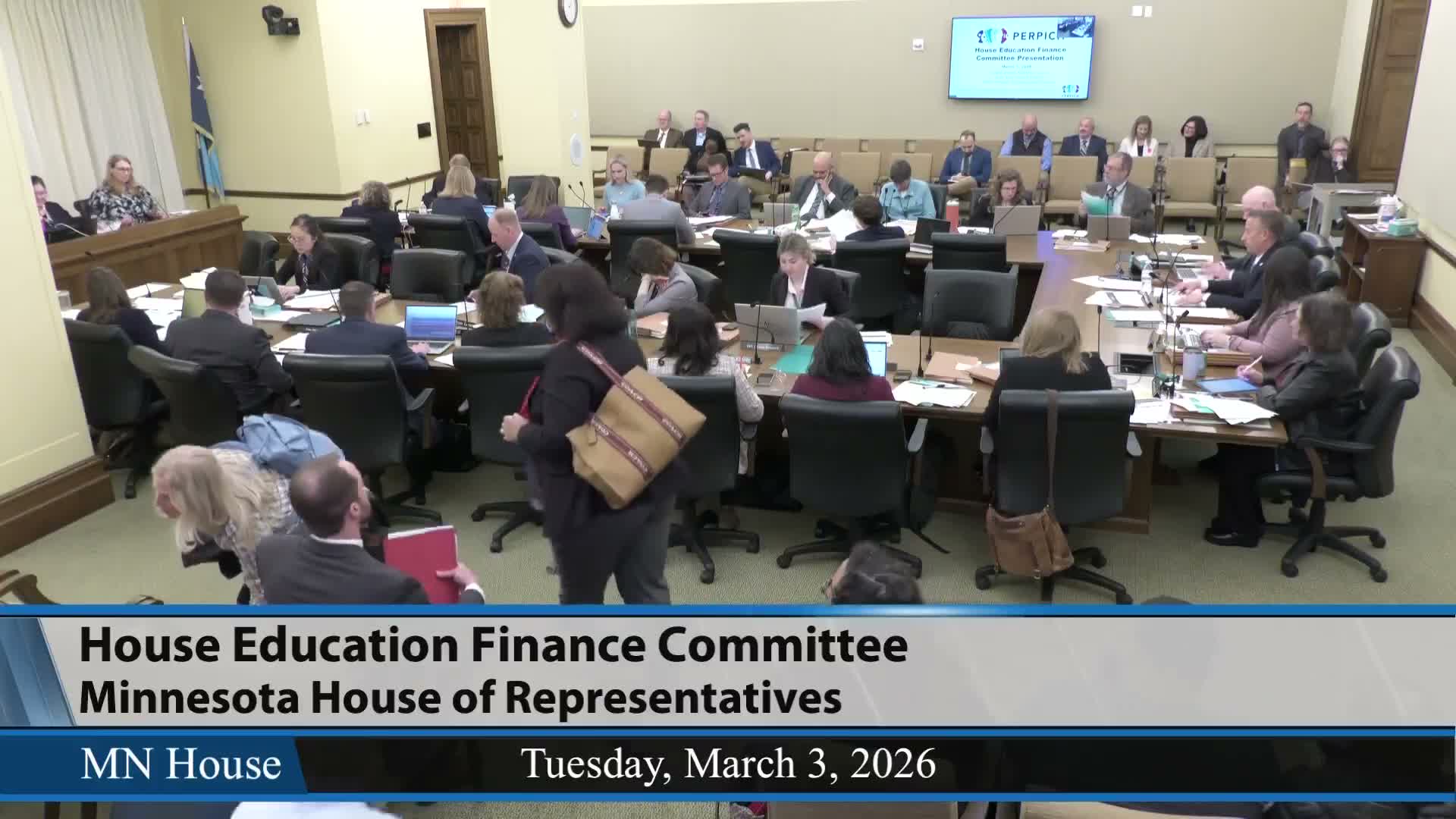
Summary
Perpich Center for Arts Education presented to the House committee, highlighting statewide professional development, library resources and arts high school outcomes. Lawmakers disputed per-pupil cost calculations; Perpich urged the committee to view its appropriation as funding statewide services, not only residential high-school seats.
The Perpich Center for Arts Education told the House Education Finance Committee on March 3 that its state appropriation funds a statewide mix of services — an arts high school, professional development and a resource library — and that dividing the appropriation by residential enrollment misstates the center’s per-student value.
Executive Director Allegra Smisak said Perpich’s FY appropriation is $8,600,000 and described three primary branches: the arts high school (residential, for 11th–12th graders), a statewide resource library and professional development and resource (PDR) programs. Smisak said PDR ran roughly 313 events last year reaching nearly 2,000 educators and cited a map showing direct service to 275 districts; the center also provided a one-pager showing activity by senate district.
Smisak highlighted Perpich’s measures of student outcomes at the arts high school (a 100% graduation rate and average ACT scores above state averages) and a white paper on absenteeism that the center says shows a significant correlation between arts offerings and improved attendance in the sample they reviewed. Finance Director John Tulp and communications director Betsy Anderson assisted the presentation and provided a breakdown of expenditures when members requested the detail.
Committee members questioned the center’s per-pupil funding. The chair calculated that, with an $8.6 million appropriation and an arts high school enrollment near 136 residential students, the appropriation equates to roughly $63,000 per student annually. Smisak and members countered that the figure is misleading because it ignores the statewide PDR and library services funded by the appropriation; Smisak asked members to consider Perpich’s statewide reach and professional development return on investment rather than only a residential-per-student calculation.
Representative Bonner, a Perpich alumnus, described the school’s interdisciplinary instruction and credited the center with providing high-quality, cross-disciplinary learning that can positively affect student engagement and academic learning. Perpich said it is seeking to grow enrollment, increase diversity (BIPOC share rose from 14% to 27% in recent years) and streamline administrative processes.
Members requested more granular budget breakdowns showing how much of the appropriation supports the arts high school versus professional development and statewide services. Perpich said those materials were provided in the committee packet and displayed a pie chart on request; the committee asked staff to ensure members have the details for further deliberation.