
Utah Court of Appeals hears challenge to attorney-fee award in Lawrence v. Labor Commission
Get AI-powered insights, summaries, and transcripts
Subscribe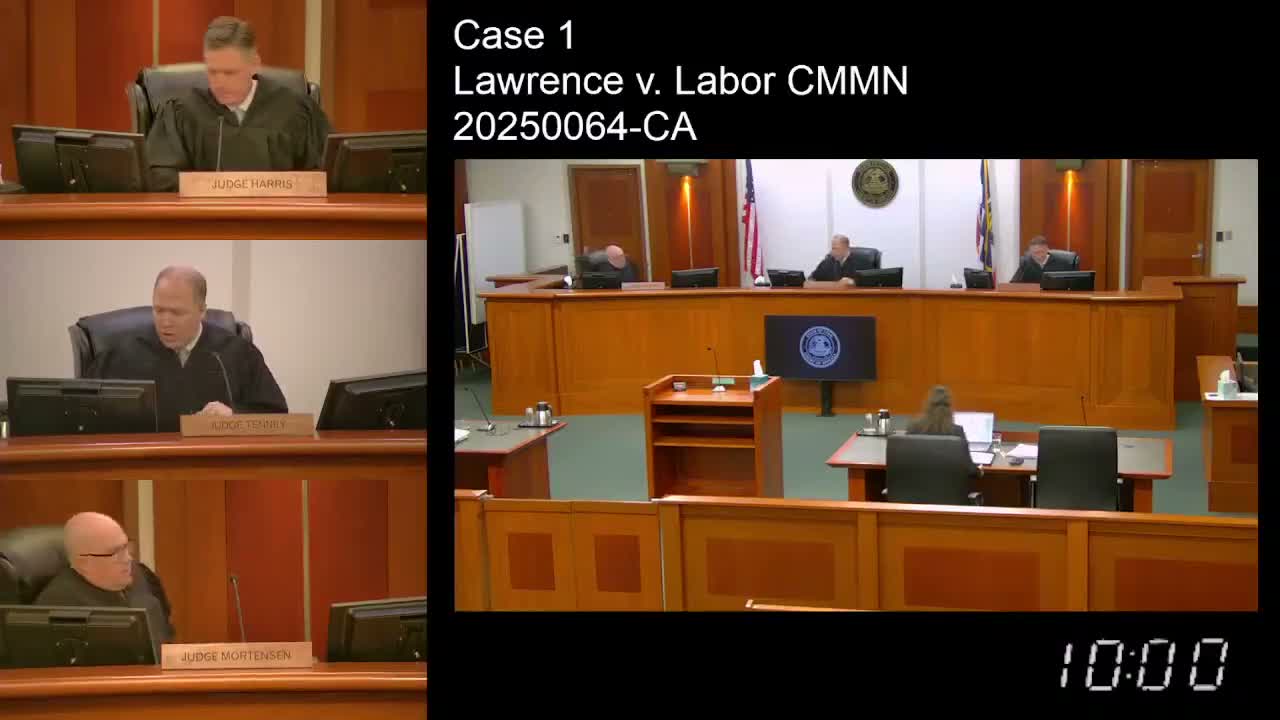
Summary
At oral argument in Lawrence v. Labor Commission, appellant counsel urged reversal of a partial attorney-fee award, arguing the ALJ admitted insufficient evidence and that a 50% award was arbitrary; respondent counsel defended the ALJ, saying affidavits supported the reduced award and the association failed to show prejudice under Christiansen precedent.
The Utah Court of Appeals on Monday heard arguments over whether an administrative law judge abused discretion in awarding partial attorney fees in Lawrence v. Labor Commission, and whether the proper remedy is remand after the Utah Supreme Court's Christiansen decisions or outright reversal.
Appellant counsel Lincoln Hopes told the three-judge panel that the ALJ repeatedly acknowledged there was "insufficient evidence" to allocate attorney hours and nevertheless awarded 50% of the requested fees. "If counsel can't allocate, it's an abusive discretion for the judge to say, well, he can't allocate, but I'll just pull out 50%," Hopes said, arguing the partial award was arbitrary and should be reversed to zero rather than remanded for another attempt to allocate hours.
Judge Ryan Taney pressed Hopes on remedies under Christiansen 2, asking whether the starting point should be remand to let the ALJ perform a full reasonableness analysis now that Christiansen clarifies the ALJ's authority. "So why isn't the outcome here for us now to remand and send it back to the ALJ to do the reasonableness analysis?" Taney asked.
Respondent counsel Allison Herr said the ALJ had effectively performed a reasonableness assessment and that the association has not demonstrated prejudice from any alleged procedural error. Herr pointed to declarations and time entries in the record — including affidavits from Nicholas Jackson, Bachman, and the Disability Law Center — swearing the work was tied to the case and describing customary rates and time required. "We do not believe that the ALJ abused its discretion in awarding partial attorney fees," Herr said, adding that the association "has not demonstrated that they were harmed by the ALJ's failure to conduct an explicit reasonableness analysis."
Much of the argument turned on whether the fee evidence below was sufficient to support an ALJ's independent allocation. Hopes highlighted an entry attributed to "Jackson" for 24.9 hours with no breakdown and said other entries were heavily redacted or failed to show how time related to the formal adjudication. He invoked Foote v. Clark to argue that fee awards must be supported by findings and evidence, and said counsel had multiple opportunities to allocate but made "no effort whatsoever." Herr responded that the record contained detailed time entries and that the ALJ reviewed the hearing record before issuing the partial award, concluding that a 50% reduction was supported by his review.
The panel also debated whether a hearing on fees was required. Herr said there is no statutory requirement under the Utah Fair Housing Act to hold a hearing on attorney fees and distinguished Cottonwood Mall — a case where counsel provided no billing statements — from the present record where affidavits and time entries exist. Hopes said he requested a hearing to permit cross-examination on redactions and allocation issues and that a hearing could have clarified the record.
Both sides acknowledged that remand is the typical path when a court applies a changed standard, but they disputed whether remand would simply give the petitioner an unwarranted fourth chance to allocate fees. Hopes urged reversal based on what he described as the ALJ's repeated findings of insufficient evidence; Herr urged affirmance or limited remand, arguing that the ALJ's findings and affidavits provided a sufficient record and that the association had not shown a reasonable likelihood of a different outcome.
The panel took the case under advisement and said it will issue a decision "as soon as practicable." The court did not indicate a timeline from the bench.
The dispute centers on allocation practices for fee awards after Christiansen, the sufficiency of affidavit and billing entries in the record, and whether appellate courts should remand to permit an ALJ to apply a clarified standard or instead reverse when a party repeatedly fails to allocate fees.