Get Full Government Meeting Transcripts, Videos, & Alerts Forever!
Get email alerts on the Electric System Resiliency topic
No spam. Unsubscribe anytime.
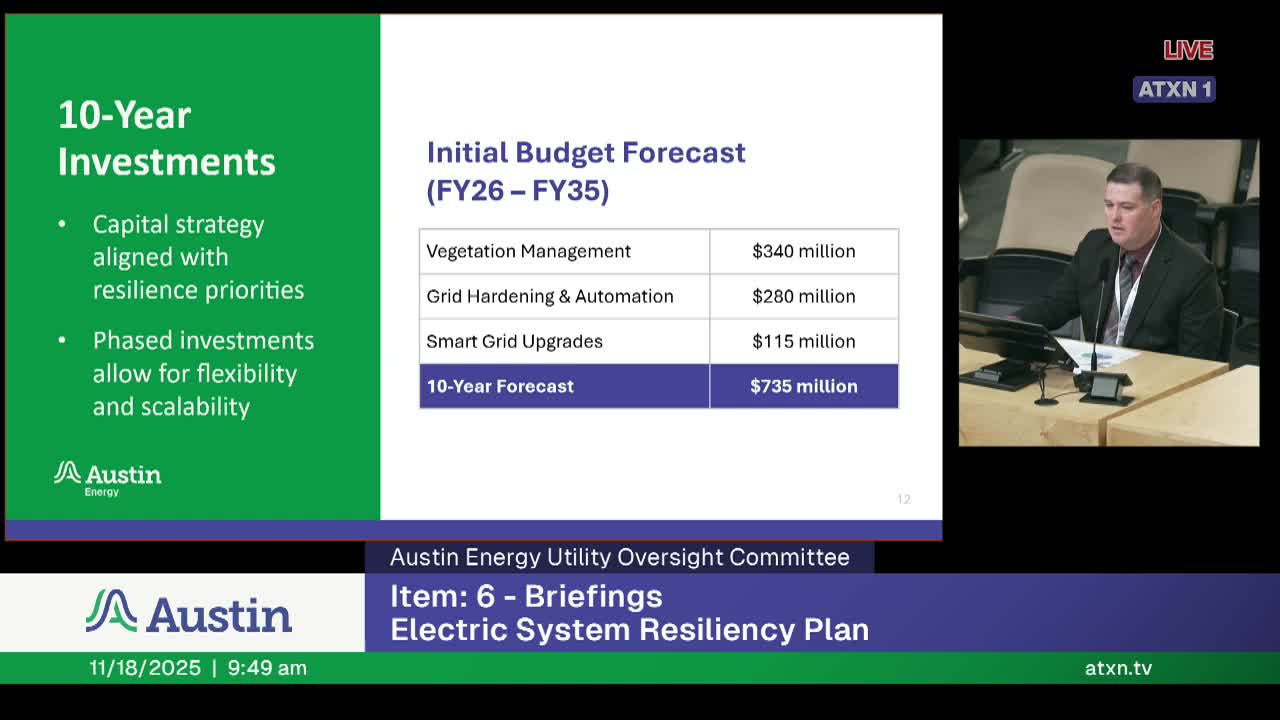
Austin Energy unveils $735M, 10‑year resiliency plan to harden 400 circuits and inspect poles
Summary
Austin Energy presented a 10‑year Electric System Resiliency Plan totaling $735 million focused on overhead hardening, vegetation management and smart grid investments, with FY26 actions including hardening 20 circuits, inspecting 8,000 poles and deploying reclosers.
David Tomchessen, vice president of electrical system engineering and technical services, presented Austin Energy’s 10‑year Electric System Resiliency Plan to the committee, emphasizing an approach that favors data‑driven, equitable investments across the service territory.
Tomchessen summarized prior undergrounding and overhead hardening studies (noting undergrounding is sometimes infeasible due to rocky soils, telecom relocations and easement costs) and said overhead hardening is often faster and less expensive. "The bottom line is $735,000,000," he said, outlining a decade of investments divided across vegetation management, grid hardening/automation and smart grid intelligence.
Tomchessen described FY26 priorities: harden 20 circuits, inspect 8,000 poles, deploy 30 mainline reclosers and 100 lateral reclosers, and expand vegetation management. He said the plan will include transparent reporting, key performance indicators and public dashboards to track progress, with a public posting targeted by mid‑December and a dashboard available no later than summer FY26.
Council members asked for clarity about whether investments reflect deferred maintenance, how geographic phasing will be published while protecting critical infrastructure, and whether transmission (not just distribution) would be integrated later. Tomchessen said the current plan focuses on distribution but that transmission resiliency efforts are underway and will be integrated in future updates.
Tomchessen also flagged risks: supply chain constraints, budget/staffing needs as the program scales, and state regulatory requirements (cited in the meeting as “Senate Bill 17 89 and House Bill 1 144”) that will affect pole inspection and maintenance obligations.
What’s next: The plan will be posted for public review (target mid‑December); staff will launch FY26 initiatives and provide periodic reporting and dashboards as implementation proceeds.