Get Full Government Meeting Transcripts, Videos, & Alerts Forever!
Get email alerts on the Municipal Budget topic
No spam. Unsubscribe anytime.
Austin council debates budget cuts, EMS brownouts and cuts to social‑service contracts after Prop Q defeat
Summary
Council heard a multi‑hour budget briefing and extensive public testimony on Nov. 18 as staff proposed across‑the‑board reductions to meet an $110M revenue shortfall; key disputes centered on EMS brownouts, police vacancies and proposed 10% reductions to many social‑service contracts.
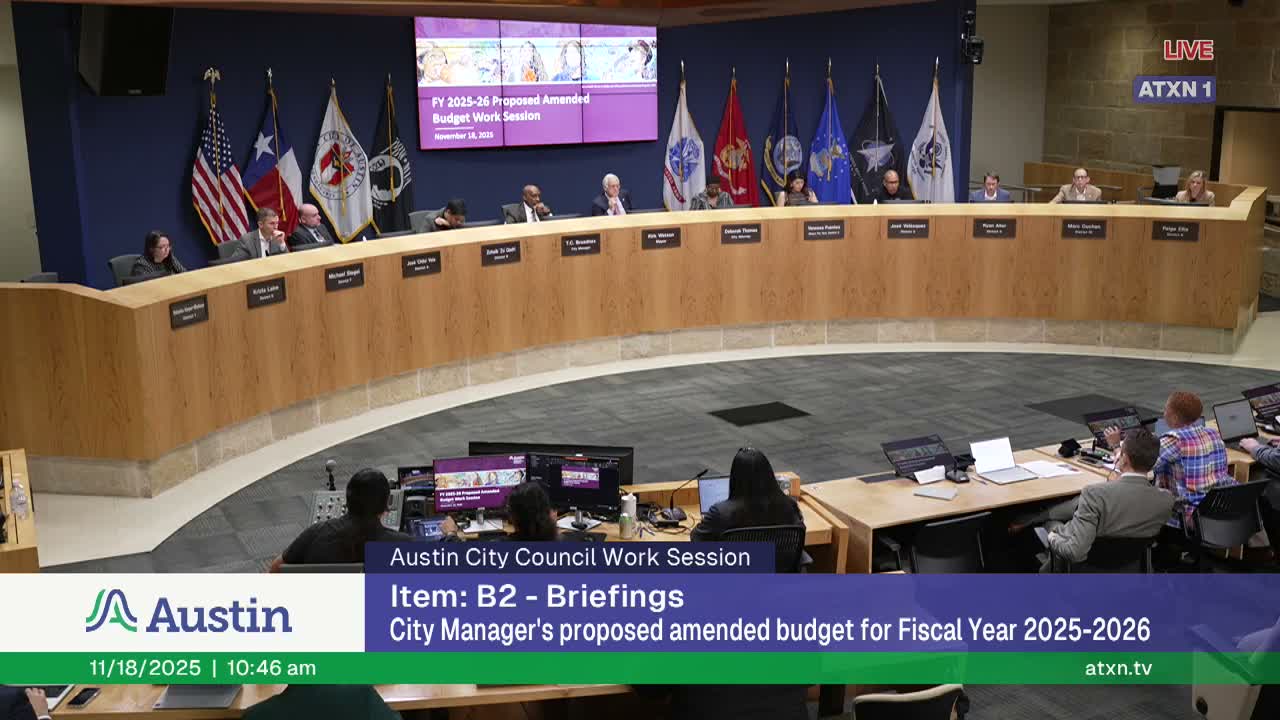
Mayor Kirk Watson reopened the Nov. 18 work session for a budget briefing and council Q&A after a morning recess. Carrie Lane, director of Budget and Organizational Excellence, told the council the failed voter approval (Prop Q) reduced general‑fund revenue roughly $110 million for FY26 and described a package of amendments that reverses an earlier $40.5 million transfer to reserves and trims department budgets to balance the year.
The presentation laid out department‑level changes, an updated forecast showing a balanced FY26 and FY27 but a projected deficit beginning in FY28, and proposed reductions to social‑service contracts (staff said many non‑HSO contracts would face a 10% cut while some HSO contracts would be trimmed about 4%). "We are here to have this conversation on how we will balance the general fund going forward with that reduced revenue," Lane said during her slide briefing.
Public testimony filled much of the afternoon. Remote and in‑person speakers urged the council to protect funding for homelessness services, the family stabilization grant and mental‑health crisis response while asking the council to look for savings in the police budget. "We need to know if these are Integral Care contracts, and if they are, these cuts must be reversed," Aloki Shaw, a frontline mental‑health provider and union representative, told the council.
Council members pressed staff on constrained options for moving restricted capital dollars into the general fund. Lane said hotel occupancy tax (HOT) funds earmarked for the convention center and certificate‑of‑obligation proceeds for Cap and Stitch are not legally available for general‑fund operations. City legal counsel also explained a police‑contract clause that can be triggered by a failed voter tax‑rate election but said context matters and that the Project Connect TRE that failed funded new initiatives rather than base wages.
EMS, vacancies and brownouts: Chief Luckritz (EMS) said the department has worked to reduce vacancy rates from 20%+ to about 15% but still faces more than 100 vacancies and a multi‑year onboarding process; he characterized "brownouts" as a scheduling response after the department reduced mandatory overtime in 2022. The chief described a roughly $4.4 million ongoing need to sustain prior staffing and training levels and highlighted alternative investments — basic life support units (BLS), collaborative care line and a 24/7 mental‑health field response (MCOT) — that can reduce ambulance demand.
Councilmembers and staff debated vacancy savings: budget staff described a citywide vacancy‑savings practice that treats anticipated vacancies as a negative line item in department budgets; for FY26 the police vacancy savings target was increased to about $33.3 million. Council members asked how vacancy savings interact with overtime, with staff explaining that higher vacancies often cause higher overtime in sworn public‑safety departments.
Social services: City staff said roughly 80 unduplicated organizations receive contracts and that the initial approach would be an across‑the‑board reduction, with follow‑up analysis to identify priority services and outcomes. The manager and staff promised to notify providers quickly and work on outcome‑driven prioritization for FY27.
Next steps: Council asked staff to return with answers to a set of technical questions and to prepare potential amendments. The council scheduled a public hearing on the proposed budget amendments for Nov. 19 at 3:00 p.m., and a regular meeting on Nov. 20 when council may vote on amended budget readings; staff emphasized that some council votes may need multiple readings and additional scheduled meetings are posted if needed.
Attributions: Quotes and specifics in this article come from the Nov. 18 Austin City Council work session transcript and are attributed to Carrie Lane (budget director), Chief Luckritz (EMS), Mayor Kirk Watson and multiple public speakers (Aloki Shaw, Mario Cantu, Jen Robicheaux). The article does not attribute statements where the transcript did not supply a speaker name.
Ending: Council members signaled top priorities (EMS surge funding and preserving homelessness response commitments) and instructed staff to identify options for rebalancing the FY26 amended budget; a public hearing and follow‑up staff memos were scheduled for the days ahead.