Get Full Government Meeting Transcripts, Videos, & Alerts Forever!
Get email alerts on the Housing Affordability topic
No spam. Unsubscribe anytime.
Bellevue planning staff backs mandatory affordable‑housing requirement; commission hears competing views and delays recommendation
Summary
At a Dec. 10 Planning Commission public hearing, staff recommended Option A of the HOMA land‑use code amendment — a mandatory affordable‑housing requirement with FAR bonuses — while developers urged delay for downtown projects and neighborhood groups pushed for redevelopment tools. The commission asked staff for follow‑ups on vesting, ground‑floor rules and nonconforming code before transmitting a recommendation to council.
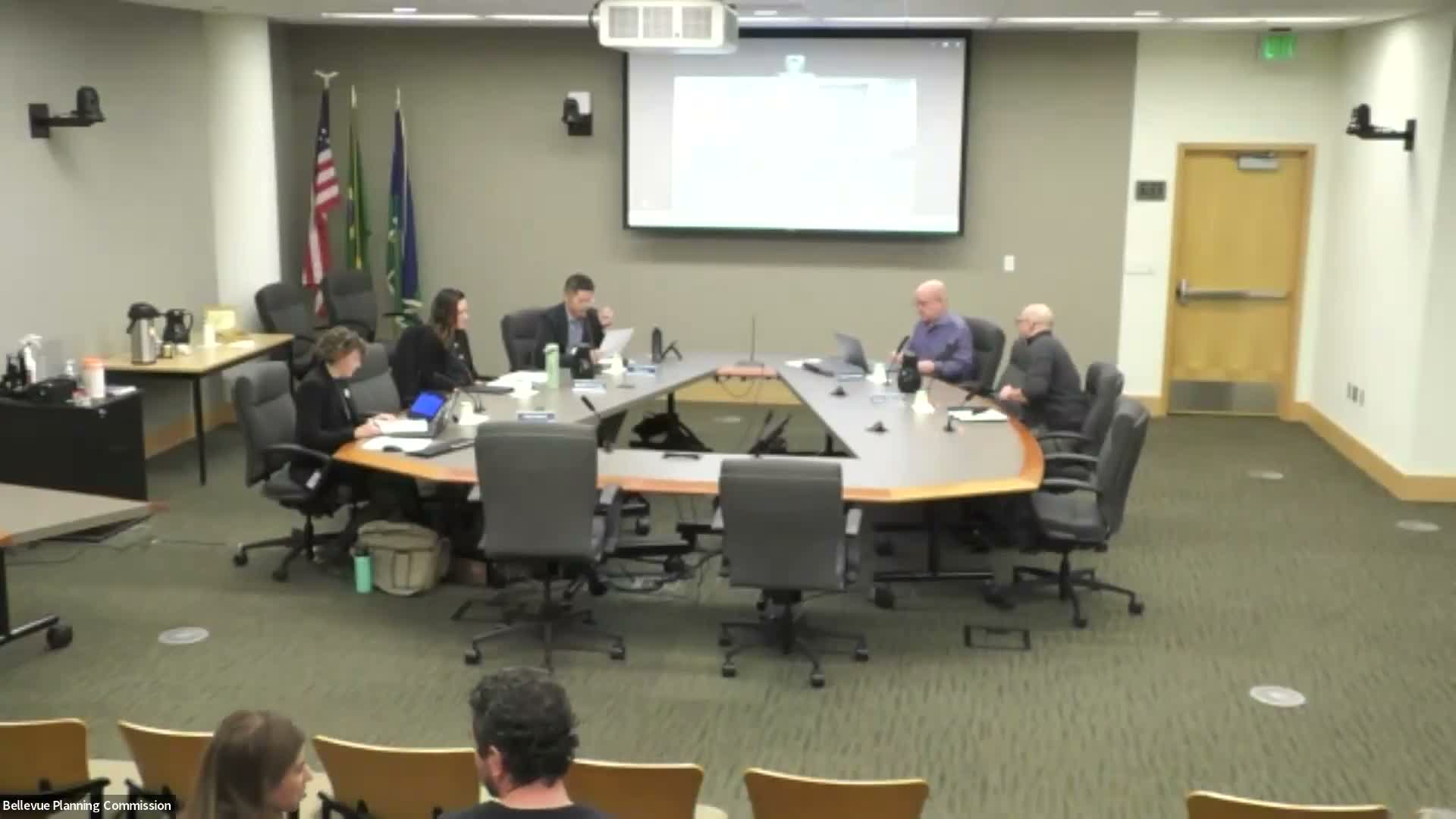
Bellevue’s Planning Commission on Dec. 10 held a citywide public hearing on the Housing Opportunities in Mixed‑Use Areas (HOMA) land‑use code amendment, during which city staff recommended a mandatory affordable‑housing approach and heard nearly three hours of testimony from developers, affordable‑housing providers and neighborhood residents. Staff asked the Commission to transmit a recommendation to City Council, but commissioners instead requested more technical follow‑up on vesting for pipeline projects, pedestrian‑oriented ground‑floor requirements and nonconforming rules and did not make a final recommendation.
Staff recommended the mandatory option, known as Option A, which would require projects with 10 or more dwelling units to set aside a percentage of units at specified area‑median‑income levels (for example, a 10% requirement at 80% AMI with alternatives of 7% at 65% AMI or 5% at 50% AMI), and would pair that requirement with a substantial FAR (floor‑area ratio) bonus. "We are recommending Option A for adoption," staff planner Matthew Menard told the Commission during the presentation of code language and incentives. Staff said the land‑transfer, fee‑in‑lieu and commercial fee options would give developers flexibility, and that the proposed FAR bonus (including a 4:1 exemption for certain exempt square footage) compensates projects for the added affordability requirement.
Why it matters: Bellevue’s housing goal in the comprehensive plan calls for large increases in capacity and staff said HOMA would move the city toward a target of roughly 5,700 new or preserved affordable units over the next decade. Backers told the Commission the mandatory approach is the most reliable way to produce units across mixed‑use neighborhoods rather than concentrating affordable housing in a few sites.
Supporters’ arguments and testimony Several affordable‑housing advocates and neighborhood coalitions urged the Commission to adopt Option A. Brady Nordstrom of the Housing Development Consortium and Eastside Affordable Housing Coalition urged commissioners to consider a long‑term view across economic cycles and said the proposed requirement is modest compared with other costs that determine feasibility. Jessica De Barros of the King County Housing Authority noted the agency owns about 3,000 units in Bellevue and urged that new land value from upzoning be used to create deeper affordability. Members of the Newport Community Coalition repeatedly said HOMA would unlock redevelopment of neighborhood shopping centers such as Newport Hills and provide needed housing, retail and open space.
Developers and downtown owners push back Several downtown owners and project teams asked the Commission to remove downtown from HOMA or to delay any recommendation so staff and owners can negotiate detailed changes. Multiple speakers said downtown was only rezoned in 2017 and that projects now in the permitting pipeline could be harmed by new mandatory requirements. "If you change the rules in the middle of the game, these projects… will be sent back to the drawing board," Legacy Commercial partner Nisha Redardi told commissioners, urging separate outreach and a tailored process for downtown. Downtown developers also argued that, outside of the perimeter overlay and projects that opt in, the proposal would function like a new cost on projects without a matching density benefit.
Key technical issues and staff responses Commissioners focused questions on several technical triggers and tools that will affect feasibility and fairness: - Triggers and thresholds: Staff confirmed affordable‑housing obligations are triggered by unit counts (for all‑residential projects: 10+ units) and by commercial size for mixed projects (the code uses a 4,000 sq. ft. commercial threshold to define a 'major commercial project'). - Fee‑in‑lieu and commercial fees: Staff said the proposed residential fee‑in‑lieu is conservative relative to neighboring cities (staff cited roughly $10 per square foot for some tiers and $13/sf for the downtown amenity incentive; the commercial fee was cited at $16.50/sf in discussion). - FAR bonuses and amenity incentives: Staff explained how FAR bonuses, the amenity incentive program and a 4:1 exemption for certain exempt square footage combine to provide what they characterized as significant carrots for providing affordable housing. - Downtown pipeline and vesting: Staff acknowledged developers’ concerns about projects already in the pipeline and recommended that the Commission consider advising Council on vesting language or an ordinance exemption — a council decision, not a code amendment — so projects designed under prior rules would retain their regulatory certainty unless they opt into HOMA. - Ground‑floor/pedestrian frontage: Staff described a 20,000 sq. ft. parcel exemption under review and recognized participants’ calls for greater flexibility where retail is not viable (such as some highway‑adjacent or low‑foot‑traffic sites). - Nonconforming provisions and impervious surface limits: Staff walked through the proposed 20% cap approach to proportional compliance and said the 60% impervious surface cap raised concerns for some developers; commissioners asked staff to compare the proposed approach to Seattle’s and bring recommended edits.
Representative quotes - "We are recommending Option A for adoption," Matthew Menard (senior planner) said during the staff presentation. - "If you change the rules in the middle of the game, these projects… will be sent back to the drawing board," Nisha Redardi (Legacy Commercial) said, urging separate downtown outreach. - Responding to the characterization that the plan creates a new downtown tax, staff said the amenity incentive is not a tax but an existing incentive framework extended to include affordable housing: "It is not a mandatory tax, nor is it a tax at all," staff clarified, describing the program as voluntary to use and mandatory only for the affordable share of amenity points once a project opts into the incentive.
Outcome and next steps The Commission closed the public hearing after hearing from dozens of speakers but did not make a formal recommendation to City Council at the Dec. 10 meeting. Commissioners said the package is close and many signaled support for Option A in principle, but requested targeted follow‑up and additional materials before forwarding a recommendation. Direction to staff included: (1) coordinate directly with downtown stakeholders and pipeline project owners to draft possible vesting/exemption language for Council consideration; (2) compare the proposed nonconforming approach and impervious‑surface thresholds with other jurisdictions (e.g., Seattle) and return with recommended edits; (3) review and refine the pedestrian/ground‑floor exceptions (including the 20,000 sq. ft. exemption) to avoid unviable retail; and (4) provide visual analysis or renderings to better illustrate transition area stepbacks and shadowing effects. The Commission scheduled further deliberations once staff returns with these targeted responses.
The Planning Commission’s recommendation, when transmitted, will go to the Bellevue City Council, which has final authority to adopt land‑use code amendments. At the meeting’s end, the Commission approved minutes and adjourned.