
West Virginia Senate swiftly concurs with House amendments and passes a package of bills
Get AI-powered insights, summaries, and transcripts
Subscribe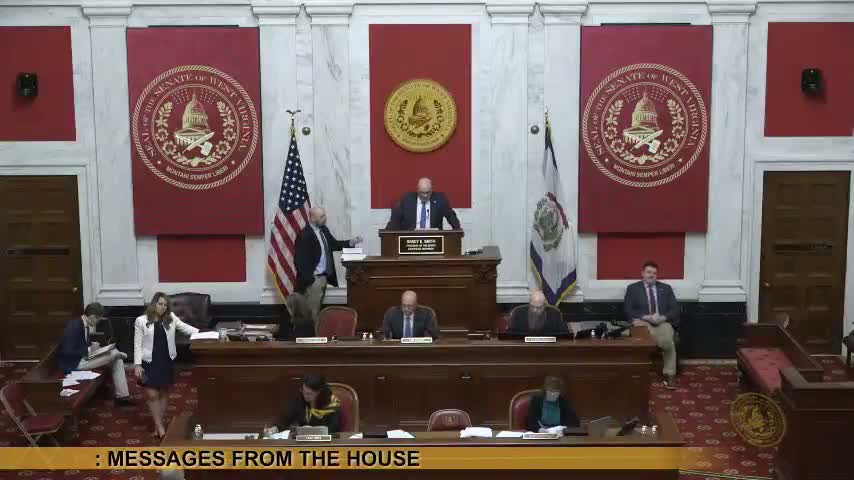
Summary
The West Virginia Senate on March 10 moved rapidly through a series of House-amended bills, concurring with amendments and passing measures on harassment definitions, voter-residency challenges, mine-inspector authority, penalties for assaults on public service workers, emergency medical services billing, jury-service eligibility, entrepreneurship office creation, tank regulation and energy policy procedural advancement.
CHARLESTON — The West Virginia Senate on March 10 concurred with a string of House amendments and passed multiple bills affecting criminal justice, elections, regulatory policy and state agencies.
The chamber received messages from the House announcing amendments to several committee substitutes, and the Senate then took up each item. Senator from Lewis moved concurrence repeatedly and outlined the principal changes before votes. “The Senate amendment reinserts a new, cleaner definition for harassment,” the Senator from Lewis said during debate on Senate Bill 4 and urged its adoption. The Senate adopted that amendment by voice and then concurred with the House amendment; the clerk later reported a recorded vote of 31 yays, 2 nays, 1 absent and the presiding officer declared Senate Bill 4 passed.
Other measures the Senate concurred with and passed included: - Senate Bill 59 (voter eligibility/residency): The House added clarifying language on the process for challenging a voter’s residency. The Senate concurred and passed the bill (recorded vote: 33 yays, 0 nays, 1 absent); lawmakers set the bill’s effective date to Jan. 1, 2027. - Senate Bill 104 (state mine inspectors): The Senate concurred with a House change to the bill’s effective date and later approved making the bill effective July 1, 2026 (33 yays, 0 nays, 1 absent). - Senate Bill 200 (assaults on public service workers): The House’s changes were described as technical; the Senate concurred and passed the bill (33–0, 1 absent). - A elections-related bill identified in the record as "senate bill 481": The House changed an effective date; the Senate concurred and made the bill effective from passage (33–0, 1 absent). - Senate Bill 531 (First Amendment Preservation Act): The House amendment added entities associated with foreign adversaries; the Senate concurred and set an effective date of July 1, 2026 (vote reported 33–0, 1 absent). - Senate Bill 641 (aboveground storage tanks): The House amendment removed transmission activities, retained storage and production activities, reduced the reclassification threshold from 50,000 gallons to 10,000 gallons, and excluded certain other fluids; the Senate concurred and passed the bill (25 yays, 8 nays, 1 absent). - Senate Bill 645 (surprise billing for ground EMS): The House reduced the reimbursement rate in the bill from 400% to the CMS rate of 200% and removed a prohibition against balance billing in certain portions; the Senate concurred and passed the bill (29 yays, 4 nays, 1 absent). - Senate Bill 800 (jury service): The House amendment allows individuals who were formerly convicted but later had records expunged or were pardoned to serve on juries; the Senate concurred and passed the bill (31 yays, 2 nays, 1 absent). - Senate Bill 878 (office of entrepreneurship): The House removed redundant language and promoted flexibility between the new office and other state agencies; the Senate concurred and later voted to make the bill effective July 1, 2026 (vote reported 34 yays, 0 nays).
On committee business, the Rules Committee reported an engrossed committee substitute for House Bill 5381 relating to development of a comprehensive energy policy and plan for the Office of Energy, with pending amendments from the Energy, Industry and Mining Committee. The Senate advanced that bill to third reading with the right to amend.
Procedural motions were routine and mostly uncontested. The chamber adjourned with the Senate President scheduling an 11 a.m. reconvening and a Rules Committee meeting at 10:45 a.m. the next day.
Votes at a glance (as reported on the floor): Senate Bill 4 — Passed (machine): 31 yays, 2 nays, 1 absent Senate Bill 59 — Passed (machine): 33 yays, 0 nays, 1 absent; effective 01/01/2027 Senate Bill 104 — Passed; effective 07/01/2026 (33 yays, 0 nays, 1 absent) Senate Bill 200 — Passed (33 yays, 0 nays, 1 absent) Senate Bill 481 — Passed; effective from passage (33 yays, 0 nays, 1 absent) Senate Bill 531 — Passed; effective 07/01/2026 (31 yays, 2 nays, 1 absent reported earlier) Senate Bill 641 — Passed (25 yays, 8 nays, 1 absent) Senate Bill 645 — Passed (29 yays, 4 nays, 1 absent) Senate Bill 800 — Passed (31 yays, 2 nays, 1 absent) Senate Bill 878 — Passed; effective 07/01/2026 (34 yays, 0 nays)
What to watch next: House Bill 5381 (energy policy) was advanced to third reading with the right to amend; the Rules Committee is scheduled to meet ahead of further consideration.
(Reporting based on the hearing transcript of the West Virginia Senate.)