Get Full Government Meeting Transcripts, Videos, & Alerts Forever!
Get email alerts on the Stormwater Management topic
No spam. Unsubscribe anytime.
City holds public hearing on draft 2025 Stormwater Management Program Plan; permit adds retrofit and mapping requirements
Summary
City utilities staff outlined changes in the reissued NPDES permit, including new mapping tasks, lower development thresholds for runoff controls, and a retrofit requirement (SMED) requiring equivalent treatment for 24.6 acres; the commission opened a public hearing, heard one resident comment, and will forward comments to the NPDES coordinator.
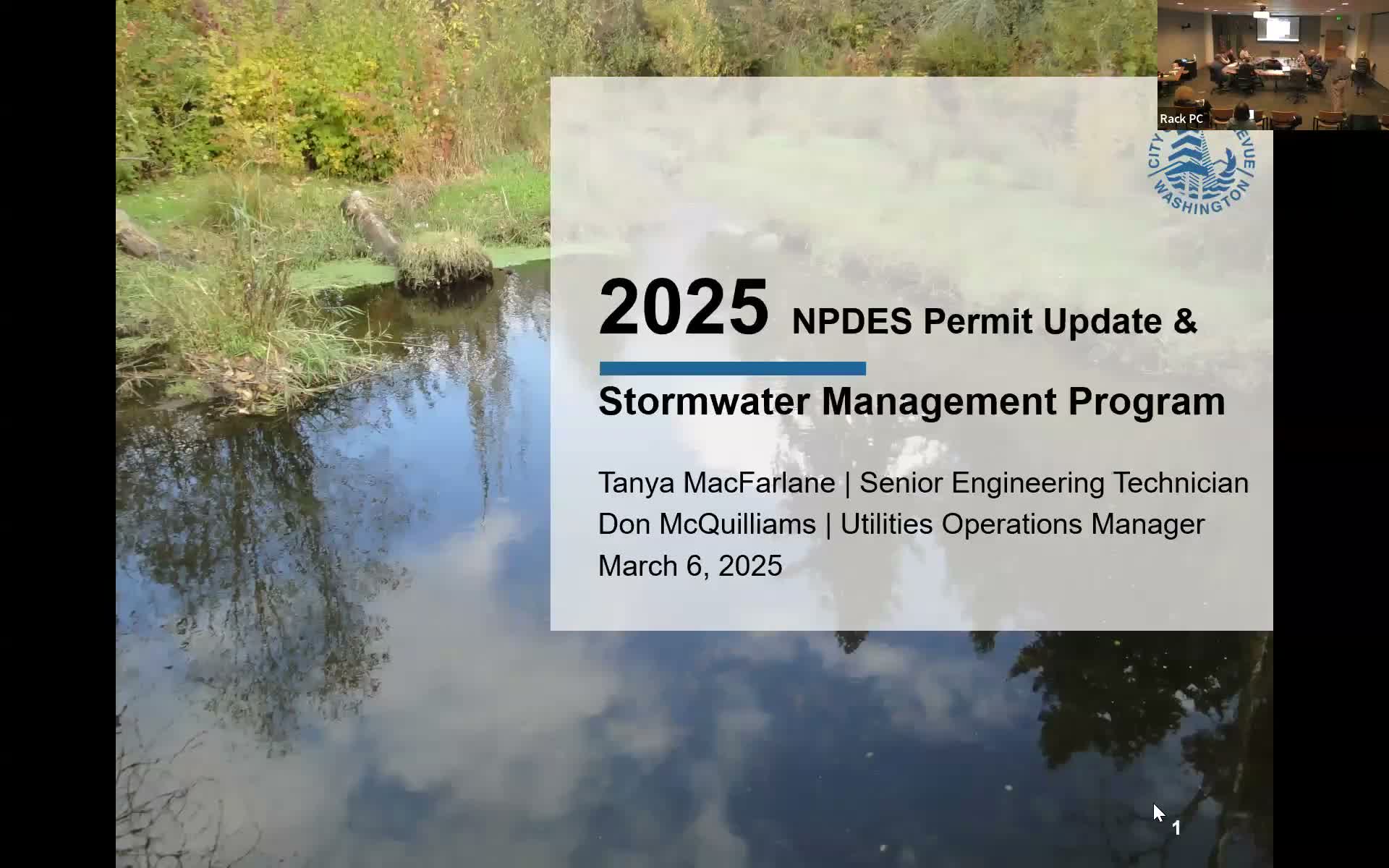
Tanya McFarland, senior engineering technician in Utilities and Water Quality, and Don McWilliams, operations manager in Utilities, briefed the Environmental Services Commission on March 6 about the draft 2025 Stormwater Management Program Plan and key changes in the recently reissued NPDES (MS4) permit.
The permit, effective Aug. 1, 2024 and valid through 2029, layers new requirements on previous permit conditions, McWilliams said. Staff highlighted three major changes that will affect city planning and capital work: new mapping requirements to identify canopy and stormwater-relevant forested areas the city controls; tighter runoff-control thresholds that may lower the development review threshold from roughly 5,000 square feet to as low as 2,000; and a new stormwater-management-for-existing-development (SMED) or retrofit clause that requires equivalent treatment for 24.6 acres of existing conditions.
“What we can do is either retrofit our existing system with ponds or vaults, or take non-structural steps like enhanced street sweeping and internal pipe cleaning,” McWilliams said, noting the city may only claim up to 25% credit for non-structural measures under the SMED requirement, leaving the majority to structural retrofits.
Why it matters: the SMED requirement creates a significant potential capital and operations need. Staff said they are still evaluating the cost and implementation approach and will coordinate with planning and CIP teams. McWilliams cautioned the requirement could be expensive and that an estimate might be available next year.
Other permit and plan highlights
- Mapping and documentation: Ecology now asks jurisdictions to map stormwater infrastructure, tree canopy and overburden communities and to identify tributary basins lacking treatment, which will require a GIS-based mapping project.
- Replaced hard-surface definition: Ecology’s language extends requirements to replaced surfaces down to the subgrade (complete reconstruction) while grind-and-overlay paving would not necessarily trigger replacement requirements.
- Inspections and operations: The permit requires continued illicit-discharge screening and specified inspection targets (Ecology’s screening/inspection percentages apply); for SMED, Ecology requires inspections of 20% of identified businesses (about 1,500 sites in Bellevue implies ~300 inspections annually).
Public hearing and comment
The commission opened a public hearing on the draft plan. Staff reported no written comments had been received in advance. One resident from the Eastgate community described long-running construction near their home and urged more neighborhood surveillance and outreach to ensure proper stormwater practices at local sites. The commission closed the public hearing and will forward both public and commission comments to the NPDES coordinator for consideration.
Regional coordination and next steps
Commissioners asked how coordination occurs with neighboring jurisdictions. McWilliams said the Western Washington permit covers many cities and that Bellevue participates in local and regional coordinator groups (an 'NVDS East Siders' group and a larger Puget Sound coordinators group) to align approaches. Staff also noted a new Western Washington stormwater maintenance manual must be adopted or matched by June 2027.
What’s next: the draft stormwater plan is on the city website for comment; staff plan to finalize the annual plan in March and submit it with the city’s annual compliance report to Ecology. The commission will forward its comments and the public-record comments to the city’s NPDES coordinator for incorporation into the plan and report.