Get Full Government Meeting Transcripts, Videos, & Alerts Forever!
Get email alerts on the Sewer Rate Design topic
No spam. Unsubscribe anytime.
Bellevue environmental panel unanimously backs three sewer rate design changes and sends recommendation to council
Summary
The Environmental Services Commission voted unanimously to recommend three sewer rate-design proposals — a single-family volumetric simplification, restructuring of the multi-family fixed charge (phased in five years), and aligning nonresidential minimum charges with King County treatment costs — for city council consideration as part of the 2027–28 rate ordinance.
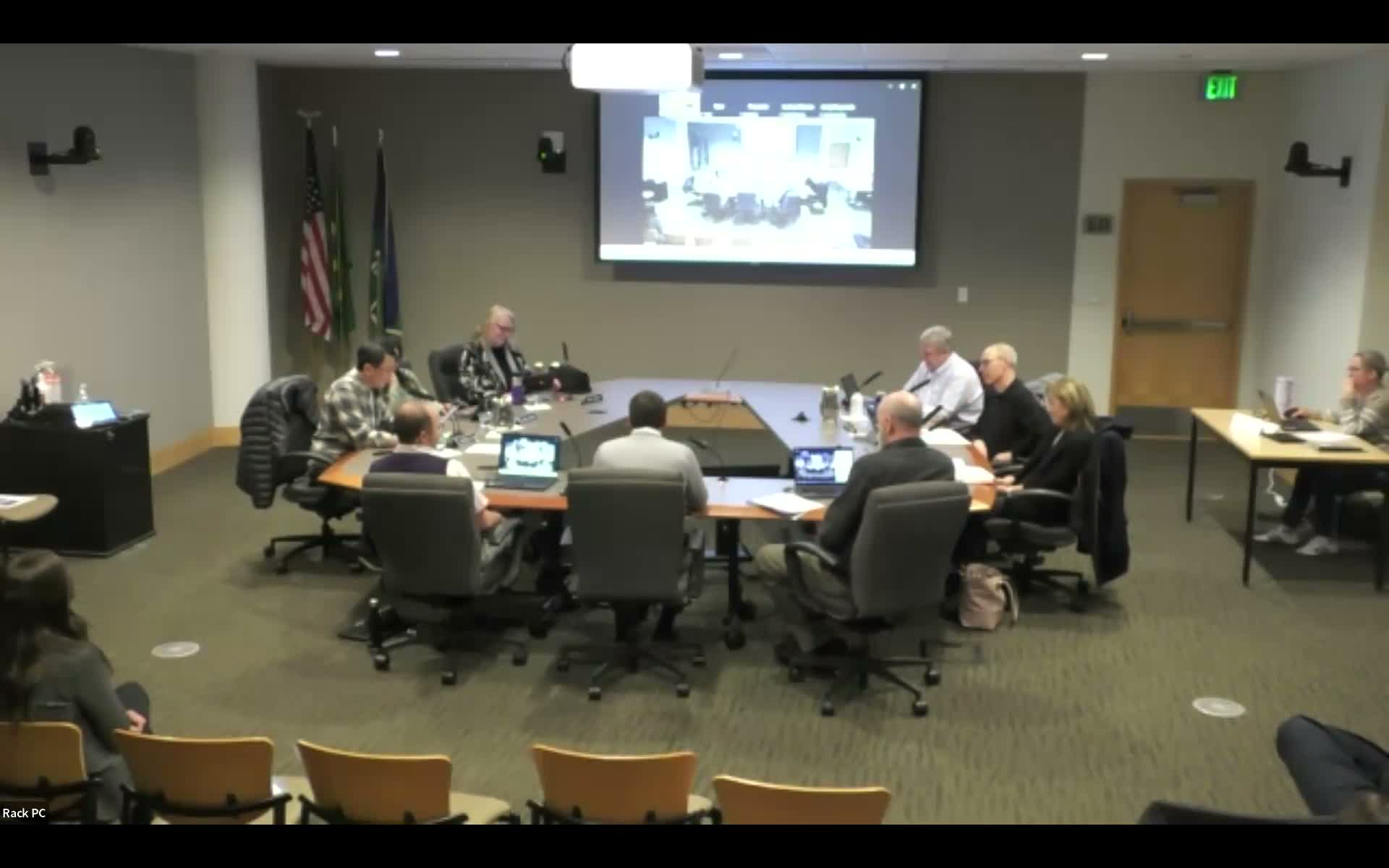
The Environmental Services Commission voted unanimously Jan. 8 to recommend three proposed changes to Bellevue’s sewer rate design that staff said aim to improve equity across customer classes while limiting abrupt bill shocks.
Staff asked the commission to forward a package that would: replace the single-family two-tier volumetric approach with a single uniform volumetric charge of $8.54 per 100 cubic feet (CCF); remove an 11-CCF allowance embedded in the multi-residential fixed charge and index that fixed charge to the class’s share of wholesale King County treatment costs with a five-year phase-in; and tie the minimum charge for nonresidential customers to the single-family wholesale-equivalent treatment cost.
"The cost-recovery study shows our multi-residential class collects about 123% of its cost, and that's effectively subsidizing other classes," said Matt Hobson, the utilities fiscal manager. "Removing the 11-CCF allowance and phasing the change in over five years addresses the root cause while mitigating sudden bill impacts." He cautioned staff estimates showed an immediate, single-year implementation of the multifamily change could produce bill increases of up to 40% for some accounts — a primary reason staff proposed the five-year phase-in.
Why it matters: Bellevue is required by state policy and the city’s financial rules to align revenue with cost-of-service findings. Staff said the three proposals do not change the overall revenue the sewer utility must collect from each class to meet system needs but can shift how costs are allocated, producing sizable individual bill winners and losers if not phased or communicated carefully.
Staff also described targeted bill impacts based on their review of every customer bill. For single-family accounts, the uniform volumetric charge would largely simplify billing with minimal adverse effects because the old upper tier applied to only a tiny fraction of accounts. For multi-residential units, most accounts in the 5–7 CCF range would see smaller increases than a simple across-the-board revenue-driven rate rise, while a small number of higher‑use units would see modest increases. For nonresidential customers, staff estimated the proposed minimum-charge alignment would lower bills on average by about $35 in 2027 for roughly one-third of small commercial accounts while shifting larger commercial bills toward a closer alignment with cost.
Commissioners asked how the changes would be communicated to ratepayers. Hobson said staff will brief the city council this spring, and any ordinance adoption would occur through the 2027–28 budget and rate-ordinance process. "Following adoption, the department does bill inserts, brochures, outreach events and prepares call-center talking points," Scott Edwards, a city staff member, said.
The commission’s motion to recommend the staff package to council was moved and seconded and carried in a roll-call vote. Chair Juan called on council staff to brief the council later this spring and noted the changes would be folded into the 2027–28 rate ordinance if council approves them.
What’s next: Staff will present the proposals to city council as part of the budget and rate ordinance process, conduct public communication and outreach through bill inserts and community events, and continue to model bill impacts as the proposals move toward any final ordinance.