Get Full Government Meeting Transcripts, Videos, & Alerts Forever!
Get email alerts on the Land Use Code Amendment topic
No spam. Unsubscribe anytime.
Bellevue planning commission directs staff to schedule public hearing on state-driven office-to-residential code changes
Summary
The commission voted Sept. 25 to schedule a public hearing on a Land Use Code Amendment implementing House Bill 1042, directing staff to prepare language that allows conversions of commercial buildings to housing while providing qualified exemptions for critical areas and recycling standards and removing a residential density cap.
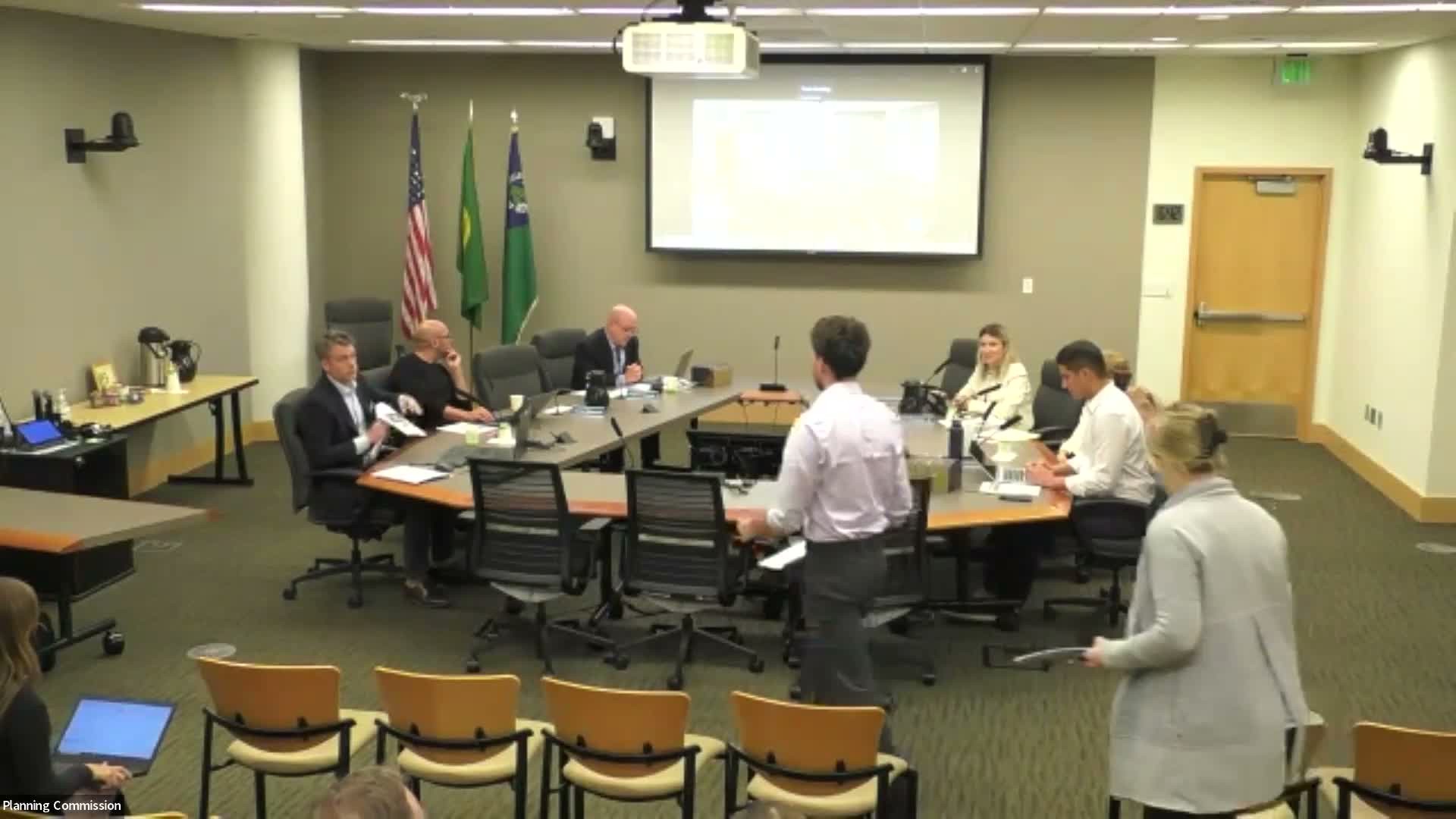
Bellevue Planning Commission Chair Creighton Gapel on Sept. 25 directed staff to prepare a Land Use Code Amendment (LUCA) implementing state House Bill 1042 to encourage conversion of existing commercial and mixed-use buildings into residential units and scheduled a planning-commission public hearing to consider the draft.
The vote follows a staff presentation by Senior Planner Matthew Menard on the requirements of HB 1042 (2023) and a strike draft that would allow a 50% increase in residential density or FAR for qualifying buildings, exempt converted residential units from new parking requirements and design standards in most locations, and remove barriers tied to nonconforming site conditions. Menard told commissioners the region-wide feasibility work (PSRC/AECOM) estimates a funding gap of about "$50 to $125 a square foot" for conversions, meaning conversions will generally need additional incentives or subsidies to be financially viable.
Menard said the strike draft goes somewhat beyond the state baseline in limited ways to increase feasibility: staff propose allowing modest envelope adjustments (roughly 5% expansion for HVAC/ADA/insulation) and a single additional penthouse/mechanical/residential story where structurally possible. The draft would exempt conversions from dimensional standards (setbacks, heights) except along identified downtown ‘‘major pedestrian corridors’’ — such as Bellevue Way and Main Street — where ground-floor active-use requirements would still apply.
Public comment included a statement from Jessie Classen, representing Bellfield Office Park, who urged the commission to make the code usable for conversions near Mercer Slough and asked staff to remove the critical-areas exception so existing buildings in buffers could qualify. Classen also recommended exempting converted residential FAR from underlying residential density limits to simplify conversions.
Commissioners focused on three directional choices staff asked for: (1) whether to allow a qualified exemption for critical areas (rather than a blanket exemption), (2) whether to provide flexibility on required recycling/solid-waste room sizes if projects can demonstrate an operational plan, and (3) whether to remove the proposed residential density multiplier cap. Commissioner Villavazis and Commissioner Farris both supported a qualified exemption for critical areas (with mitigation and staff review), recycling flexibility conditioned on an acceptable plan, and removing the multiplier. Commissioner Carlo urged retaining recycling/solid-waste space requirements unless staff can show operational needs would still be met.
On each point the commission gave direction to staff: craft language allowing a staff-reviewed, qualified approach to critical-area impacts (including mitigation as appropriate); permit recycling/solid-waste flexibility when applicants provide an acceptable operational plan with service arrangements; and remove the residential density multiplier (effectively not imposing the proposed upper cap). Chair Gapel summarized those three directed items before the commission voted to schedule the LUCA public hearing; commissioners voted in favor.
Staff also reminded the commission of a statutory deadline: if Bellevue does not adopt a compliant LUCA by June 30, 2025, state rules governing conversions would supersede local code. Menard noted other potential state incentives (including a separate sales-tax vacation bill) and federal tools (LIHTC) that may affect whether conversions are financially feasible.
Next steps: staff will prepare the proposed LUCA and supporting materials for a planning-commission public hearing (date to be set); the commission's direction noted above will be reflected in the draft. After the planning-commission hearing, the item will proceed to City Council for final action. The commission also approved the Sept. 11 minutes and adjourned the meeting.