Get Full Government Meeting Transcripts, Videos, & Alerts Forever!
Get email alerts on the Sustainable District topic
No spam. Unsubscribe anytime.
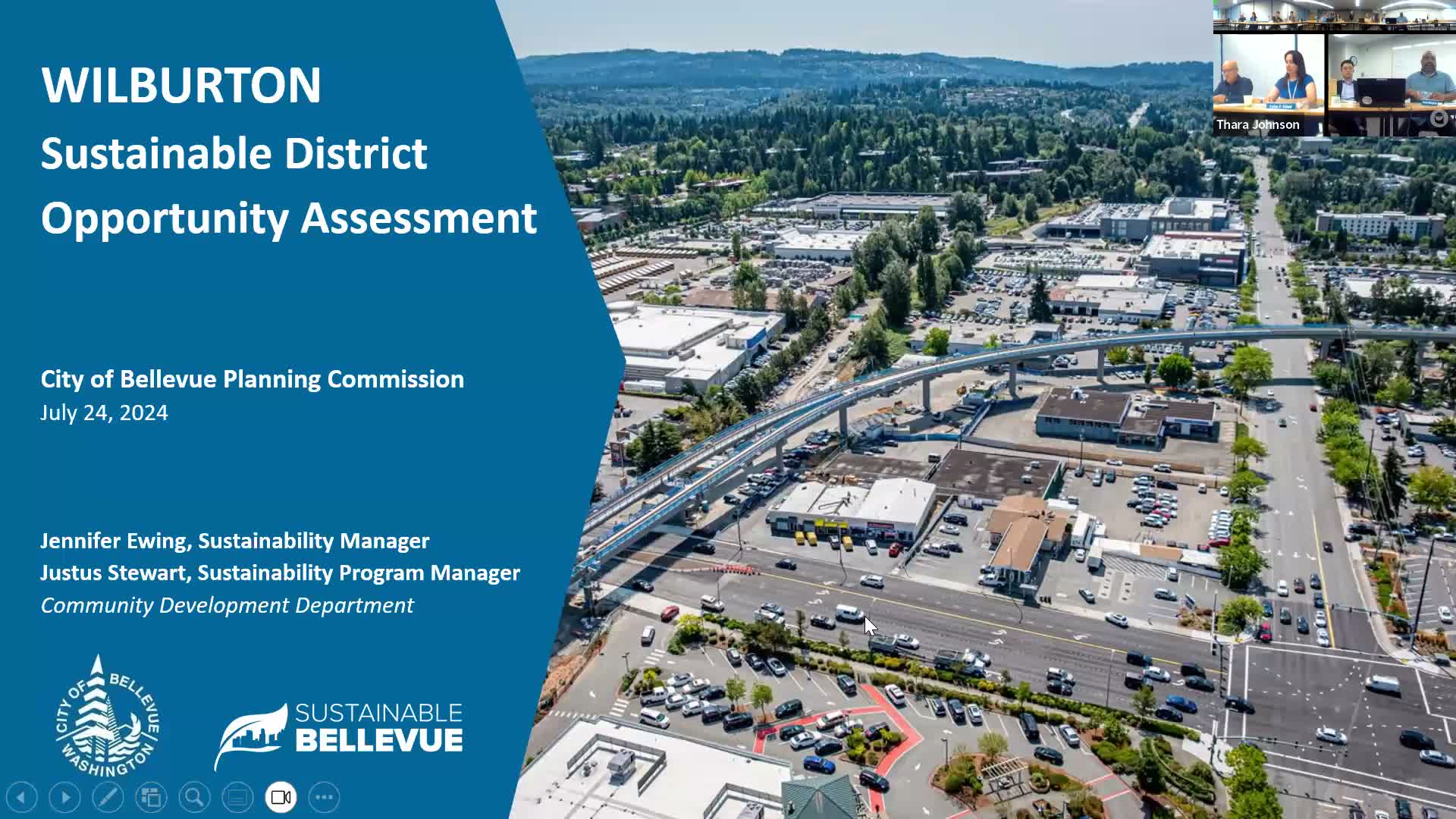
Staff outline Wilburton sustainable‑district assessment; district energy and stormwater park emerge as priorities
Summary
City staff presented an opportunity assessment for a Wilburton sustainable district that highlights sewer‑heat district energy, green stormwater infrastructure, high‑performance buildings and urban canopy goals; staff said LEED for Cities & Communities is being evaluated and that silver certification appears plausible under current policies.
City planning and sustainability staff briefed the Planning Commission on July 24 on a Wilburton sustainable‑district opportunity assessment that aims to knit existing transit‑oriented investments, public assets and private development into a coordinated sustainability strategy.
Staff framed the exercise as an information‑only assessment to identify whether a district approach could accelerate citywide sustainability goals. "This is really an idea to get together a lot of the transit oriented development and sustainability amenities and features of Wilburton into more of like a cohesive sustainability neighborhood," Jennifer Ewing, the city’s sustainability manager, said.
Key opportunities and tradeoffs - District energy: staff flagged sewer‑heat recovery along a large King County sewer main running under the Eastrail as a promising source for a district heating/cooling system and said King County is seeking partners to pilot such technology. Staff described early feasibility work with property owners and utilities and said a larger system could offer carbon and resilience benefits but requires phased partnerships and significant capital. - Green stormwater infrastructure: staff proposed exploring stormwater parks, wetland daylighting along Sturtevant Creek and shared water systems to manage high water tables and create amenities, while cautioning about feasibility and cost in wet zones. - Green building and materials: staff discussed all‑electric building potential, low‑carbon materials (including mass timber) and smart building systems to reduce load and improve occupant health. - Urban canopy and livability: staff identified tree canopy, street trees and public‑realm greening as part of the district identity and emphasized livability and access to green space.
Certification, metrics and next steps: staff reviewed frameworks and said LEED for Cities & Communities aligns well with the district’s priorities; initial scoring suggests the district could likely reach a silver certification level under current and anticipated policies, though staff said they are still evaluating costs versus benefits. Justice Stewart said staff will continue technical study (including district energy feasibility) and stakeholder engagement and could move to an implementation plan if the assessment shows a clear opportunity.
Commissioners questioned implementation details: they pressed staff about electrical‑grid impacts of electrification, the scale required for district energy to be financially viable, certification costs versus building‑level approaches, and measurement strategies for district outcomes. Several commissioners suggested prioritizing projects with high, demonstrable returns (one commissioner highlighted stormwater/ day‑lighting as a potential keystone project). Staff said they are analyzing costs, precedents and metrics and will return with more detailed work; some implementation items that affect land‑use code will come back to the commission as code amendments are drafted.
No regulatory decisions were made; the assessment remains at the opportunity study stage and staff will continue outreach and research before any implementation plan is proposed.