Get Full Government Meeting Transcripts, Videos, & Alerts Forever!
Get email alerts on the Neighborhood Planning topic
No spam. Unsubscribe anytime.
Arts Commission weighs draft Crossroads and Newport neighborhood policies that prioritize culturally responsive public spaces
Summary
City planners presented draft neighborhood-area policies for Crossroads and Newport that emphasize culturally responsive design, multilingual signage, school‑community coordination and intergenerational gathering space; the Arts Commission will advise on arts and cultural implementation as plans move to the planning commission and city council.
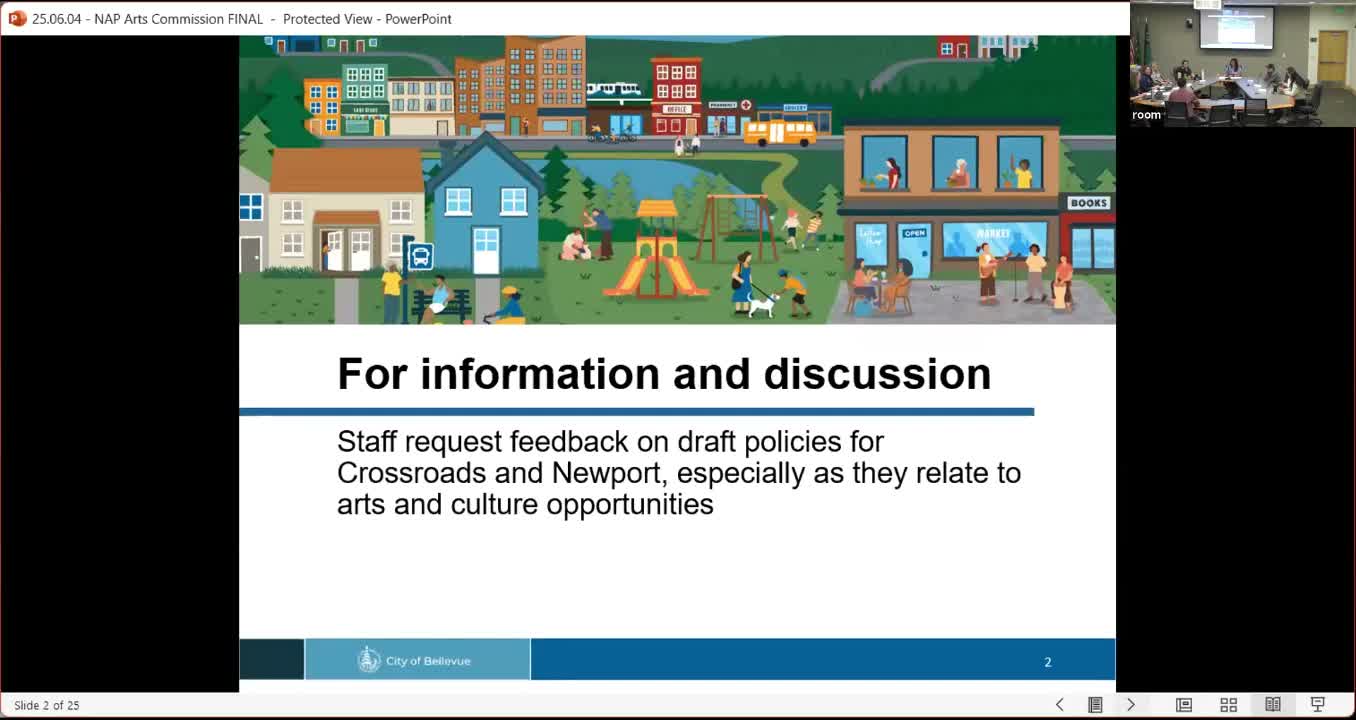
City senior planner Justin Panganiban asked the Bellevue Arts Commission on Thursday to review draft neighborhood-area policies for the Crossroads and Newport areas and provide feedback on how those policies could better support arts and cultural investments.
"We are seeking feedback from the commission on if these policies are providing adequate direction on supporting arts and cultural investments in these 2 neighborhood areas," Panganiban said. He described the Great Neighborhoods program as a city effort launched in 2018 to refresh neighborhood plans and said the draft policies will inform the Planning Commission’s recommendations to city council later this year.
Panganiban walked the commission through draft policy themes for Crossroads: a culturally responsive built environment, support for a diverse small-business district, and strengthened, welcoming public gathering spaces. He cited community input calling for more culturally specific public art, multilingual wayfinding and more play and programming for seniors and youth in Crossroads.
Commissioners pressed staff on implementation details during discussion. One member asked whether the policy that authorizes acquiring parcels for parks (referred to in the materials as SCX‑17) could be used to site public-art opportunities; Panganiban said acquisition and parks planning are closely related and that such parcels could support arts uses. Another commissioner asked whether multilingual signage could mirror models such as Seattle’s Chinatown–International District; Panganiban said the draft sets broad policy direction and that design specifics would be developed during implementation.
On Newport, staff highlighted different local priorities: protection of natural and shoreline assets, a shortage of indoor gathering space, opportunities to coordinate with Bellevue School District properties (two former school sites are under consideration), and policy support for intergenerational spaces. Commissioners noted that Newport has limited transit connections and urged continued coordination with transportation planners to improve neighborhood connectivity.
Panganiban and commissioners emphasized that the neighborhood policies set a framework rather than design prescriptions; subsequent steps—land-use code changes, programs, partnerships and funding—would determine how policies translate into built projects and ongoing arts investments. The commission agreed to provide feedback to staff for refinement before the Planning Commission review.
The presentation closed with staff noting the draft policies being part of Bellevue’s comprehensive plan process and that responses from boards and commissions will be incorporated as staff refines recommendations for the Planning Commission.