Get Full Government Meeting Transcripts, Videos, & Alerts Forever!
Get email alerts on the Hb 1042 topic
No spam. Unsubscribe anytime.
Planning commission recommends code changes to encourage conversion of existing buildings to housing
Summary
The Planning Commission voted to recommend a land-use code amendment implementing Washington House Bill 1042 to make it easier to convert qualifying commercial buildings into residential units, allowing added density, limited horizontal expansion and a single additional story in some cases; staff said financial incentives will still likely be needed for many projects.
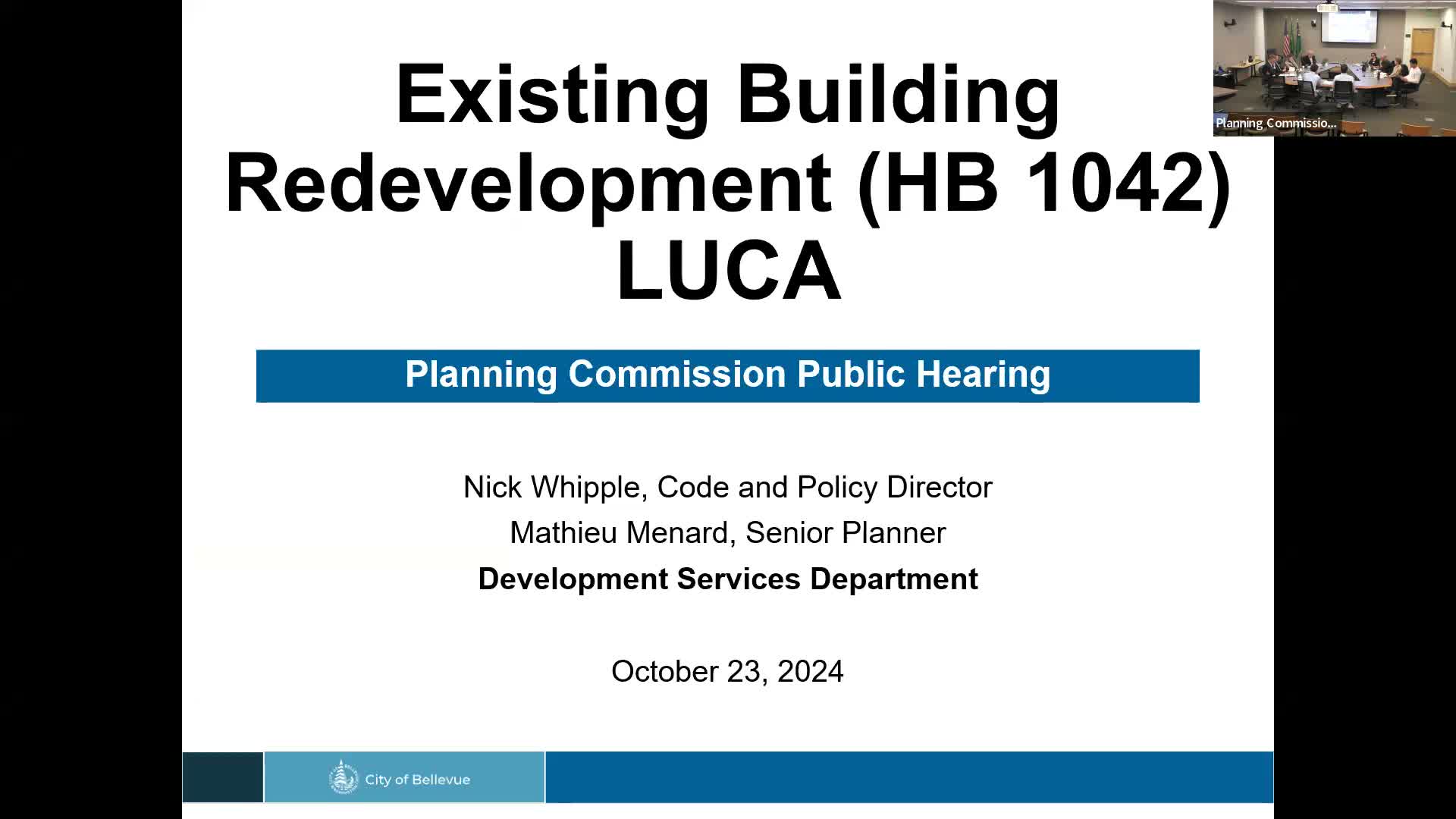
The Bellevue Planning Commission voted on Oct. 23 to recommend a land-use code amendment intended to encourage the conversion of older commercial and mixed‑use buildings into residential units, aligning local code with Washington House Bill 1042.
Staff told the commission the draft amendment would require allowance of at least 50% greater residential density in qualifying buildings, prohibit requiring additional parking for residential conversions, permit up to a 5% horizontal expansion to accommodate necessities such as ducting or ramps and allow a single additional story in limited cases. "We are trying to encourage the production of housing with this LUCA by updating the LUCA for consistency with House Bill 1042," Senior Planner Matthew Bernard said.
The amendment applies to buildings that received a certificate of occupancy more than three years prior and are located in commercial or mixed‑use districts that allow multifamily housing. Staff said the code change also exempts qualifying projects from many local design and nonconforming‑structure provisions and from ground‑floor use requirements except along certain major pedestrian corridors in downtown.
Why it matters: supporters said the changes remove administrative barriers to reuse of underutilized commercial space and could produce new housing without greenfield development. Opponents and skeptical commissioners urged caution, saying conversions often face a financing gap and technical retrofit challenges. "It sounds like there's about a 10% financing gap for these units," Bernard said, citing regional examples and presentations to staff; he added that state tax incentives tied to affordable housing and programs such as MFTE or LIHTC often make conversions financially viable.
Public testimony included builders and property owners who urged clarity and flexibility. Isaac Patterson, an attorney representing a local developer group, thanked staff and urged removal of remaining subjective phrasing in related design language so the city complies with state law. Builder Mike Nykram described small‑lot infill projects in Seattle and urged the commission to consider how feasible conversions would be in Bellevue.
Commission discussion focused on feasibility and scope. Several commissioners questioned whether the 5% horizontal expansion and a single additional story would be sufficient to make many conversions work, and whether allowing more stories where zoning height would permit might be more useful. Staff said the single‑story allowance is intended to stay within the bill's scope and to avoid triggering broader environmental review (SEPA) or reopening dimensional requirements that the LUCA otherwise exempts.
Motion and next steps: A commissioner moved that the commission adopt the resolution recommending the LUCA; after debate the commission approved the motion and will forward the recommendation to the city council. The transcript records that some commissioners voted no and the chair cast the deciding vote in favor. The recommendation asks council to consider final code language and accompanying city code amendments (for transportation concurrency and SEPA exemptions) before a planned 2025 adoption.
Implementation details and caveats: staff emphasized that the LUCA itself does not include financial incentives; city staff and community development teams will separately explore state‑authorized incentives and MFTE applicability. The LUCA also makes explicit that critical‑area and shoreline management regulations continue to apply and will control in any conflict with the LUCA. Staff also revised recycling and solid‑waste provisions to require at least one recycling and one solid‑waste collection area, with director discretion to size and screen those facilities to fit existing building shells.
The commission’s recommendation heads to the city council for review and possible adoption in 2025.