Get Full Government Meeting Transcripts, Videos, & Alerts Forever!
Get email alerts on the School Readiness Fraud topic
No spam. Unsubscribe anytime.
State officials tell committee Florida pays school‑readiness providers on attendance and has layered fraud controls
Summary
Department of Education and early‑learning coalitions told the PreK–12 Budget Subcommittee that Florida’s School Readiness (CCDF) program pays providers on attendance (not enrollment), requires daily sign‑in/out, and enforces anti‑fraud plans, audits and monitoring; recent data show limited active investigations.
State officials told the PreK–12 Budget Subcommittee that Florida’s School Readiness program — the state’s implementation of the federal Child Care and Development Fund (CCDF) — pays providers based on daily attendance rather than prospective enrollment and maintains multiple layers of fraud prevention and monitoring.
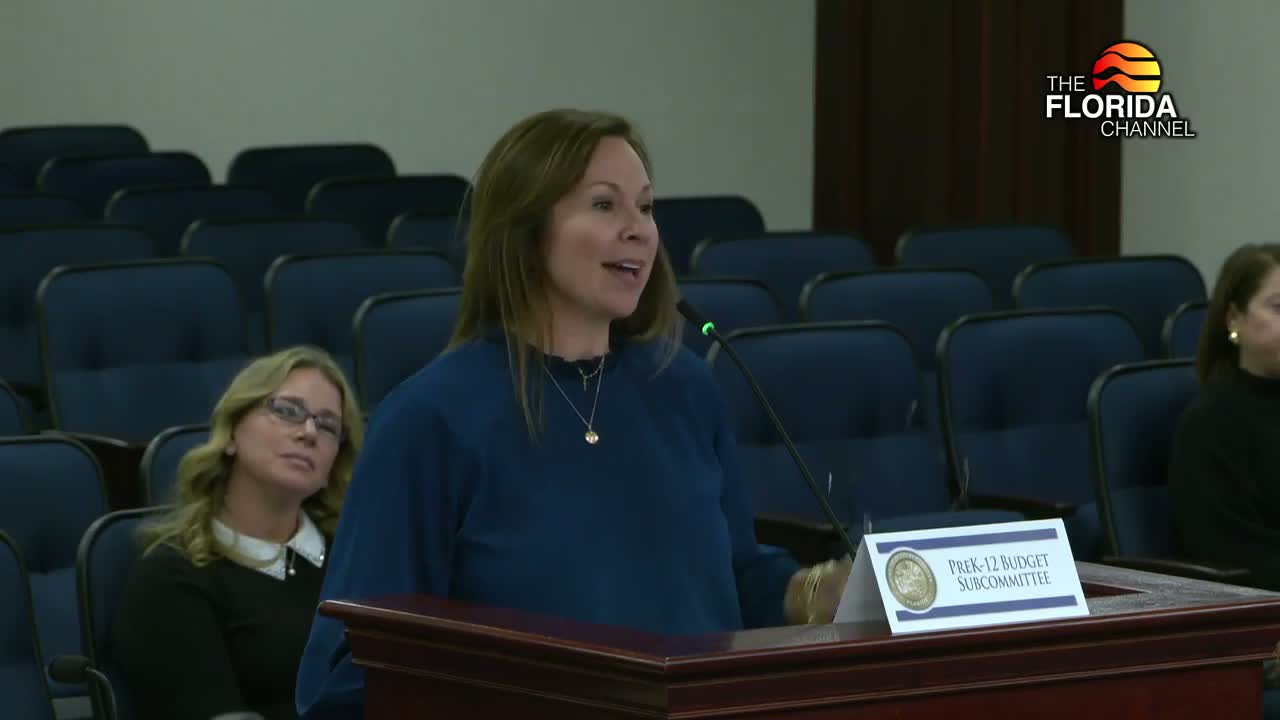
"We reimburse providers only for services actually delivered and do not provide prospective or advanced payments," Carrie Miller, chancellor of the Division of Early Learning at the Florida Department of Education, said. She told members the SR program covers roughly 6,900 providers and serves about 212,000 children across the state.
Miller described a three‑tiered approach: (1) local early learning coalitions (ELCs) are required to adopt annual anti‑fraud plans submitted to the DOE Office of Inspector General; (2) ELCs and providers undergo fiscal and programmatic monitoring — including annual on‑site reviews and third‑party CPA single audits; and (3) the Department of Children and Families conducts annual licensing inspections and, for many private providers, unannounced visits three times per year.
Molly Grant, executive director of the Florida Association of Early Learning Coalitions, said coalitions operate internal fiscal controls (separation of duties, reconciliation and desk reviews), required fraud training, and regular sampling and monitoring of providers. She emphasized that attendance verification — daily sign‑in and sign‑out with parent signatures — is the primary mechanism preventing improper payments.
When asked about enforcement outcomes, Miller provided program‑year figures: six provider referrals to the Bureau of Public Assistance Fraud (BPAF) (three not investigated, one pending assignment, two actively under investigation) and 260 recipient (family) referrals (133 not investigated, 113 pending screening or assignment, 10 with active investigation or overpayment requests, and four awaiting status). Miller and Grant characterized these numbers as consistent with a system that uncovers and refers suspected abuse for investigation while generally deterring widespread fraud.
Members asked follow‑up questions about special guardianship situations, including retired grandparents and military families. Grant said guardians with legal custody may submit documentation and the coalitions will provide additional details to committee members after the hearing.
The chair thanked the presenters and said the committee will continue monitoring SR program integrity and funding flows to protect taxpayer dollars that support early childhood care and work participation requirements.
Attribution: Statements in this article are based on presentations by Carrie Miller (Chancellor, Division of Early Learning, Florida Department of Education) and Molly Grant (Executive Director, Florida Association of Early Learning Coalitions) during the PreK–12 Budget Subcommittee meeting.