Get Full Government Meeting Transcripts, Videos, & Alerts Forever!
Get email alerts on the Wilburton Luca topic
No spam. Unsubscribe anytime.
Developers and dealers press Planning Commission for flexibility as Wilburton LUCA advances
Summary
At a Bellevue Planning Commission study session, developers, housing advocates and a Lexus dealer clashed over Wilburton LUCA details: access-corridor widths, parking reductions, amenity incentives for small sites, and nonconforming-site rules; commissioners requested comparisons and tighter staff responses.
Developers, housing advocates and business representatives pressed Bellevue planners Thursday over draft rules for Wilburton’s land-use code amendment, raising sharply divergent concerns about access-corridor widths, parking minimums, amenity incentives and nonconforming-site rules.
Public commenters representing housing coalitions and FutureWise urged rules that unlock more housing and permit flexible design tools. "Building design is directly connected to the success of affordable housing," said Brady Nordstrom, associate director of government relations and policy at HDC, speaking for the Eastside Affordable Housing Coalition. FutureWise’s Alex Brennan and Jasmine Smith said the Wilburton LUCA is a "really important opportunity" for housing at all income levels.
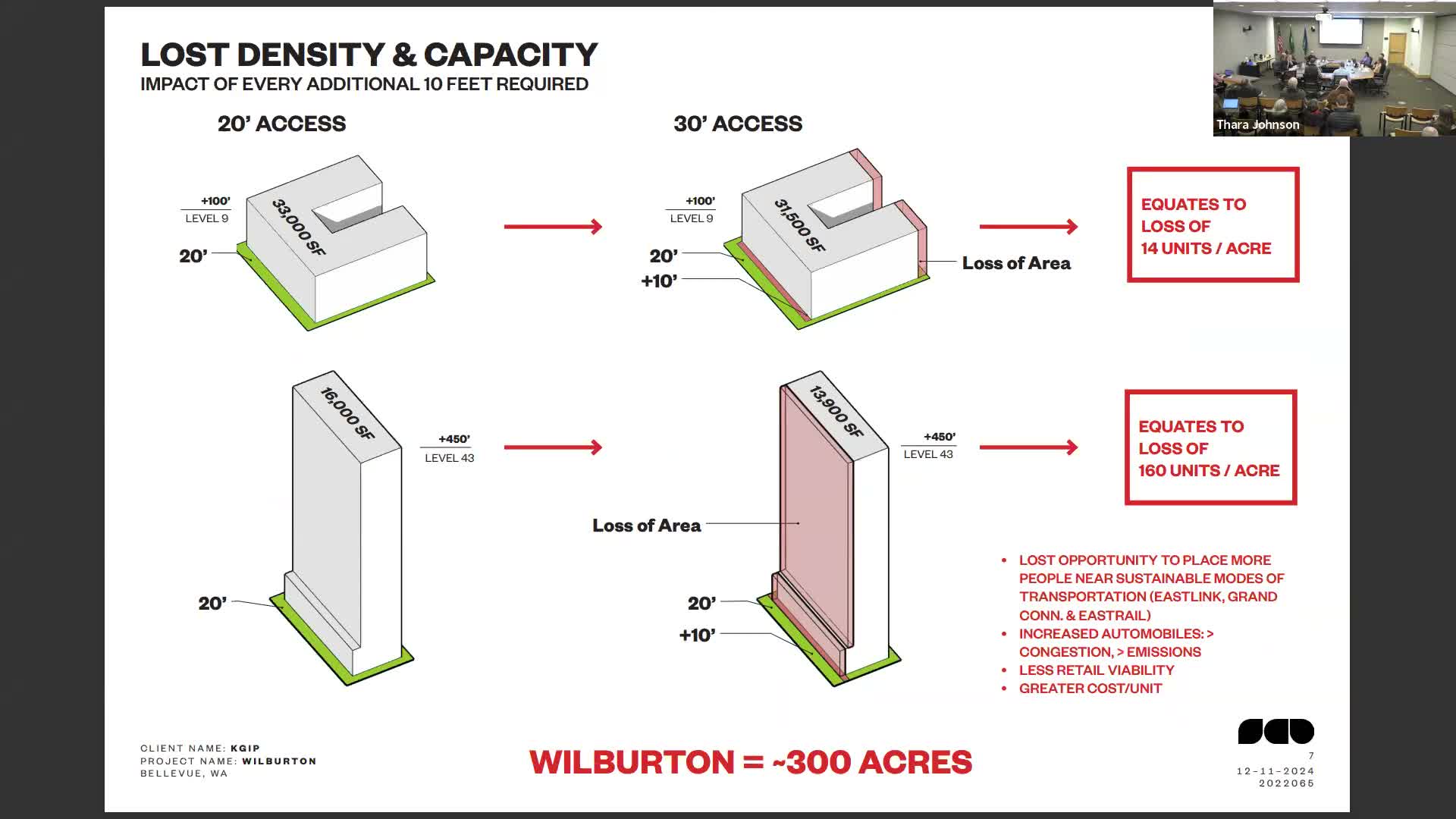
Developers and property owners warned staff that broad access-corridor and sidewalk-width requirements would reduce residential unit yields on narrow or small sites. Andrew Coats of KG Investment Properties presented a simplified analysis and said, "for every 10 feet, you lose 14 units per acre on mid‑rise construction" (developer modeling summary). Neil Molnick showed precedent projects in other cities to argue for flexible, context-sensitive corridors.
Auto dealer Jim Rose, representing Lexus of Bellevue and O'Brien Auto Group, told commissioners that corporate franchise requirements depend on outdoor vehicle display and parking configuration. "Failure to meet those items then causes us to be put on a list that we could potentially lose our franchise," he said, and provided tax and sales figures to underscore the financial stakes.
Staff proposed a parking approach that reduces citywide minimums by 75% for Wilburton with additional reductions possible through site-specific studies; staff also said they revised shared-parking provisions to mirror downtown practice. Josh Steiner, project manager for the LUCA, said the proposed dimensional rules retain base FARs and allow additional FAR by earning amenity points in an incentive system.
Robbie Seppler, assistant city attorney, explained the citywide nonconforming-site rules (BMC 20.25.60): remodel and expansion thresholds are calculated against replacement value and reviewed over a rolling three‑year window; remodels above 30% and below 100% of replacement value trigger proportional compliance, and expansions over defined thresholds require full compliance. Seppler walked commissioners through the proportional‑compliance dollar example that determines required site improvements and how the director sequences those improvements.
Commissioners asked staff for a side‑by‑side comparison of the citywide nonconforming approach vs. the BelRed existing‑conditions model used elsewhere in Bellevue, more amenity options usable by small sites, and examples showing how access-corridor widths would function in practice. Several commissioners urged staff to re‑examine 51‑foot access corridors and 30‑foot fire/access widths that they said could materially reduce housing yields on constrained parcels.
Staff agreed to return with tighter language, example test fits, a comparison of nonconforming approaches, and adjustments to amenity options for small sites ahead of the next LUCA study session and the January hearings. The Commission extended the meeting to continue discussion and later approved routine minutes and adjourned.
Votes and formal motions from the session included a carried motion to set a public hearing on the objective‑design LUCA and a carried motion to extend the meeting into the evening.