
Committee endorses safe-storage rules for school property after testimony from students and law enforcement
Get AI-powered insights, summaries, and transcripts
Subscribe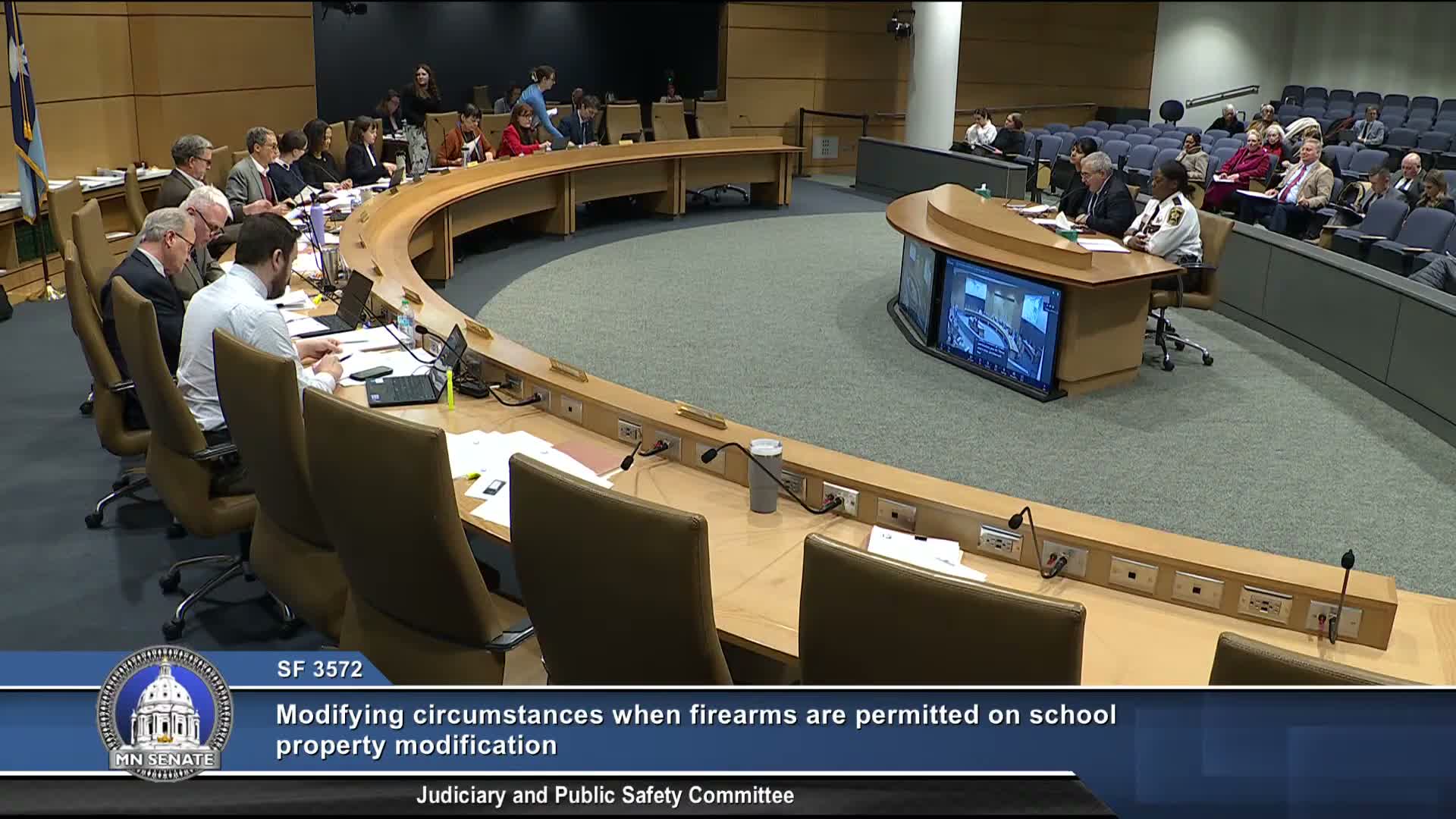
Summary
The Senate Judiciary and Public Safety Committee recommended passage of SF 3572, which would require firearms on school property to be unloaded and secured and would remove principals' authority to authorize carry inside school facilities; testimony included Hennepin County Sheriff Dwanna Witt, a student from Edina, and both school and gun-rights advocates.
The Minnesota Senate Judiciary and Public Safety Committee on March 16 recommended SF 3572 to pass after a day of testimony that ranged from students’ accounts of fear at school to law-enforcement appeals for clearer, statewide rules.
Sen. Swadzinski, the bill’s sponsor, said the measure would require firearms in vehicles on school property to be unloaded and secured in locked containers or trunks, extend storage protections to Minnesota High School League events held off campus, and remove the existing statutory exception that permits a principal or superintendent to authorize a person to carry inside school facilities. He framed the proposal as a practical step to reduce preventable access to firearms on school grounds.
Hennepin County Sheriff Dwanna Witt testified in support, telling the committee that consistent statewide storage requirements would make compliance clearer and enforcement fairer. “Safe storage laws address one of the most common pathways by which guns end up in the wrong hands,” she said, describing thefts from vehicles as a primary source of firearms used in crimes and citing agency seizure statistics.
Student Aditi Jha of Edina High School told senators that the proposal is not about taking away rights but about creating guardrails for responsible ownership so students can learn without fear. “We should be thinking about the history test next week, not if another lockdown could mean that we can't see our loved ones again,” she said.
Maya Olsen, a Bloomington school board member and substitute teacher, recounted conducting lockdown drills with students of all ages and said adults must act to prevent school shootings. Anna Leamy, director of government relations and advocacy for the Minnesota Gun Owners Caucus, opposed the bill, arguing it removes a ‘‘carefully structured’’ statutory discretion that allowed vetted permit-holders to be approved by school leadership in limited circumstances.
Committee members questioned how the proposal would affect remote and rural schools with long law-enforcement response times and whether private schools or private security would be covered. Counsel noted certain statutory exceptions would remain in place for active peace officers, military training participants, ceremonial units and marked law-enforcement activities, but the bill would remove the ability of school administrators to grant additional carry permissions.
The committee adopted an amendment setting the criminal-law effective date and, on roll call, recommended SF 3572 as amended to pass and be referred to the Senate Committee on Education Policy (motion carried: 6–3). The chair said constituents with concerns about testimony opportunities should speak with him directly and reiterated that threats directed at lawmakers would be investigated by Capitol Security and the Minnesota Bureau of Criminal Apprehension.
If enacted as amended, the provision would take effect on the date specified by the amendment and apply to crimes committed on or after that date as described in the bill text.