Get Full Government Meeting Transcripts, Videos, & Alerts Forever!
Get email alerts on the Great Neighborhoods topic
No spam. Unsubscribe anytime.
Bellevue launches Crossroads and Newport neighborhood-area planning; staff promises multilingual outreach
Summary
Community development staff outlined the Great Neighborhoods program and a 16–18 month planning schedule for Crossroads and Newport, emphasizing mailed questionnaires, multilingual cultural outreach assistants and in-person idea fairs in November.
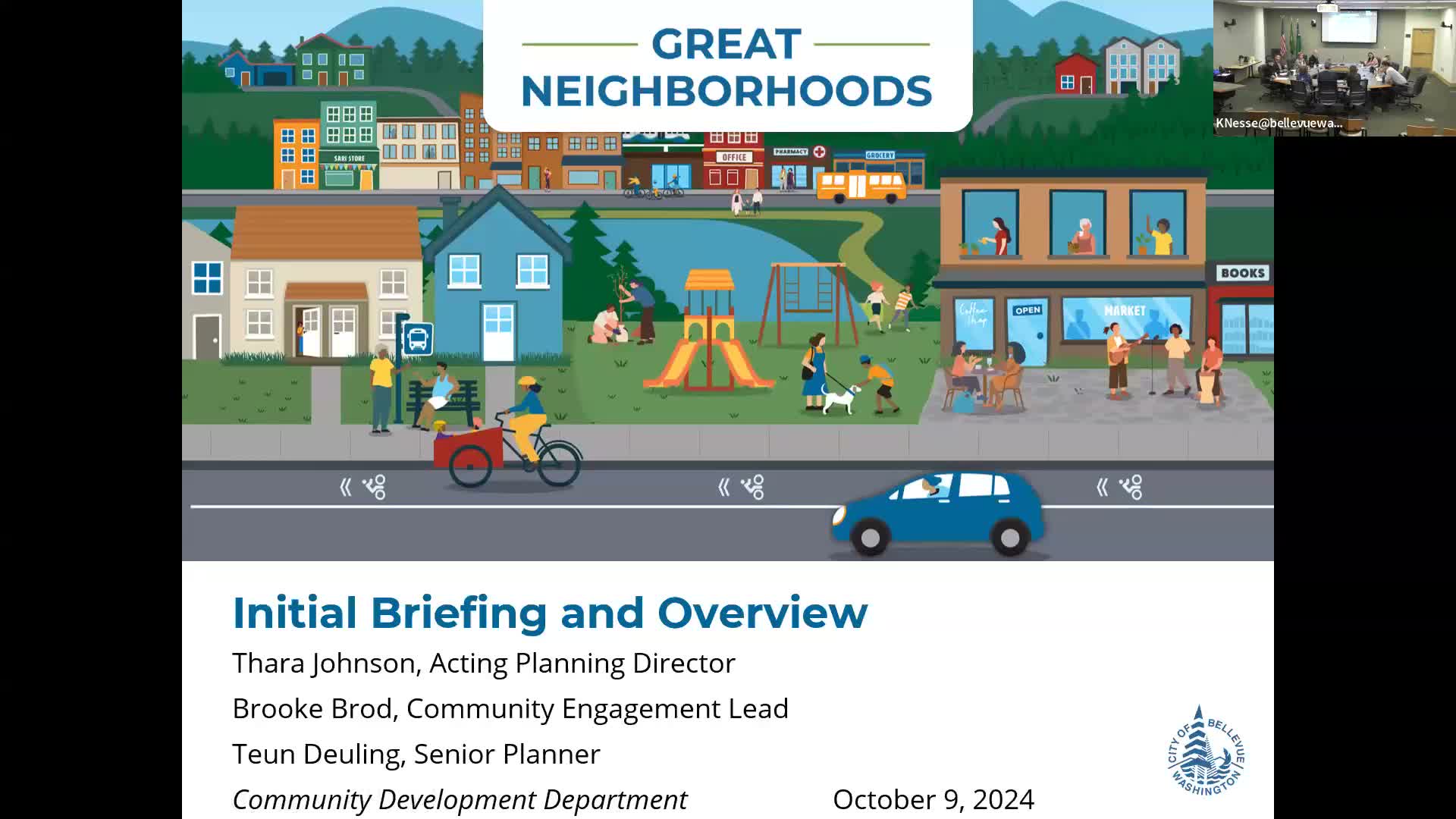
Community Development staff presented an initial briefing on the Great Neighborhoods neighborhood-area planning process for Crossroads and Newport.
Tara Johnson said council initiated the program and the work will focus on bringing local context to citywide policies developed during the comprehensive-plan periodic update. Tun Dooling described the four-phase process (Discover, Define, Refine, Adopt) that staff will use over an estimated 16–18 months and noted adoption is targeted for mid-2025 to mid-2026 depending on segment timing.
Brooke Broad outlined outreach plans designed to reach diverse populations: staff will mail questionnaires to every household in the neighborhood areas, run an on-demand online engagement hub with translations, host in-person idea fairs (Crossroads Community Center on Nov. 14; Newport swim-and-tennis club on Nov. 20) and expand a cultural outreach-assistant program to include a dedicated Korean-language assistant for Newport outreach. "We've just recently brought on a fourth cultural outreach assistant to help us connect with the Korean community," Broad said.
Staff said neighborhood plans will address five key elements — land use, urban design, neighborhood identity, public realm and neighborhood connectivity — and will coordinate with Parks and Community Services and Transportation to identify capital improvement priorities that come out of the planning process.
Commissioners urged staff to apply lessons from earlier neighborhood efforts, prioritize resident voices over out-of-area commenters, amplify safety in connectivity planning (especially for biking and walking), and ensure translated communication includes clear sign-up/contact details for follow-up.
Staff committed to close coordination across city departments, to targeted cultural outreach in multiple languages, and to providing commissioners with summaries of lessons learned from prior neighborhood-area work.