Get Full Government Meeting Transcripts, Videos, & Alerts Forever!
Get email alerts on the Middle Housing topic
No spam. Unsubscribe anytime.
Bellevue staff outline changes to meet state 'middle housing' laws; commissioners press for data on impacts
Summary
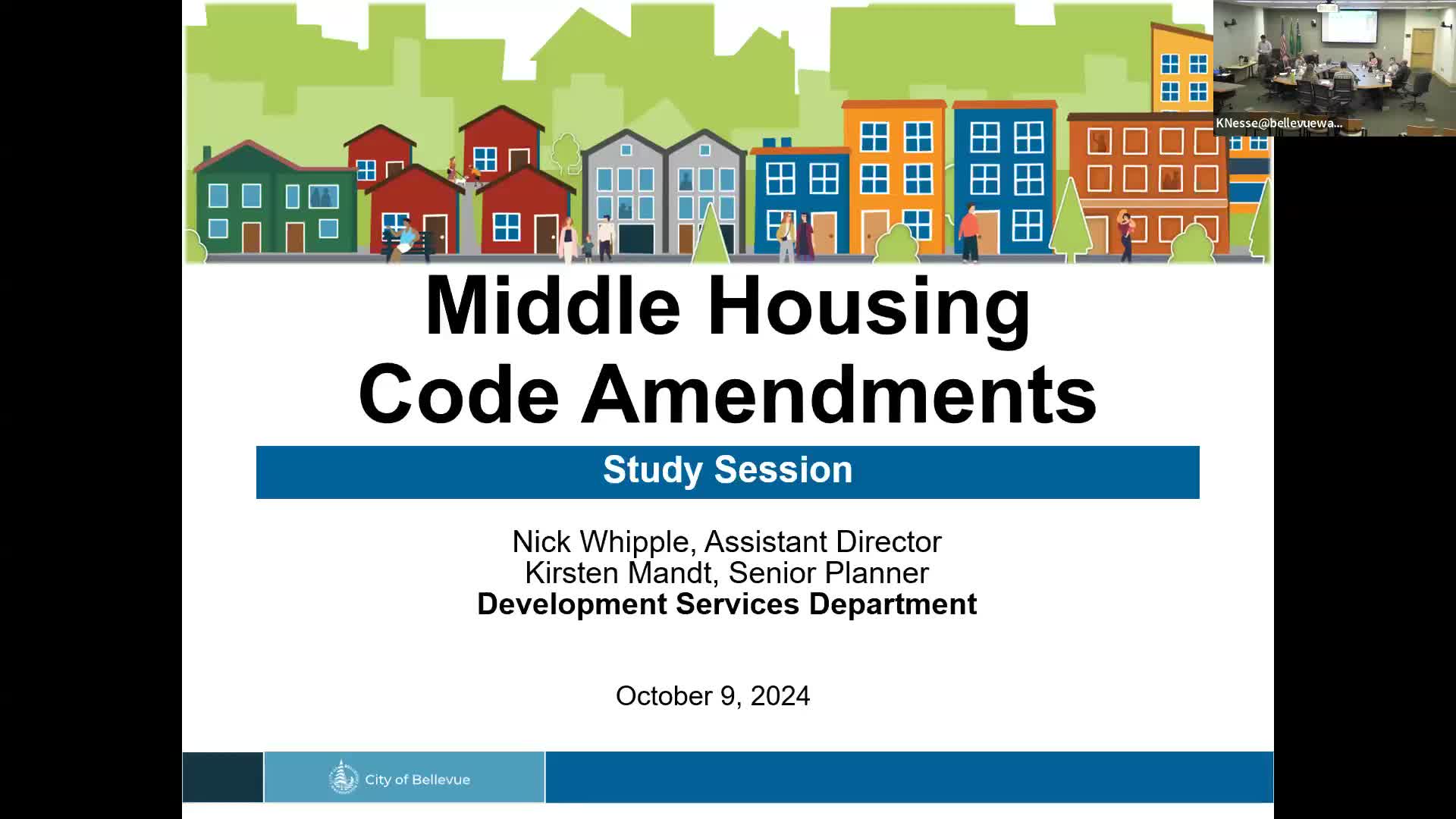
Development Services staff briefed the Planning Commission on implementing House Bills 1110 and 1337, which require new ‘middle housing’ densities and ADU allowances; commissioners pressed staff for clarifications on transit boundaries, parking, tree-retention interactions and likely unit production.
Staff presented an information-only study session on local code changes needed to comply with two state laws that affect single-family zoning and accessory dwelling units.
Nick Whipple, assistant director in Development Services, summarized House Bill 1110 as assigning "new density requirements on a per lot basis," including a requirement to allow four units on every qualifying residential lot citywide and up to six units within a quarter-mile of frequent transit or when two of the units are affordable. Whipple also said the bill limits some local controls and restricts how much parking cities may require near transit.
Kirsten Bant, code-and-policy senior planner, reviewed House Bill 1337 as the ADU bill, saying the city will be required to allow two ADUs on single-family lots, cannot impose owner-occupancy requirements, and must set size and height allowances. "There are also size, there are limits to what we can set in terms of a maximum size requirement for these as well as height restrictions," Bant said as staff described code provisions they will draft.
Staff framed the local initiative around four goals: clarity in code language, encouraging middle-housing types, ensuring implementation across permit divisions, and regional coordination. They described possible local choices — for example, permitting all middle-housing typologies rather than forcing the six-of-nine typology selection in the state model — and outlined a schedule that aims for draft code in February and adoption by the June 30, 2025 statutory deadline.
Commissioners repeatedly asked for more quantitative context. Commissioner Lou pressed staff on how the commission should define the "major transit stop" used for the quarter-mile rule and how parking reductions will be calculated (per unit, per lot or otherwise). Bant said staff will align definitions with state guidance and noted some parking reductions in the law are prescriptive.
On neighborhood character, Commissioner Villavazos urged the staff to consider modest increases in height limits (noting a practical difference between 35 and 38 feet) and use incentives to preserve porches and street-front continuity. "The difference between 35 to 38 can mean a lot, in terms of quality for the product," Villavazos said.
Commissioners also raised tree-retention and permitting concerns after multiple public commenters reported recent tree removals on redevelopment sites. Nick Whipple said the city’s existing tree-credit system is residential-lot-based and staff are not proposing special exceptions for middle housing; removal remains possible but would need to meet minimum credit requirements, typically via planting or retained canopy.
Staff agreed to compile follow-up data: historic ADU permitting, any early indicators of production after the city’s recent ADU reforms, and estimates from environmental review materials that could inform likely unit yields. Staff also committed to respond to points in a Master Builders Association letter that had been circulated to the commission.
The session concluded with staff noting remaining technical issues to resolve (parking analysis, SEPA language consistency, how to reconcile "units per lot" with some zones’ dwelling-units-per-acre metrics) and promising more detailed analysis at future meetings.