Get Full Government Meeting Transcripts, Videos, & Alerts Forever!
Get email alerts on the Cimd Retail Clarification topic
No spam. Unsubscribe anytime.
Boca Raton planning board approves clarification to CIMD retail rules, excludes gyms and tutoring
Summary
The Planning & Zoning Board voted 6–0 to approve an amendment clarifying what counts as "retail sales or services" for Commercial Industrial Multifamily Developments (CIMDs), excluding gyms and tutoring, and adding requirements for ground‑floor public access, signage/marketing, and a 45‑hour weekly minimum for on‑site retail.
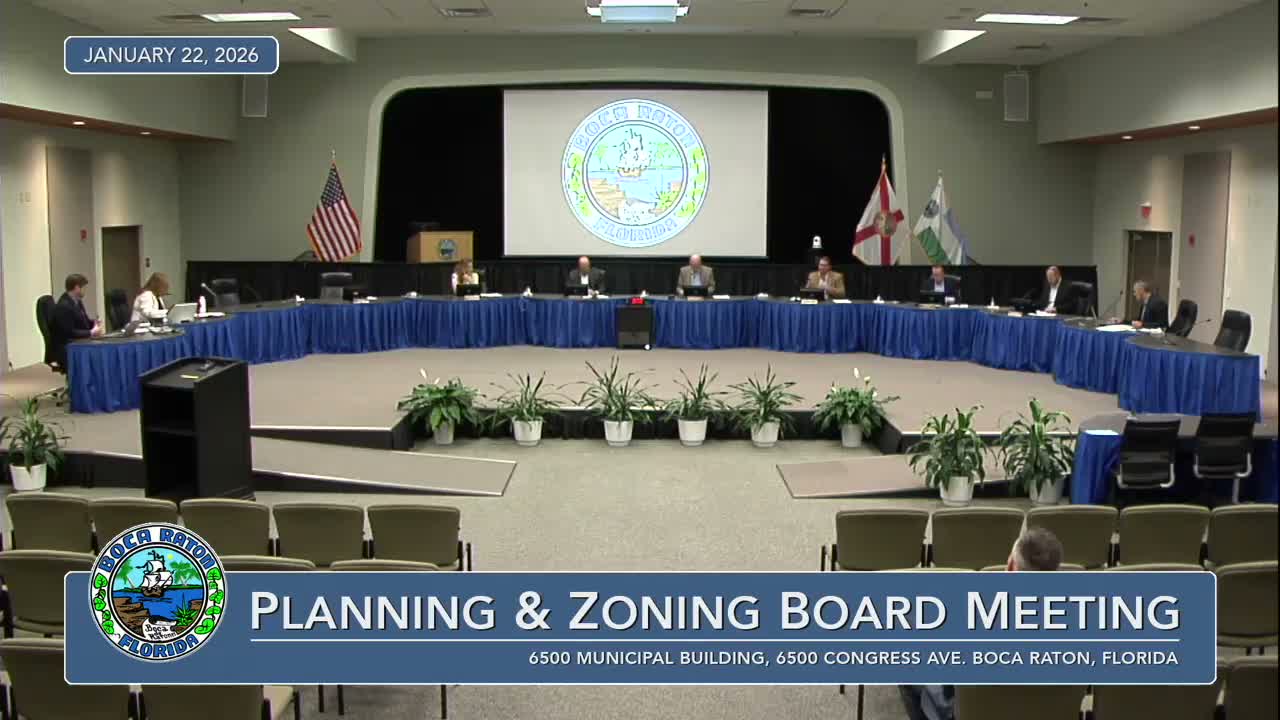
The Planning & Zoning Board of the City of Boca Raton voted unanimously on Jan. 22 to approve an amendment clarifying what qualifies as "retail sales or services" in Commercial Industrial Multifamily Developments (CIMDs), a local zoning option intended to add affordable workforce housing in parts of the city where residential uses are not normally allowed.
Brandon Shadd, the city's development services director, told the board the amendment adds a definition that explicitly excludes fitness centers or gyms and tutoring or similar instructional services from counting toward the CIMD on‑site retail requirement. Shadd said the ordinance also requires on‑site retail to be an independent operation with public accessibility, including a separate ground‑floor pedestrian entrance and exterior business identification, and to demonstrate public advertising or marketing.
The clarification follows the city council's earlier adoption of a CIMD program (noted in the staff presentation as adopted Feb. 13, 2024, by ordinance) that allows multifamily housing in planned‑mobility areas in exchange for meeting nonresidential use requirements. Under the existing framework discussed at the hearing, projects can satisfy those requirements by (1) proximity to at least 25,000 sq ft of existing nonresidential uses within one‑quarter mile, (2) providing on‑site nonresidential space equal to the greater of 5,000 sq ft or 10% of the project's square footage (up to a 25,000 sq ft cap), of which at least 2,000 sq ft must be restaurant or retail, or (3) a combination of on‑site and off‑site space totaling the same caps.
Board members questioned several details. One member asked whether boutique fitness studios such as Pilates would be prevented from locating in CIMDs; Shadd said those uses could be present but would not count toward the modest on‑site retail minimum. Another question asked whether a gym could be approved by variance to meet the 2,000‑sq‑ft requirement; Shadd replied gyms are not eligible to satisfy that minimum and would not be approved as the qualifying retail component. Shadd said the 2,000‑sq‑ft figure reflected a prior council compromise and developers could meet the requirement with multiple smaller retail bays if needed.
A public commenter representing "Developments" supported the program but urged several clarifications: whether the language erroneously applied to off‑site mall tenants, concerns that the definition could exclude common residential amenities (karate, kickboxing, Pilates), that a 60‑hour weekly operating requirement would be onerous for some businesses, that marketing or signage rules could disadvantage small or mom‑and‑pop tenants, and that the sign code could conflict with required exterior identification. Shadd acknowledged a scrivener's error in the draft and clarified the change applies only to on‑site uses; he also said staff is willing to work with applicants and the sign code office to resolve conflicts and that modest demonstrations of public marketing (for example, a social‑media listing) would be acceptable.
After discussion, Vice Chair Dornblazer moved to approve the ordinance with the scrivener correction and to reduce the weekly hours requirement from 60; the motion was seconded by Board member Mitchell and amended on the floor to set required weekly hours at 45. The board approved the amended motion by roll call, 6–0.
The board did not take further action on appeals language; Shadd said change‑of‑use reviews would be handled through the usual certificate‑of‑use process and that there is no express provision in the draft for administrative appeals to the city council. The hearing record shows staff recommended approval and indicated the amendment aims to promote walkability and reduce vehicle miles traveled by ensuring CIMD projects include bona fide, publicly accessible retail services at street level.
The board adjourned at 6:29 p.m.