Get Full Government Meeting Transcripts, Videos, & Alerts Forever!
Get email alerts on the Government Campus Redevelopment topic
No spam. Unsubscribe anytime.
Boca Raton council reviews Terra Frisbee P3 for downtown government campus; residents raise concerns about referendum clause
Summary
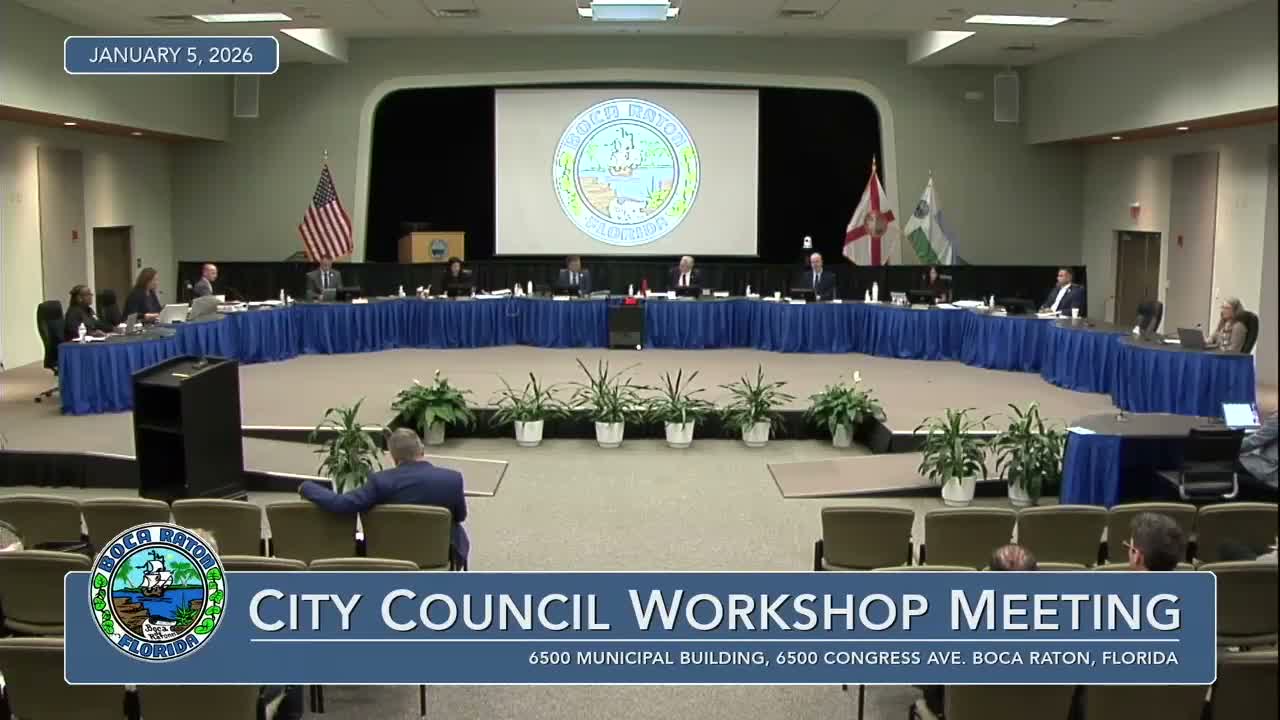
At a Jan. 5 workshop Deputy City Manager Andy Lukasick and consultants outlined a proposed public–private partnership with Terra Frisbee to redevelop Boca Raton’s government campus. Staff presented financial projections and public‑realm plans; residents objected to contract language they say could leave parts of the agreement effective if a referendum does not occur.
Deputy City Manager Andy Lukasick told the Boca Raton City Council at a Jan. 5 workshop that the city intends to introduce an ordinance Jan. 6 and consider it Jan. 20 to authorize a public–private partnership (P3) with Terra Frisbee to redevelop the downtown government campus, with a voter referendum tentatively scheduled for March 10.
The presentation outlined a transit‑oriented, pedestrian‑scaled master plan adjacent to the BrightLine station and described a mix of uses including office, retail, residential and a civic core with a police and fire substation, community center and expanded Memorial Park. Lukasick said consultants CBRE and PFM projected non‑discounted revenues over a 99‑year lease term in the low billions and presented present‑value estimates intended to inform the council’s review.
Why it matters: the project would repurpose public land in the downtown campus and change land‑use and development regulations for the area. Staff presented financial projections (CBRE non‑discounted revenue ~$4.1 billion; PFM ~$4.3 billion) and present‑value estimates (CBRE ~$347.2 million; PFM ~$330 million), and PFM’s net present value after operating‑cost assumptions of roughly $175.8 million. Leanne Course, an executive vice president with CBRE, said the developer will make a one‑time mobility contribution of $7,800,000 and that the project is expected to generate construction jobs and recurring employment.
Councilmember questions focused on modeling assumptions and updated consultant numbers. Councilmember Thompson pressed staff on why earlier figures differed; staff explained the presentations model different rental‑stream options (percentage‑rent versus fair‑market rent) and different development‑intensity scenarios and said the revised PFM material is available on the project webpage. “Using the same underlying assumptions, you get these numbers on the percentage rent cash flow formula as opposed to the fair‑market value,” a staff presenter said, explaining why alternate numbers were shown.
Public commenters concentrated their remarks on two legal and governance points: first, whether the council should finalize and sign agreements before the March 10 referendum; and second, a clause in the draft Master Partnership Agreement (Section 23.24) that states, as read by speakers, “the failure of the referendum to occur shall not be deemed a rejection and shall have no effect on the effectiveness of this agreement.” Joe Magus argued that language could allow the agreement to remain effective if a referendum does not occur; John Perlman and others said that outcome would contradict prior assurances that voters would decide the project. “That clause is predicated on a giant if,” Magus said during public comment.
City legal counsel responded to those concerns at the workshop. Mr. Taylor, legal counsel, said the clause was drafted to prevent a court or procedural challenge from canceling the voters’ ability to decide the matter and that the city and partner intend for a referendum to proceed. On the city’s projected public‑facilities spending, legal counsel said the agreement contains a preliminary budget estimate and that the written language treats that figure as an outer cap and not a contractual obligation to spend the full amount: “this cap represents an outer limit on the city's authority to expend funds and not a commitment or obligation to fund this public facilities in such amount,” he said.
Residents also raised transparency and process concerns: Mike Liebelson asked that large contract documents be delivered in searchable formats and questioned why the city would enter a P3 if it intends to spend substantial public dollars (he cited an estimate discussed in the documents of roughly $201 million for the city portion of facilities). Others urged the council to ensure early‑phase mixed uses are enforced so promised retail and entertainment are not deferred indefinitely.
What’s next: staff said the council will introduce the implementing ordinance on Jan. 6, consider action on Jan. 20 (10 a.m. start), and that land‑development regulations (form‑based code) will return for council consideration in February. If the council adopts the ordinance, the referendum is scheduled for March 10, after which regulatory site‑plan review and rezoning actions would follow if the project proceeds.
The workshop closed after councilmember reports and brief remarks reiterating the city’s intention to publish clarified contract language online. The council adjourned at 3:15 p.m.