Get Full Government Meeting Transcripts, Videos, & Alerts Forever!
Get email alerts on the Government Campus topic
No spam. Unsubscribe anytime.
Boca Raton previews 1 Boca government campus; council set to consider referendum and leases ahead of March vote
Summary
City staff and developer Terra Frisbie presented a revised downtown government campus plan that moves private development east of NW 2nd Avenue, expands Memorial Park and stages public facilities; CBRE laid out a 99-year revenue model and an estimated $7.8 million mobility contribution. Council set a Dec. 2 review of ballot language and a March referendum; residents raised fiscal and transparency concerns during public comment.
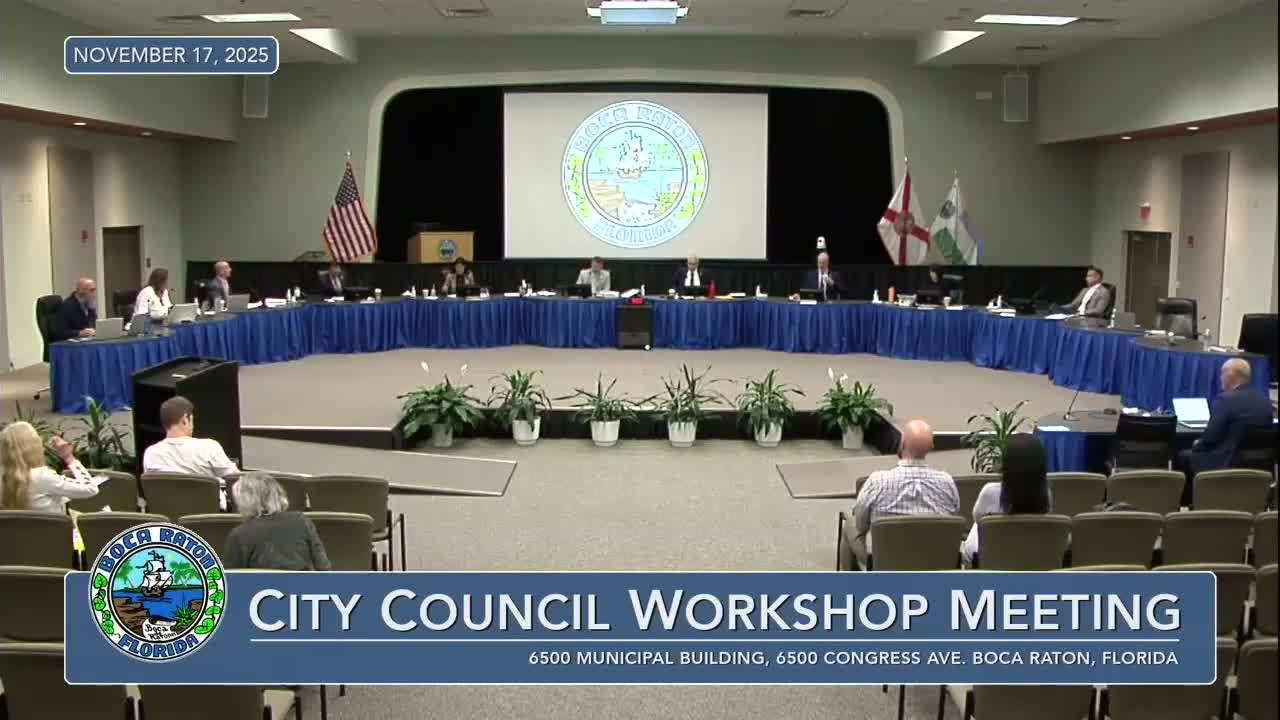
The Boca Raton City Council on Monday reviewed a scaled-back proposal for a downtown government campus from developer Terra Frisbie and heard lengthy public comment about financing, park preservation and project transparency.
Deputy City Manager Mr. Lukasik opened the workshop with a recap of the process: unsolicited proposals arrived in October 2024, the city issued an offering memorandum in December, the council chose Terra Frisbie as its development partner earlier this year and staff entered an interim agreement in March that has since been extended to May 2026 to allow more public engagement. He told the council the coming schedule includes a Dec. 2 review of ballot language, Planning & Zoning consideration of leases on Dec. 18, council hearings on Jan. 6 and Jan. 20 for the master plan and ground leases, and a March referendum for voters to ratify any development agreement the council approves.
Rob Frisbie, representing the 1 Boca team, said the latest master plan substantially reduces private development on city land, relocates the bulk of new private construction to the east side of NW 2nd Avenue, and expands public amenities. "We continue to refine the proposed development," Frisbie said, highlighting plans to increase Memorial Park’s recreational acreage from roughly 7.6 acres to more than 15 acres and a reduction of private building area from roughly 1.6 million square feet in earlier concepts to about 1.1 million square feet in the current plan.
Staff described several proposed public facilities to be delivered as part of the partnership: a downtown police and fire substation intended for public-facing services and smaller response vehicles; a roughly 30,000-square-foot community center with flexible meeting and multipurpose space and ground-floor food and beverage uses; a new or modernized tennis center (planned for about 10 courts); improved ballfields and a modern skate park; and a garden-walk and Banyan Village retail node intended to serve park visitors.
CBRE, the city’s financial consultant, presented the project’s revenue framework. The city would hold a 99-year ground lease on roughly 7.72 acres and receive a minimum base rent plus percentage rent tied to developer revenue; CBRE said the city would also share upside (10% of developer profit above target yield-on-cost), collect a 1% transfer fee on future sales of buildings sited on leased city land, and expects an approximate mobility contribution of $7.8 million from the developer. CBRE presented long-range projections and a net-present-value view discounted at 4.5 percent; its summary projected substantial nominal gross revenues over 99 years and a discounted-present-value total in the low hundreds of millions.
Council members and staff emphasized that the conceptual public facilities and designs will be refined through further engagement if the project moves forward. Mr. Lukasik said design and detailed public outreach will follow council direction and any ratification by voters.
Public comment was robust and often critical. Resident John Perlman challenged the transit-based premise of the plan and argued voters would reject a proposal tied to Brightline, which he described as financially stressed; he also said advertising that the plan "doubles green space" could be misleading unless the city clarifies how the park areas will be held and programmed. Several other speakers supported the Save Boca petition requiring voter approval for sale or long-term leases of public land, questioned an $80 million CIP line item tied in city documents to the government campus, and asked for more transparent and detailed financial backups, appraisals and sensitivity analyses.
CBRE and staff answered numerous technical questions in the meeting. CBRE clarified that the 1% transfer fee applies to sales of buildings constructed on city-leased land (it does not apply to privately owned condo parcels), that revenue assumptions include percentage rents of roughly 7% for residential and 4% for retail/office/hotel uses in the CBRE model, and that detailed year-by-year and scenario analyses supporting the headline NPV figures are available and being reviewed by the city’s independent advisor PFM.
Council members pressed for additional details on assumptions and risk: one council member asked for sensitivity runs showing how different discount rates, rent trajectories and timing would change the present-value results; another highlighted the effect that the CRA’s expiration in 2043 could have on tax increment financing that currently benefits downtown projects.
The workshop closed with staff and consultants confirming they would provide the requested materials (year-by-year projections, the appraisal and sensitivity testing) and with the council scheduling follow-up reviews. The council will consider ballot language at its Dec. 2 meeting to meet the elections deadline for a March referendum. The meeting adjourned at 5:49 p.m.